
1. Challenges of Rubber Expansion Joints in Extreme Low-Temperature Environments
Rubber expansion joints are critical flexible components in piping systems, widely used to absorb vibration, compensate for thermal movement, and reduce mechanical stress. However, in extreme low-temperature environments, such as Arctic regions, cold-climate energy systems, marine applications, and northern industrial infrastructure, conventional rubber expansion joints face significant limitations.
At temperatures below -30°C, standard rubber compounds often experience:
-
Severe loss of elasticity
-
Material hardening and brittleness
-
Increased risk of cracking, leakage, and structural failure
Operating reliably at -60°C represents a major technical challenge for rubber materials and product design, and has long been considered a threshold that few rubber expansion joints can successfully meet.
2. Development of a -60°C Low-Temperature Rubber Expansion Joint
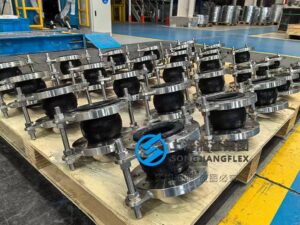
To meet the growing demand for piping systems operating under extreme cold conditions, our factory has carried out systematic research and development on low-temperature rubber compound formulation, structural reinforcement design, and manufacturing processes.
As a result, we have successfully developed a rubber expansion joint capable of stable operation at -60°C, representing a significant technical advancement in low-temperature rubber applications.
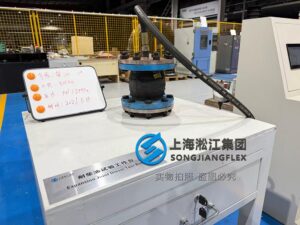
To verify its reliability, comprehensive low-temperature, pressure, and mechanical performance tests were conducted in our factory under controlled conditions.
3. -60°C Low-Temperature Performance Testing
Test Conditions
-
Test temperature: -60°C
-
Test method: Full assembly exposure in a constant ultra-low-temperature environment
-
Test objective: Evaluate material flexibility, structural integrity, and bonding stability under extreme cold
Test Results
During and after the -60°C low-temperature exposure:
-
No cracking, brittleness, or delamination was observed
-
The rubber body maintained essential elastic recovery
-
The bonding between rubber and metal flanges remained stable
These results confirm that the rubber expansion joint retains its fundamental functional properties even under extreme low-temperature conditions.
4. Pressure Testing Under Low-Temperature Conditions
Low temperatures significantly amplify material stress and potential defects. Therefore, pressure testing was carried out while the rubber expansion joint was in a -60°C condition.
Key Evaluation Criteria
-
Internal pressure resistance
-
Sealing performance
-
Structural stability of rubber and reinforcement layers
Test Outcomes
-
No leakage, bulging, or structural instability occurred
-
Sealing surfaces remained intact throughout the test
-
No permanent deformation was observed after pressure release
The results demonstrate that the product is not only low-temperature resistant, but also fully capable of safe pressure operation in extreme cold environments.
5. Comprehensive Mechanical and Material Performance Evaluation
In addition to low-temperature and pressure testing, the rubber expansion joint underwent a series of mechanical and material performance evaluations, including:
-
Tensile strength and elongation at break
-
Compression set
-
Elastic recovery performance
-
Low-temperature aging behavior
The data indicates that mechanical property degradation at -60°C is well controlled, ensuring long-term operational reliability rather than short-term survivability.
6. Engineering Significance of This Technical Breakthrough
The successful validation of a -60°C low-temperature rubber expansion joint significantly expands the application range of rubber expansion joints in extreme environments.
This development provides reliable solutions for:
-
Energy and petrochemical systems in cold regions
-
Marine and offshore installations
-
District heating and industrial piping in northern climates
-
Infrastructure projects exposed to extreme seasonal temperature variations
By reducing the risk of low-temperature failure, this technology helps minimize downtime, maintenance costs, and operational risks.
7. Conclusion: Engineering Reliability Proven by Testing
True reliability in rubber expansion joints is not defined by theoretical parameters alone, but by verified performance under real-world extreme conditions.
The successful completion of -60°C low-temperature, pressure, and mechanical performance testing represents a major milestone in our low-temperature rubber technology development. We will continue to invest in advanced material research and performance validation to deliver safe, durable, and application-specific rubber expansion joint solutions.
For technical inquiries or project-specific requirements regarding low-temperature rubber expansion joints, we welcome professional discussions and engineering collaboration.