Rubber components used in pipeline systems often face severe challenges in extremely cold environments. When temperatures drop far below freezing, ordinary rubber expansion joints may lose flexibility, suffer material embrittlement, and ultimately fail. For projects in cold regions, relying on standard specifications without real low-temperature verification can lead to serious operational risks.
To ensure reliability under such harsh conditions, low temperature rubber expansion joints must be validated through dedicated cryogenic testing. Only by simulating real extreme environments can engineers confirm whether a rubber expansion joint is capable of maintaining sealing performance, pressure resistance, and movement compensation at -60°C.

Why Standard Rubber Expansion Joints Are Not Suitable for Extreme Cold by Default
Most rubber expansion joints are designed for conventional temperature ranges. At extremely low temperatures, rubber materials undergo significant physical changes, including increased hardness and reduced elasticity. These changes directly affect the joint’s ability to absorb vibration, accommodate pipeline displacement, and maintain a tight seal.
In cold-region pipeline systems, failure of a rubber expansion joint can result in leakage, pressure loss, or unplanned shutdowns. This is why rubber expansion joints intended for cold climates must be specifically engineered and tested for cryogenic environments rather than assumed to perform based on room-temperature properties.
How Extreme Low-Temperature Testing Simulates Real Cold-Climate Conditions
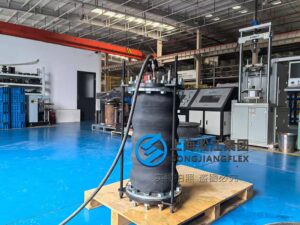
To accurately evaluate performance in cold regions, the rubber expansion joint was placed in a controlled low-temperature chamber set to -60°C for an extended 24-hour period. This ensured that the rubber material, reinforcement layers, and overall structure were fully exposed to extreme cold rather than short-term surface cooling.
Following the low-temperature exposure, the rubber expansion joint underwent immediate functional testing. Pressure resistance, axial movement, and angular deflection were carefully examined to determine whether the product could still perform as required in real pipeline operating conditions.
What Performance Indicators Matter Most at -60°C?
At extreme low temperatures, three performance indicators are especially critical for rubber expansion joints. First, structural integrity must be maintained without visible cracking or material separation. Second, sealing performance must remain stable under pressure to prevent leakage. Third, the joint must retain enough flexibility to accommodate thermal movement and vibration.
The -60°C test confirmed that a properly designed low temperature rubber expansion joint can meet all three requirements. Even after prolonged cryogenic exposure, the joint demonstrated stable pressure performance and reliable movement capability, making it suitable for cold climate pipeline applications.
Applications of -60°C Rubber Expansion Joints in Cold Regions
Proven -60°C performance is particularly important for pipeline systems in regions such as Russia, Northern Europe, Central Asia, and other extremely cold areas. Industries including water supply, energy transmission, chemical processing, and industrial utilities all depend on stable pipeline operation in harsh environments.
For these applications, a cryogenic rubber expansion joint that has passed extreme low-temperature testing offers reduced maintenance risk and improved system reliability. Engineers and procurement teams can select such products with greater confidence, knowing that performance has been verified under real cold-climate conditions.
Why Continuous Cryogenic Testing Improves Long-Term Reliability
Extreme environments demand long-term reliability, not short-term success. Extending low-temperature exposure time and conducting repeated performance tests provide valuable data on material aging and durability. This data-driven approach allows continuous optimization of rubber formulations and structural design.
Ongoing cryogenic testing ensures that rubber expansion joints used in cold regions meet increasingly higher standards. In pipeline engineering, consistent testing and validation are key to achieving dependable performance under extreme operating conditions.
Summary
Extreme cold conditions demand verified solutions. -60°C testing proves that well-designed rubber expansion joints can deliver reliable sealing, flexibility, and durability in cold-region pipeline systems.