What Is an NHF External Threaded Rubber Vibration Isolator?
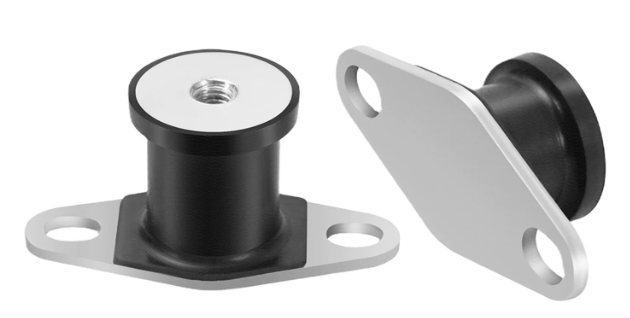
The NHF External Threaded Rubber Vibration Isolator with Mounting Plate is a compact rubber-metal vibration control component designed to reduce mechanical vibration, absorb shock, and minimize structure-borne noise in industrial machinery.
Its structure consists of an elastic rubber body, an external threaded stud, and a metal mounting plate with fixing holes. This configuration provides secure mechanical installation while allowing controlled elastic deformation between the equipment and its supporting structure.
The NHF series includes five models with different material configurations:
| Model | Rubber Material | Metal Material | Hardness |
|---|---|---|---|
| NHF11 | Natural Rubber (NR) | S45C, Zinc Plated | Shore A 60 |
| NHF15 | Natural Rubber (NR) | S45C, Zinc Plated | Shore A 45 |
| NHF31 | Chloroprene Rubber (CR) | S45C, Zinc Plated | Shore A 60 |
| NHF35 | Chloroprene Rubber (CR) | SUS304 Stainless Steel | Shore A 60 |
| NHE43 | Conductive Butyl Rubber | SUS304 Stainless Steel | Shore A 60 |
Natural rubber provides good elasticity and dynamic vibration damping characteristics. Chloroprene rubber offers improved resistance to weathering and ozone, while conductive butyl rubber is available for applications requiring specific electrical properties.
With different rubber hardness levels and metal materials, these industrial rubber vibration mounts can be selected according to equipment loads, operating conditions, and environmental requirements.
Where Are NHF Rubber Vibration Mounts Used?
NHF threaded rubber vibration isolators can be used in a wide range of industrial equipment where compact mounting dimensions and vibration reduction are required.
Electric Motors and Drive Systems: Suitable for evaluating vibration isolation in small three-phase induction motors, brushless DC motors, gear motors, conveyor drive units, motorized roller assemblies, and compact gearbox systems. Rubber mounts help reduce vibration transmitted from rotating components to machine frames.
HVAC and Ventilation Equipment: Common potential applications include small centrifugal fans, axial flow fans, cabinet exhaust fans, ventilation modules, and compact air-handling equipment. Properly selected mounts help reduce fan-induced vibration and mechanical noise.
Pumps and Fluid Handling Systems: NHF rubber mounts may be used for miniature centrifugal pumps, diaphragm dosing pumps, laboratory peristaltic pumps, compact circulation pumps, and small vacuum pump assemblies. They help limit vibration transfer into supporting frames and nearby equipment.
Automated Manufacturing Equipment: Applications include automatic labeling machines, carton sealing machines, bottle filling machines, conveyor drive modules, small sorting machines, and automated screw fastening systems. Rubber vibration isolation can reduce unwanted vibration transmission between machine assemblies.
Laboratory and Electronic Equipment: NHF mounts can also be considered for laboratory mixers, small vacuum pump supports, electronic testing fixtures, benchtop equipment modules, and auxiliary components of precision manufacturing systems.
The final selection should consider equipment weight, operating frequency, mounting orientation, allowable load, and required stiffness. Highly sensitive precision instruments may require specialized low-frequency isolation systems.
Frequently Asked Questions About NHF Rubber Vibration Isolators
1. How do NHF rubber vibration isolators reduce mechanical vibration?
NHF rubber vibration isolators use an elastic rubber element positioned between the threaded mounting stud and the metal fixing plate. When equipment generates vibration, the rubber deforms elastically and helps reduce the transmission of dynamic forces into the supporting structure.
The effectiveness of vibration isolation depends on rubber stiffness, equipment mass, excitation frequency, and installation conditions. Proper selection can reduce structure-borne vibration and mechanical noise. However, an isolator must have a suitable natural frequency relative to the operating vibration frequency to achieve effective isolation.
2. What is the difference between NHF11 and NHF15 rubber mounts?
Both NHF11 and NHF15 use natural rubber with zinc-plated S45C metal components. Their primary material specification difference is rubber hardness.
NHF11 features Shore A 60 rubber, while NHF15 uses softer Shore A 45 rubber. For otherwise comparable geometry, softer rubber generally provides greater elastic deformation under the same load.
NHF15 may be considered for lighter equipment requiring greater flexibility, while NHF11 may be more suitable where higher stiffness is desirable. However, actual load capacity and vibration isolation performance must be confirmed using the relevant model’s technical data.
3. Can NHF rubber vibration mounts be used for electric motors and pumps?
Yes, NHF rubber mounts can be considered for small electric motors, compact centrifugal pumps, diaphragm pumps, laboratory vacuum pumps, and motor-driven mechanical assemblies.
These machines generate vibration through rotor imbalance, motor operation, hydraulic pulsation, or mechanical transmission. Rubber mounts can help reduce vibration transferred to supporting frames.
However, mounting selection must consider equipment weight, rotational speed, center of gravity, and operating forces. Larger reciprocating machines or equipment generating substantial dynamic loads may require spring isolators or specially designed restrained vibration mounts.
4. How do I choose the correct load capacity for an NHF vibration isolator?
First, determine the equipment’s total operating weight and the number of mounting points. For evenly distributed loads, divide the supported weight by the number of isolators to estimate the static load per mount.
For example, a machine weighing 80 kg supported by four equally loaded mounts would impose approximately 20 kg on each isolator.
Actual load distribution may differ due to an offset center of gravity. Engineers should also consider dynamic forces, allowable load in the intended direction, working deflection, and directional stiffness before selecting a model.
5. What is the difference between natural rubber and chloroprene rubber mounts?
Natural rubber is widely used in industrial vibration isolators because of its elasticity, resilience, and fatigue performance under suitable operating conditions.
Chloroprene rubber, also known as neoprene or CR, generally provides better resistance to ozone and weathering, together with moderate resistance to certain oils.
For indoor machinery operating in relatively clean environments, natural rubber may be an economical option. Chloroprene rubber may be preferable where environmental exposure is more demanding.
Material selection should also consider operating temperature, chemical exposure, mechanical load, and the specific rubber compound formulation.
6. How should NHF external threaded rubber vibration isolators be installed?
NHF rubber vibration isolators should be installed on flat, structurally stable mounting surfaces. The integrated mounting plate is secured to the supporting structure, while the external threaded stud connects to the equipment.
Before installation, verify the thread specification, mounting hole dimensions, equipment weight, and available installation height.
Avoid twisting the rubber body or introducing excessive lateral forces during fastening. Mounting points should distribute equipment weight appropriately.
After installation, inspect the assembly during startup and normal operation to confirm mechanical stability, acceptable displacement, and effective vibration reduction.
7. Can NHF rubber vibration isolators be customized for different equipment?
Custom rubber vibration mounts may be developed to accommodate specific equipment designs, installation dimensions, and operating requirements, subject to engineering and manufacturing feasibility.
Potential customization options include external thread size, stud length, mounting plate dimensions, rubber hardness, rubber compound, and metal material.
For example, an automated packaging machine may require a particular stud length to match an existing motor bracket, while laboratory equipment may require different rubber stiffness characteristics.
To evaluate a customized mounting solution, customers should provide equipment weight, operating frequency, mounting dimensions, technical drawings, and environmental conditions.
Find the Right NHF Rubber Vibration Isolator for Your Equipment
Choosing the correct NHF External Threaded Rubber Vibration Isolator can help improve equipment stability, reduce vibration transmission, and minimize mechanical noise.
Whether your application involves electric motors, ventilation fans, industrial pumps, automated production machinery, or laboratory equipment, selecting the appropriate rubber material, hardness, and mounting configuration is essential.
For product selection, technical specifications, or customized rubber vibration mounts, please send us your equipment drawings, operating loads, installation dimensions, and application requirements.
Email: [email protected]
Our company’s new website is now live, featuring the latest product introductions. For more details, please visit https://shsjflex.com/