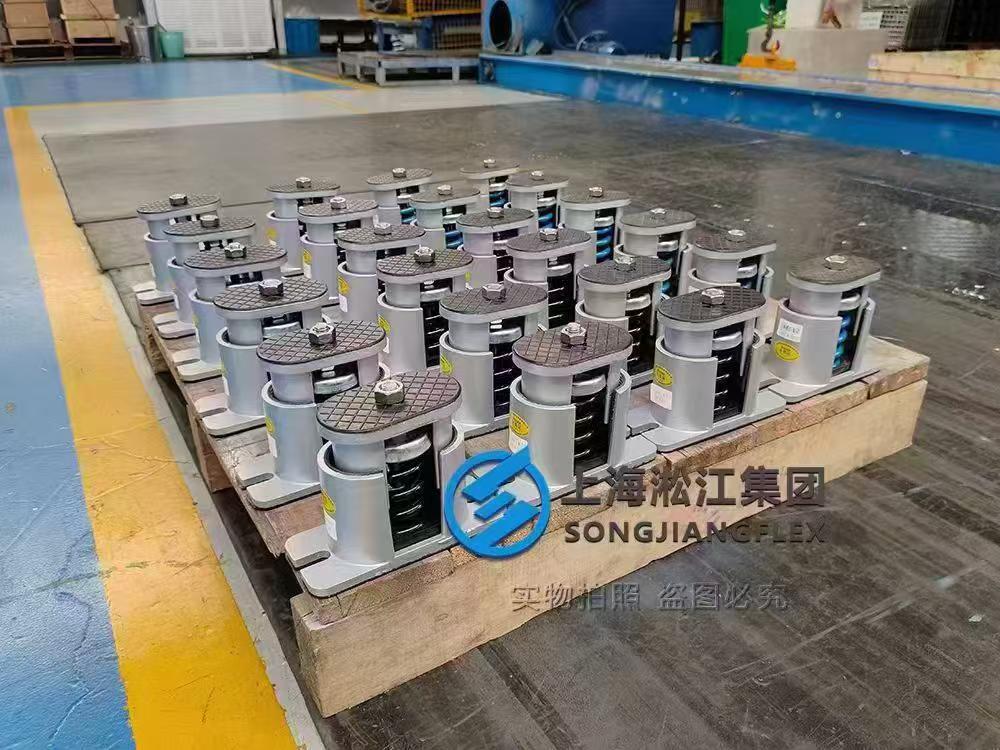
In modern commercial buildings, industrial facilities, and HVAC mechanical rooms, pump vibration can become a serious concern for equipment reliability, pipeline stability, and building acoustic comfort. Selecting a suitable pump inertia base with spring vibration isolators is an important part of controlling mechanical vibration and structure-borne noise.
At Shanghai Songjiang Vibration Absorber Co., Ltd. (SONGJIANG), we provide customized LB-S Type and LB-A Type Pump Inertia Base solutions for water pump installations. Our manufacturing approach focuses on project-specific dimensions, equipment operating loads, installation requirements, and compatible vibration isolation components.
Rather than treating every pump installation as identical, we work with customers to review their equipment drawings, installation conditions, and technical requirements before developing a suitable custom pump inertia base and vibration isolator assembly.
What Are LB-S and LB-A Pump Inertia Bases?
LB-S Type and LB-A Type Pump Inertia Bases are equipment support solutions designed to work with compatible vibration isolators. Depending on the specified construction, the system may use a fabricated steel support frame, a reinforced concrete-filled inertia base, spring vibration isolators, mounting brackets, and equipment anchoring components.
The principal purpose of an inertia base is to provide a rigid, stable mounting platform for rotating machinery while controlling excessive equipment movement. When combined with correctly selected spring isolators, the system helps reduce vibration transmission from the pump assembly into the supporting floor and surrounding building structure.
The functional differences between LB-S and LB-A should be confirmed against the applicable product drawings and project specifications. Both series can be considered within a customized pump support and vibration isolation solution, subject to engineering review.
A complete pump inertia base assembly may include:
-
Custom fabricated structural steel base frames
-
Reinforcement provisions for concrete-filled inertia bases
-
Spring vibration isolators with suitable load ratings
-
Height-adjustable isolation mounting assemblies
-
Pump and electric motor mounting supports
-
Custom bolt holes, anchor plates, and mounting brackets
-
Optional restrained isolators for applications requiring lateral movement control
-
Flexible rubber expansion joints for connected pipework
The inertia base and vibration isolators perform different but complementary functions. The inertia base improves mass distribution and mechanical stability, while the isolators reduce the transmission of dynamic forces to the supporting structure. This distinction is particularly important when designing pump vibration control systems.
Why Do Customers Order Customized Pump Inertia Bases?
Standard pump mounting frames are not always suitable for the dimensions, operating conditions, or vibration control requirements of a particular project.
For example, a customer installing a horizontal centrifugal pump in a commercial building may have limited installation space, a specific pump-to-motor alignment requirement, and restrictions on the overall height of the equipment assembly.
Another customer may require an inertia base for a large industrial circulating water pump, where the operating weight, pipeline connections, and starting torque differ significantly from those of a smaller HVAC pump.
In these situations, customization becomes essential.
SONGJIANG can review customer-supplied technical drawings and manufacturing requirements to develop suitable LB-S or LB-A pump inertia base configurations.
Custom Dimensions and Installation Layouts
Different pump manufacturers use different baseplate dimensions and mounting arrangements. Therefore, an inertia base should be designed around the actual equipment rather than selected solely by pump motor power.
Customers may request customization of the overall base length, width, height, frame construction, equipment mounting holes, motor support positions, spring isolator locations, and installation clearances.
For horizontal split-case centrifugal pumps, the base configuration may also need to accommodate suction elbow supports or other structural components. In some applications, a T-shaped inertia base is preferable to a conventional rectangular frame because it provides appropriate support for the pump and associated piping arrangement.
Customized Spring Vibration Isolator Selection
The spring isolators must be selected according to the actual supported load and the required vibration isolation performance.
SONGJIANG can evaluate compatible spring vibration isolators, including adjustable spring mounts, for use beneath the pump inertia base.
Important selection considerations include the total operating weight, individual mounting-point loads, motor speed, required static deflection, available installation height, and environmental conditions.
For equipment with an uneven center of gravity, different isolator load capacities may be required at different mounting positions.
This approach helps avoid excessive spring compression, uneven equipment support, and undesirable rocking motion during operation.
Which Water Pump Equipment Can Use LB-S and LB-A Inertia Bases?
LB-S and LB-A pump inertia base assemblies can be evaluated for various commercial and industrial pumping applications. The following equipment types are particularly relevant to customized vibration isolation projects.
HVAC Chilled Water and Condenser Water Pumps
In central air conditioning systems, pumps circulate chilled water or condenser water between chillers, cooling towers, air handling units, and heat exchangers.
Typical equipment includes:
-
Horizontal end-suction chilled water centrifugal pumps
-
Double-suction chilled water circulation pumps
-
Horizontal split-case condenser water pumps
-
Primary chilled water pump sets
-
Secondary chilled water distribution pumps
-
Variable-frequency chilled water booster pumps
-
Cooling tower condenser water circulation pumps
-
Plate heat exchanger circulation pumps
These pumps are frequently installed in commercial office buildings, hospitals, hotels, shopping malls, and data centers.
For mechanical rooms located above occupied spaces, a concrete inertia base supported by spring vibration isolators can be particularly valuable because the building structure may transmit pump vibration to adjacent rooms or floors.
Industrial Process Water and Cooling Water Pumps
Industrial plants often operate water pumps continuously, sometimes under variable load conditions.
Potential applications include process cooling water pumps, closed-loop cooling circulation pumps, cooling tower return pumps, industrial water transfer pumps, heat exchanger circulation pumps, and equipment cooling pump skids.
These systems may be installed in chemical processing facilities, pharmaceutical manufacturing plants, semiconductor production facilities, automotive manufacturing plants, and industrial machinery workshops.
Customized pump inertia bases help accommodate equipment dimensions, structural support requirements, and different operating load conditions.
Building Water Supply and Pressure Booster Pumps
Water supply systems can generate mechanical vibration through motor rotation, impeller imbalance, hydraulic pressure fluctuations, and pump startup or shutdown.
Relevant equipment includes variable-frequency water supply booster pump sets, domestic water transfer pumps, high-rise building pressure booster pumps, commercial water distribution pumps, and packaged multistage centrifugal pump systems.
Where appropriate, customized inertia bases and spring isolation assemblies can be incorporated into the pump installation to reduce vibration transmission into the supporting floor.
Fire Protection Pump Systems
Fire pump installations may involve horizontal split-case fire pumps, end-suction fire pumps, diesel-driven fire pump packages, and electric motor-driven fire water pumps.
These applications require particular attention to equipment anchorage, alignment, operating loads, and applicable fire protection requirements.
An inertia base or vibration isolation arrangement should only be adopted where permitted by the relevant fire protection standards, equipment manufacturer, and project authority.
Pharmaceutical and Precision Manufacturing Facilities
Facilities containing vibration-sensitive production equipment may require additional control of vibration generated by nearby mechanical systems.
Examples include pharmaceutical purified water circulation pumps, water-for-injection distribution pumps, cleanroom chilled water circulation pumps, semiconductor process cooling water pumps, and precision temperature-control circulation pumps.
In these environments, the pump isolation system should be considered together with the floor structure, piping supports, and nearby vibration-sensitive equipment.
How Does SONGJIANG Customize a Pump Inertia Base for a Customer Order?
The following example illustrates a typical engineering inquiry and customization workflow. The dimensions and loads are illustrative, not specifications for an actual completed customer order.
A customer plans to install a horizontal centrifugal chilled water pump in a commercial building’s mechanical equipment room. The pump requires a rigid support platform and vibration isolation from the building structure.
Example customer requirements
| Technical parameter | Project requirement |
|---|---|
| Equipment | Horizontal centrifugal chilled water pump |
| Pump and motor weight | 1,200 kg |
| Motor speed | 1,450 RPM |
| Proposed base dimensions | 2,000 × 1,000 mm |
| Proposed inertia base height | 200 mm |
| Isolation supports | 4 points, subject to verification |
| Installation | Indoor concrete floor |
| Main objective | Reduce vibration transmission and improve operating stability |
The customer also requests customized motor mounting holes, compatible spring vibration isolators, and a suitable surface protection treatment for the steel frame.
Step 1: Review Equipment Drawings
Our technical team reviews the pump assembly drawing, motor position, baseplate dimensions, and mounting-hole layout.
The available space for installation and future maintenance is also considered. Sufficient clearance must remain around the pump, motor, coupling guard, and connected piping.
Step 2: Determine Operating Load
The load calculation includes the pump and motor assembly, the inertia base, any concrete filling, and other components supported by the isolators.
For a concrete-filled frame, the weight of the concrete must be included when determining the final operating load.
The total load is then distributed among the selected isolator positions according to the equipment’s actual center of gravity and structural arrangement.
Step 3: Select Spring Vibration Isolators
For a pump operating at 1,450 RPM, the fundamental rotational frequency is approximately:
The selected isolators should provide an appropriate natural frequency below the relevant operating excitation frequencies.
Static deflection, spring stiffness, damping, and mounting-point loads must be considered together.
The final isolator model cannot be determined from motor speed alone. A complete selection also requires the total operating weight, load distribution, and project-specific isolation requirements.
Step 4: Manufacture the Customized Base
Following drawing approval, the inertia base frame can be manufactured according to the agreed structural dimensions, material requirements, mounting positions, and surface treatment specifications.
Where a concrete-filled inertia base is specified, the manufacturing and delivery scope should clearly state whether the steel frame is supplied for site concrete pouring or whether a completed assembly is required.
Step 5: Installation and Final Inspection
During installation, the contractor should verify base level, equipment alignment, isolator compression, anchor positions, and piping flexibility.
The pump should be checked under its normal operating conditions to confirm that the isolation assembly is properly loaded and that no unintended rigid contact bypasses the isolators.
Why Should Pump Inertia Bases Be Combined With Spring Vibration Isolators?
An inertia base alone is not equivalent to a complete vibration isolation system.
Although a heavier base can improve mechanical stability and reduce certain equipment movements, it does not necessarily prevent vibration from reaching the floor.
The spring vibration isolators create a compliant support between the pump assembly and the building structure.
When correctly selected, the combination offers several practical benefits.
Improved equipment stability: The inertia base provides a rigid mounting platform for the pump and motor, helping maintain their relative alignment.
Reduced structure-borne vibration: Properly selected spring isolators reduce dynamic force transmission into the floor and surrounding structure.
Better control of startup and shutdown movement: Additional inertia can help moderate motion associated with transient operating forces.
Flexible installation design: Customized isolator brackets and support positions allow the assembly to accommodate different equipment arrangements.
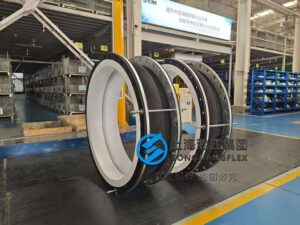
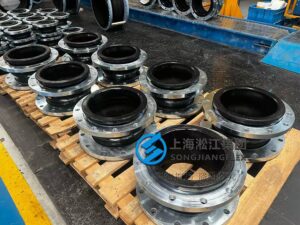
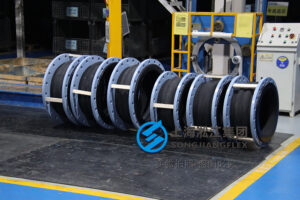
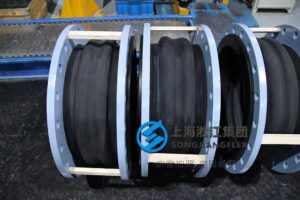
More complete noise and vibration control: When combined with suitable flexible pipe connectors and vibration-isolated pipe supports, the system can address multiple vibration transmission paths.
ASHRAE engineering guidance identifies concrete inertia bases as a preferred solution for flexible-coupled pumps and a desirable option for many close-coupled pump applications.
How Important Are Flexible Rubber Expansion Joints in Pump Isolation?
A properly selected inertia base and spring isolation system can still perform poorly if vibration travels through rigid suction and discharge piping.
For this reason, flexible rubber expansion joints are often considered as part of a complete pump vibration isolation arrangement.
Suitable flexible connectors may help accommodate limited movement between the isolated pump and connected piping while reducing vibration transmission through the pipeline.
Typical applications include chilled water piping, condenser water piping, industrial cooling water lines, and building water supply systems.
The connector material and construction should be selected according to the operating medium, temperature, pressure, movement requirements, and flange standard.
SONGJIANG also manufactures rubber expansion joints and flexible pipe connectors, allowing customers to discuss pump base isolation and piping flexibility within the same technical inquiry.
However, flexible connectors should not be used to compensate for incorrect pipe alignment or unsupported piping loads. Independent pipe supports, appropriate flexible connector movement allowances, and correct pump flange alignment remain essential.
What Technical Information Is Required for a Customized LB-S or LB-A Pump Inertia Base?
For customers requesting a quotation, accurate equipment information helps reduce unnecessary design revisions and manufacturing delays.
The most useful information includes the pump manufacturer and model, pump type, motor power, rated speed, total operating weight, baseplate dimensions, center of gravity, mounting-hole layout, and installation drawings.
We also recommend providing the following project details:
-
Required inertia base dimensions and any height restrictions
-
Concrete-filled or steel-frame construction requirements
-
Number and positions of vibration isolation supports
-
Target static deflection or vibration isolation criteria
-
Equipment installation floor and foundation type
-
Available maintenance and installation clearance
-
Indoor, outdoor, corrosive, or humid operating environment
-
Requirements for lateral restraints, anchoring, or seismic protection
-
Required surface treatment and applicable project standards
-
Order quantity and delivery destination
If the customer does not have a complete inertia base drawing, available pump drawings, equipment photographs, and mounting dimensions can be used for an initial technical review.
The final manufacturing configuration should be confirmed through approved drawings and engineering calculations.
Frequently Asked Questions About LB-S and LB-A Pump Inertia Bases
1. What is the difference between a pump inertia base and an ordinary steel pump base?
An ordinary steel pump base mainly provides structural support and maintains the relative positions of the pump and motor. It may be rigidly fixed to a concrete foundation or installed as part of another mounting system.
A pump inertia base is designed to provide additional mass and rigidity, commonly through a reinforced steel frame filled with concrete. This added mass helps control equipment movement caused by unbalanced forces, starting torque, and other dynamic effects.
When an inertia base is installed on spring vibration isolators, the assembly can provide both equipment stability and vibration isolation.
The correct choice depends on the pump type, equipment weight, operating speed, installation floor, and vibration control objectives. A conventional steel base may be adequate for some installations, while an inertia base is more appropriate where additional stability or isolation performance is required.
2. Can LB-S and LB-A pump inertia bases be manufactured according to customer drawings?
Yes. SONGJIANG supports customized pump inertia base manufacturing based on customer-supplied technical drawings and confirmed project specifications.
Customization may involve overall dimensions, frame geometry, equipment mounting holes, isolator brackets, anchoring positions, reinforcement arrangements, and surface protection requirements.
Customers can provide PDF drawings, CAD files, pump baseplate drawings, or detailed dimensioned sketches for review.
Before manufacturing, our team will check whether the proposed construction is compatible with the equipment weight, mounting arrangement, and intended vibration isolators.
For non-standard designs, technical clarification and drawing approval are important steps before production begins.
3. How many spring vibration isolators are required under a pump inertia base?
The required number of spring isolators depends on the dimensions and total supported weight of the pump assembly, the center of gravity, the base structure, and the load capacity of each isolator.
A relatively compact pump inertia base may use four isolation points, while a larger or heavier assembly may require six, eight, or additional support positions.
However, the total operating weight should not automatically be divided equally among all supports.
For example, a pump motor positioned toward one end of the inertia base may create uneven loading. The isolators closest to the heavier section may require greater load capacity.
Our technical team can review the equipment arrangement and recommend a suitable support configuration based on the actual load distribution.
4. Is a concrete-filled inertia base always better than a steel inertia base?
Not necessarily. Concrete-filled inertia bases offer additional mass, which can help control excessive equipment movement and improve stability in certain pump installations.
However, they also increase the total supported weight and may require additional structural capacity, installation labor, and curing time.
A fabricated steel base may be more suitable where installation weight is restricted, available height is limited, or the equipment does not require additional inertia.
The final decision should be based on engineering considerations rather than assuming that a heavier base always provides better isolation.
Spring isolator selection, pump operating frequency, structural rigidity, and piping connections are equally important to the overall system performance.
5. Can LB-S and LB-A pump inertia bases be used for variable-frequency water pumps?
Yes, subject to technical review. Variable-frequency drive pumps operate over a range of motor speeds, so the vibration excitation frequency changes during operation.
This makes isolator selection more complicated than for a constant-speed pump.
The design should consider the minimum and maximum operating speeds, normal operating range, pump and motor weight, and possible resonance conditions.
At certain speeds, the excitation frequency may approach the natural frequency of the isolated system, resulting in increased vibration.
For this reason, customers should provide the expected speed range and any known vibration problems.
A suitable isolation solution may require adjusted spring stiffness, additional damping, or changes to the operating speed range to avoid problematic resonance conditions.
6. Can an inertia base completely eliminate pump vibration and noise?
No vibration isolation system can guarantee the complete elimination of all vibration and noise.
A properly engineered inertia base and spring isolator assembly can significantly reduce certain vibration transmission paths, but actual performance depends on the equipment condition, excitation frequencies, isolation characteristics, piping arrangement, and supporting structure.
For example, excessive vibration caused by a damaged bearing, impeller imbalance, shaft misalignment, or cavitation should be addressed at the source.
Likewise, rigid piping, incorrectly installed anchors, or unintended contact between the inertia base and surrounding structure can reduce the effectiveness of the isolation system.
For projects with strict acoustic or vibration limits, measurements before and after installation are recommended to verify actual performance.
7. Can SONGJIANG supply the pump inertia base together with vibration isolators and flexible connectors?
SONGJIANG can review requirements for a combined pump vibration control package that includes a customized inertia base, compatible spring vibration isolators, and suitable rubber expansion joints.
This approach helps customers coordinate the dimensions, load requirements, and installation conditions of the different components.
For example, a chilled water pump project may require a fabricated inertia base, adjustable spring mounts, suction and discharge flexible rubber connectors, and specific mounting accessories.
Each component must still be selected according to its own technical requirements.
For flexible connectors, the customer should provide the pipeline diameter, operating pressure, temperature, medium, flange standard, and expected movement.
For the inertia base and isolators, equipment weight, speed, mounting dimensions, and support-point loads are essential.
The final supply scope will be confirmed in the quotation and approved technical documents.
8. What should customers check before placing a bulk order for customized pump inertia bases?
Before confirming a production order, customers should verify that the approved drawings accurately reflect the pump dimensions, mounting-hole positions, equipment weight, and installation conditions.
It is particularly important to confirm whether the quoted inertia base includes concrete filling, spring vibration isolators, mounting bolts, and other accessories.
Customers should also confirm the required material, surface treatment, quantity, delivery schedule, packaging, and inspection documentation.
For projects involving multiple pump models, a separate technical schedule for each pump assembly can help prevent confusion between different base dimensions and isolator load ratings.
For custom-manufactured equipment, early confirmation of these details helps avoid production changes and installation problems.
Why Choose SONGJIANG for Customized Pump Inertia Base Solutions?
SONGJIANG focuses on manufacturing vibration isolation products and providing customized equipment support solutions for industrial and commercial applications.
Our product range includes spring vibration isolators, rubber vibration mounts, flexible rubber expansion joints, and other vibration control components.
For LB-S and LB-A pump inertia base inquiries, we emphasize the importance of understanding each customer’s actual installation requirements before confirming the manufacturing arrangement.
Whether the project involves a chilled water pump in a commercial building, a condenser water pump in a central cooling plant, or an industrial circulation pump in a manufacturing facility, accurate technical information is essential to developing a suitable solution.
Our objective is to help customers obtain compatible, project-specific pump support and vibration isolation components rather than relying on a single standard configuration for every application.
Contact SONGJIANG for Custom LB-S and LB-A Pump Inertia Bases
Are you looking for a manufacturer of customized pump inertia bases, spring vibration isolators, or complete water pump vibration isolation assemblies?
Send us your pump drawings, equipment specifications, operating weight, motor speed, required base dimensions, and order quantity.
Our team can review your requirements and discuss suitable manufacturing options for your project.
Shanghai Songjiang Vibration Absorber Co., Ltd.
Email: [email protected]
Website: https://shsjflex.com/
Our company’s new website is now live, featuring the latest product introductions. For more details, please visit https://shsjflex.com/
We welcome inquiries from HVAC contractors, MEP engineering companies, pump manufacturers, equipment distributors, industrial plant operators, and international project procurement teams.