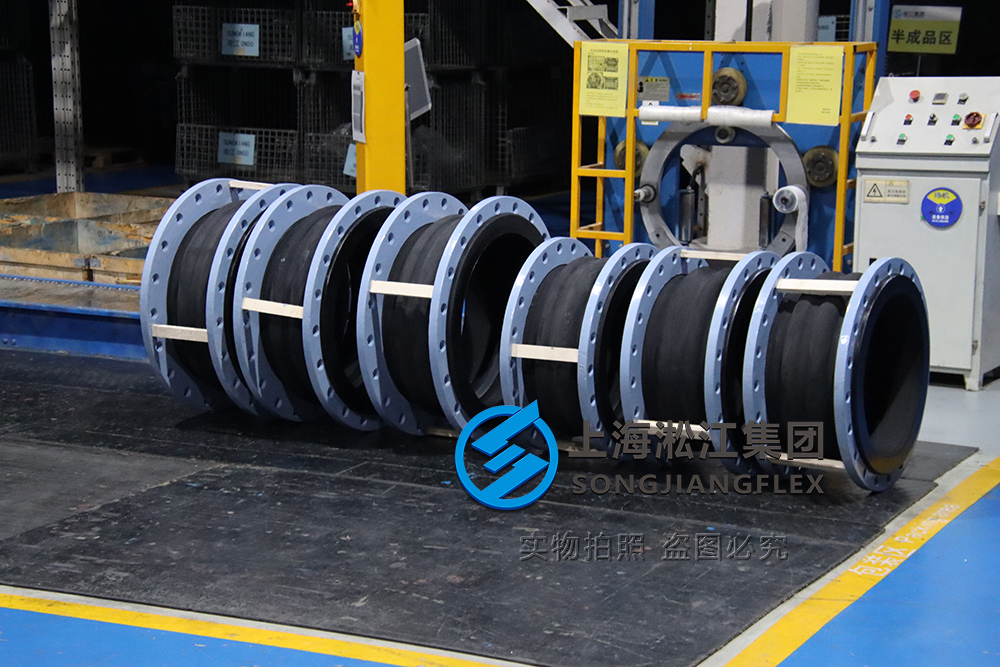
Standard products are not always the right solution for large industrial pipelines.
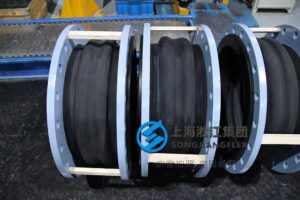
Recently, a Russian customer required a batch of large-diameter hand-wrapped double-sphere rubber expansion joints with control rods. Instead of selecting a standard molded joint from a catalogue, the project required a customized solution based on the customer’s exact pipeline dimensions, operating conditions, movement requirements, and installation environment.
For this type of order, every detail matters—from the rubber material and nominal diameter to face-to-face length, flange drilling, double-sphere geometry, control rod arrangement, pressure, temperature, and required displacement.
This project demonstrates one of the key advantages of hand-wrapped rubber expansion joints: they can be engineered around the pipeline rather than forcing the pipeline to adapt to a standard product.
Why Did the Russian Customer Need a Custom-Made Joint?
Large pipelines are often part of existing industrial systems where dimensions have already been fixed.
The customer may already have:
- an existing pipe outside diameter;
- fixed mating flanges;
- limited installation space;
- a specified face-to-face length;
- defined axial and lateral movement;
- a particular flange standard;
- specific working pressure;
- low ambient temperatures;
- vacuum requirements;
- or special project documentation.
In such situations, simply choosing a “similar” rubber joint is not enough.
For Russian projects in particular, we frequently need to review the customer’s pipeline drawings, flange dimensions, operating temperature, pressure, medium, installation length, and applicable GOST or project-specific requirements before production.
Russian-standard rubber expansion joint connections can also involve GOST flange dimensions and project-specific control-rod configurations, so flange drilling should always be confirmed against the approved drawing before manufacturing.
Why Use Hand-Wrapped Construction?
A conventional molded rubber expansion joint is manufactured with a fixed mold. This works well for standard sizes and mass production, but becomes restrictive when the customer requires an unusual diameter, special length, large movement, or project-specific geometry.
A hand-wrapped rubber expansion joint is built manually, layer by layer.
The construction can include:
inner rubber layer → reinforced rubber layers → high-strength synthetic cord fabric → structural reinforcement → outer rubber cover → integral rubber flange sections → vulcanization and finishing.
Because the process is not restricted by a fixed standard mold, the diameter, face-to-face length, reinforcement arrangement, and arch geometry can be customized.
This is especially useful for large-diameter cooling-water, power-plant, municipal-water, seawater, chemical-process, and industrial circulation pipelines.
Why Did We Use a Double-Sphere Design?
The Russian customer’s order required a double-sphere / double-arch configuration rather than a conventional single-sphere design.
The additional flexible arch can provide greater movement capability and a lower effective spring rate than a comparable single-arch arrangement, depending on the final engineered geometry.
This makes double-sphere hand-wrapped joints particularly useful where the pipeline needs to accommodate significant:
axial compression, axial extension, lateral displacement, angular movement, thermal expansion, equipment movement, or installation deviation.
However, movement values should never simply be copied from another product.
For a custom project, the required axial, lateral, and angular movement must be confirmed before production, because these parameters directly influence the number of arches, overall length, reinforcement design, and control-rod setting.
Why Were Control Rods Added?
The external rods are not decorative accessories.
When internal pressure acts on a large-diameter expansion joint, it creates axial pressure thrust. As the effective diameter increases, this force can become significant.
The control rod system can be designed to limit excessive extension and help keep movement within the engineered range.
For a large-diameter Russian project, the rod arrangement therefore needs to be considered together with:
pipe diameter, internal pressure, allowable movement, number of rods, rod diameter, lug structure, flange strength, anchor arrangement, and connected equipment.
The rod nuts must also be set according to the intended function. If they are tightened incorrectly, they may prevent the expansion joint from providing the movement for which it was designed.
What Equipment Can These Large Rubber Joints Connect To?
Large hand-wrapped rubber expansion joints are commonly associated with heavy industrial piping rather than small building-service pipes.
Typical connected equipment can include:
large horizontal split-case pumps, vertical turbine pumps, circulating-water pumps, cooling-water pumps, condenser water boxes, cooling towers, surface condensers, plate heat exchangers, seawater intake pumps, industrial water pumps, large process tanks, filtration systems, wastewater pumping stations, and heat-exchange systems.
In power and utility projects, they may be installed around:
thermal power plant circulating-water systems, condenser cooling-water lines, boiler auxiliary cooling systems, district heating facilities, industrial cooling-water stations, and large pump discharge headers.
For chemical or mining applications, customized rubber compounds can also be considered for process-water pumps, slurry systems, scrubber circulation lines, chemical tanks, mineral-processing equipment, and wastewater-treatment installations.
The exact rubber material must always be selected according to the actual medium and temperature.
Precise Flange Matching Is Essential
For a custom Russian order, writing only “DN1200” or “DN1600” is not enough.
Before manufacturing, we prefer to confirm the complete flange data, including:
flange outside diameter, flange inside diameter, bolt circle diameter (PCD), number of bolt holes, bolt-hole diameter, flange thickness, sealing-face configuration, and flange material.
This is particularly important when the project uses GOST 33259, GOST 12820, or customer-specific flange dimensions.
The approved drawing becomes the manufacturing reference.
For replacement projects, we also recommend measuring the actual existing mating flanges rather than relying only on the nominal pipe size.
Rubber Material Is Selected by the Actual Medium
Customization is not limited to dimensions.
The rubber compound must match the fluid inside the pipeline.
For example:
EPDM may be considered for many water and cooling-water applications.
NBR is commonly selected for petroleum oils and oil-containing media.
CR / Neoprene can be considered for selected industrial applications requiring weathering and chemical resistance.
FKM may be evaluated for higher-temperature or more chemically demanding service.
For aggressive chemical media, a PTFE-lined rubber expansion joint may also be considered.
For Russian projects operating in very cold climates, low-temperature flexibility and the minimum design temperature should also be confirmed before the rubber compound is finalized.
Customization Continues Through Production
Once the customer approves the technical drawing, production begins according to the confirmed specification.
For a large hand-wrapped double-sphere joint, the process can include:
material preparation → manual rubber layering → reinforcement winding → double-arch forming → flange-area construction → vulcanization → surface finishing → flange installation → control rod assembly → dimensional inspection → final inspection and testing.
The large size makes dimensional control particularly important.
We check key dimensions against the approved drawing rather than treating the product as a generic catalogue item.
FAQ
1. What information should a customer provide for a custom large-diameter rubber expansion joint?
For accurate customization, please provide the actual pipe size or outside diameter, medium, concentration if applicable, operating temperature, minimum ambient temperature, working pressure, design pressure, vacuum requirement, face-to-face length, axial movement, lateral movement, angular movement, flange standard, and quantity.
For Russian projects, please also provide the required GOST standard or complete flange dimensions whenever possible.
A pipeline drawing is extremely useful because it allows us to understand the relationship between the expansion joint, pumps, valves, anchors, guides, supports, and other connected equipment.
2. Why choose a double-sphere joint instead of a single-sphere joint?
A double-sphere or double-arch configuration can provide greater movement capability and lower stiffness compared with a similar single-arch configuration.
It can therefore be useful when the pipeline requires larger axial or lateral displacement.
However, “more movement” does not automatically mean that a double-sphere design is always better. The correct configuration depends on the available installation length, pressure, required movement, pipeline stability, and anchor arrangement.
The number of arches should therefore be selected according to engineering requirements rather than appearance.
3. Can the control rods be customized too?
Yes. The control-rod system is part of the custom design.
The number of rods, rod diameter, material, lug thickness, nut arrangement, surface treatment, and allowable movement clearance can be designed according to the joint size and project requirements.
For large-diameter joints, control rods should be evaluated carefully because internal pressure can generate substantial axial thrust.
Customers should also inform us whether the rods are intended primarily as movement limiters or as part of a continuously restrained piping design.
4. Can you manufacture according to a customer’s existing drawing?
Yes. Hand-wrapped construction is particularly suitable for drawing-based manufacturing.
Customers can provide an existing expansion-joint drawing, pipeline drawing, flange drawing, or dimensional sketch.
Our engineers can review the diameter, F2F length, flange drilling, rubber material, pressure, temperature, movement, vacuum condition, and rod arrangement before production.
If some information on the drawing conflicts with the operating conditions, we will confirm the technical details before manufacturing rather than changing critical dimensions without customer approval.
Custom Means Following the Customer’s Pipeline
For this Russian order, the most important word was not simply “large.”
It was customized.
A large-diameter hand-wrapped double-sphere rubber expansion joint must match the customer’s actual pipeline—from the flange drilling and installation length to the movement, pressure, temperature, rubber material, and control-rod configuration.
That is the value of custom manufacturing: the expansion joint is engineered around the customer’s requirements, not selected only from a standard catalogue.
If you have a large-diameter or non-standard piping project, send us your drawing and operating data for technical evaluation.
Our company’s new website is now live, featuring the latest product introductions. For more details, please visit https://shsjflex.com/
Email: [email protected]