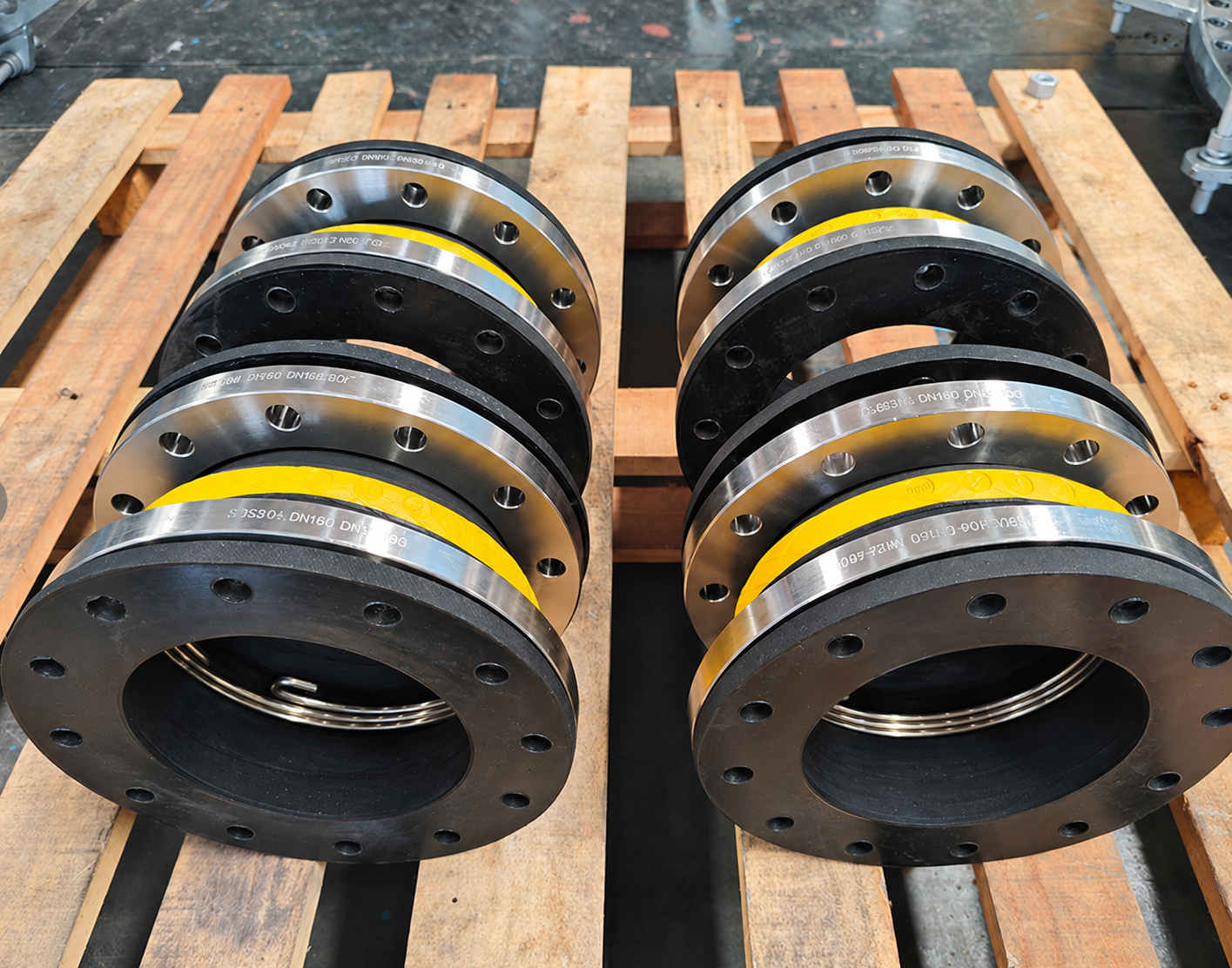
A batch of custom hand-wrapped vacuum rubber expansion joints has been manufactured for a South Korean marine customer, providing a flexible piping solution for demanding shipboard applications.
These marine rubber expansion joints are designed to accommodate pipeline movement, reduce vibration transmission, and maintain reliable sealing under specified vacuum operating conditions. Their customized construction makes them suitable for marine piping systems where standard molded rubber expansion joints cannot meet dimensional or operating requirements.
Unlike conventional molded rubber joints, hand-wrapped rubber expansion joints can be manufactured with customized diameters, face-to-face lengths, flange configurations, rubber compounds, and reinforcement structures.
For this Korean marine project, a distinctive feature is the yellow identification ring, used to distinguish the oil-resistant rubber configuration from standard water-service expansion joints.
What Makes These Marine Vacuum Rubber Expansion Joints Different?
1. Hand-Wrapped Construction for Custom Marine Piping
Hand-wrapped manufacturing provides greater flexibility when producing non-standard rubber expansion joints for shipbuilding, marine equipment installation, and ship maintenance projects.
The construction typically combines multiple rubber layers, reinforcement materials, and metallic connecting flanges to provide flexibility, mechanical strength, and reliable sealing.
Unlike standard molded products, customized hand-wrapped expansion joints can accommodate project-specific installation dimensions and flange arrangements.
Key customization options include:
- Custom Diameters: Suitable for non-standard marine piping dimensions and large-diameter connections.
- Flexible Installation Lengths: Face-to-face dimensions can be adjusted to match existing shipboard piping layouts.
- Customized Flanges: Flange dimensions, drilling patterns, and materials can be selected according to project requirements.
- Rubber Material Selection: NBR, EPDM, and other suitable rubber compounds can be considered according to fluid compatibility.
- Reinforced Construction: Reinforcement arrangements can be engineered for the specified operating pressure, vacuum level, and movement requirements.
This flexibility is particularly valuable when replacing existing marine expansion joints that are no longer available in standard dimensions.
2. Vacuum-Resistant Design for Marine Pumping Systems
Vacuum resistance is an important design consideration for rubber expansion joints installed in marine pump suction lines and other negative-pressure piping systems.
When internal pressure falls below atmospheric pressure, the rubber body experiences external compressive loading. Without sufficient reinforcement, the expansion joint may deform or collapse.
A properly engineered vacuum-resistant rubber expansion joint may incorporate reinforced rubber layers and internal vacuum-support rings, depending on its diameter, installation length, and operating conditions.
Can a rubber expansion joint withstand full vacuum?
Yes. Rubber expansion joints can be specifically designed for full vacuum service, but their suitability must be confirmed for the individual product configuration.
Full vacuum resistance should never be assumed solely because an expansion joint is described as reinforced or suitable for marine applications.
For reliable selection, engineers should verify the minimum operating pressure, rubber body construction, reinforcement arrangement, and allowable movements.
3. Yellow Identification Ring for Oil-Resistant Rubber
One distinctive feature of the customized marine rubber expansion joints supplied for this Korean project is the yellow identification ring.
The yellow ring is used to identify the oil-resistant rubber configuration, helping distinguish these products from standard water-service rubber expansion joints during manufacturing, inspection, and installation.
For marine systems involving compatible petroleum-based oils, NBR (Nitrile Butadiene Rubber) is commonly considered because of its resistance to many mineral oils and certain petroleum products.
However, rubber compatibility depends on the actual fluid composition, temperature, operating pressure, and exposure conditions.
The yellow identification ring provides a convenient visual reference but does not replace material certification or chemical compatibility verification.
4. Vibration Isolation and Pipeline Movement Compensation
Shipboard piping systems are exposed to continuous mechanical vibration from diesel engines, centrifugal pumps, compressors, and auxiliary machinery.
Rigid piping connections can transmit vibration into supporting structures, potentially contributing to noise, mechanical fatigue, and equipment stress.
Marine rubber expansion joints provide flexibility between connected piping components and can help reduce the transmission of vibration and structure-borne noise.
Their elastic rubber construction also accommodates specified axial, lateral, and angular movements.
However, rubber expansion joints must not be used as substitutes for properly designed pipe anchors, guides, or equipment supports.
Korean Marine Customer Project – Custom Manufacturing Details
This project involved the manufacture of hand-wrapped vacuum rubber expansion joints for a South Korean marine customer.
The customized products were intended for shipboard piping applications requiring vacuum-resistant construction, oil-resistant rubber identification, and compatibility with project-specific installation requirements.
Project Overview
| Technical Item | Project Information |
|---|---|
| Product | Hand-Wrapped Vacuum Rubber Expansion Joint |
| Customer Market | South Korea |
| Industry | Marine Engineering |
| Application | Shipboard Piping Systems |
| Manufacturing Method | Custom Hand-Wrapped Construction |
| Rubber Configuration | Oil-Resistant Rubber |
| Identification | Yellow Identification Ring |
| Vacuum Performance | Designed for Specified Vacuum Conditions |
| Flange Configuration | Customized to Project Requirements |
| Service-Life Target | More Than 10 Years Under Suitable Conditions |
Note: Exact dimensions, rubber grade, vacuum rating, and movement capacities must be verified against the approved project drawings and technical specifications.
Why Was Custom Manufacturing Selected?
Marine piping installations frequently require non-standard expansion joints because of restricted installation space, existing flange configurations, and equipment-specific operating conditions.
Standard molded rubber expansion joints are generally manufactured using fixed tooling, which limits the available dimensions and configurations.
Hand-wrapped manufacturing allows engineers to develop expansion joints that better match existing piping layouts without requiring the entire piping system to be redesigned.
For the Korean marine customer, this manufacturing flexibility provided a practical approach to meeting the project’s customized requirements.
Manufacturing and Quality Considerations
For custom marine rubber expansion joints, dimensional accuracy and rubber reinforcement quality are important factors affecting installation compatibility and long-term performance.
Key manufacturing and inspection considerations include:
- Verification of the approved product dimensions and flange drilling patterns.
- Selection of rubber compounds compatible with the specified operating medium.
- Inspection of rubber reinforcement and bonding quality.
- Dimensional inspection after manufacturing.
- Pressure or vacuum testing where specified by the approved inspection and test plan.
- Final visual inspection before packaging and delivery.
These quality-control activities help support consistent manufacturing and reduce installation risks.
Where Are Marine Vacuum Rubber Expansion Joints Used?
Marine rubber expansion joints are widely considered for piping systems that require vibration reduction, movement accommodation, and flexible equipment connections.
The following are typical application areas, subject to confirmation of the specific operating conditions.
Marine Bilge and Ballast Pump Systems
Bilge and ballast pumping systems can experience negative pressure at pump suction connections, particularly during changing flow conditions.
Vacuum-resistant rubber expansion joints can provide flexible connections while helping reduce vibration transmission from pumps to connected piping.
Marine Centrifugal Pump Suction Lines
Centrifugal pumps used for seawater transfer, cooling-water circulation, and auxiliary water systems can generate continuous mechanical vibration.
Properly selected rubber expansion joints help isolate vibration and accommodate limited movement between pumps and connected pipelines.
For suction applications, vacuum resistance must be verified to prevent excessive deformation of the rubber body.
Marine Diesel Engine Auxiliary Piping
Marine diesel engines operate under continuous vibration and dynamic loading.
Rubber expansion joints may be installed in compatible auxiliary piping systems to accommodate movement and reduce vibration transmission.
Oil-resistant rubber configurations can be considered for suitable lubrication-related applications, subject to material compatibility and operating-temperature requirements.
Marine Fuel Oil Transfer Systems
Marine fuel oil transfer systems may require flexible piping connections capable of accommodating vibration and limited displacement.
Oil-resistant rubber compounds such as NBR may be suitable for certain fuel-service applications.
However, the exact fuel composition, operating temperature, pressure, and applicable marine safety requirements must be evaluated before selecting a rubber expansion joint.
Shipboard Cooling and Auxiliary Machinery
Marine cooling-water pumps, heat exchangers, seawater circulation systems, and auxiliary equipment can benefit from flexible rubber connections.
These expansion joints help accommodate installation tolerances and reduce vibration transmission between machinery and piping.
The rubber compound must be selected according to the actual medium, including seawater, freshwater, cooling fluids, or oil-containing liquids.
Frequently Asked Questions About Marine Vacuum Rubber Expansion Joints
1. Can Rubber Expansion Joints Withstand Full Vacuum?
Yes, rubber expansion joints can be engineered for full vacuum conditions when their construction is specifically designed and verified for negative-pressure service.
Depending on the diameter and installation length, additional reinforcement or internal vacuum-support rings may be required.
The maximum allowable vacuum must be confirmed for the exact product configuration.
2. What Rubber Material Is Best for Oil-Resistant Marine Expansion Joints?
NBR is commonly used for applications involving compatible mineral oils and petroleum-based fluids.
EPDM is generally more suitable for many water-based applications but is usually unsuitable for petroleum oil exposure.
Final rubber selection should consider fluid composition, temperature, pressure, and applicable marine requirements.
3. What Is the Difference Between Molded and Hand-Wrapped Rubber Expansion Joints?
Molded rubber expansion joints are produced using dedicated molds and are generally suitable for standardized dimensions and repeat production.
Hand-wrapped rubber expansion joints offer greater flexibility in diameter, installation length, reinforcement design, and flange configuration.
Hand-wrapped construction is particularly useful for non-standard marine piping systems, large-diameter applications, and customized replacement projects.
4. Can Marine Rubber Expansion Joints Last More Than 10 Years?
A service life exceeding 10 years can be established as a design target when materials, operating conditions, and maintenance requirements are properly considered.
Actual service life depends on temperature, pressure, vacuum exposure, fluid compatibility, movement cycles, rubber aging, and installation quality.
Regular inspection and preventive maintenance are essential for long-term reliability.
5. What Information Is Required for a Custom Marine Rubber Expansion Joint Quotation?
For accurate technical selection and quotation, customers should provide:
- Nominal pipe diameter and installation length.
- Flange standard, outside diameter, bolt-circle diameter, and bolt-hole details.
- Operating and design pressure, including maximum vacuum.
- Minimum and maximum operating temperatures.
- Fluid medium and chemical composition.
- Required axial, lateral, and angular movements.
- Quantity, drawings, and applicable marine certification requirements.
Providing complete technical information helps engineers determine suitable materials, reinforcement structures, and manufacturing configurations.
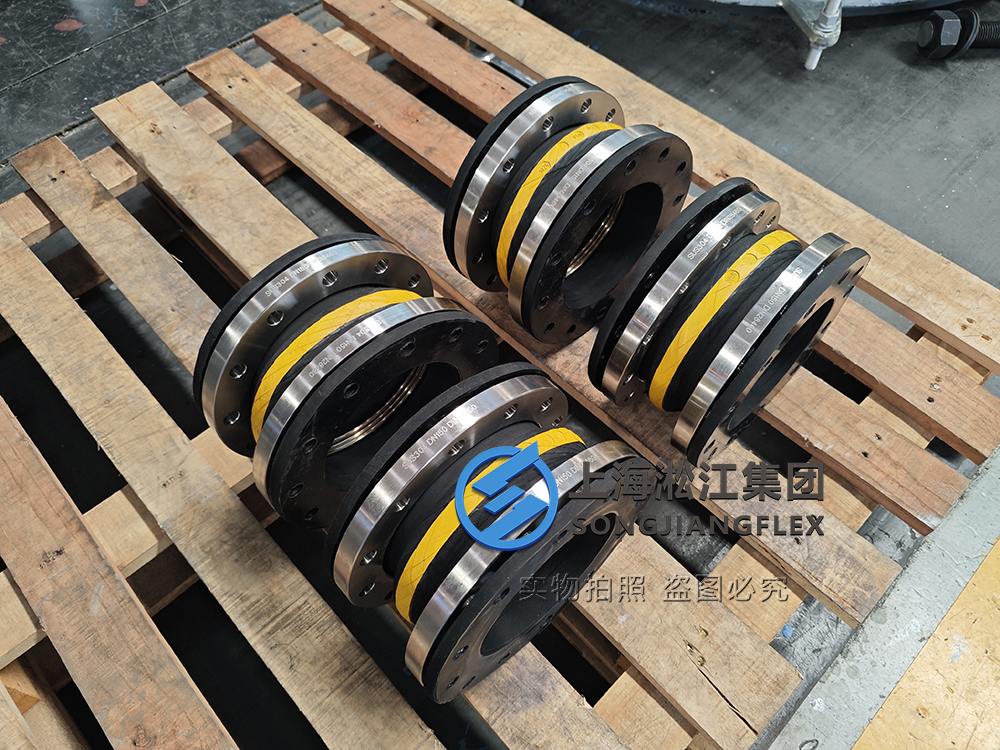
Custom Marine Vacuum Rubber Expansion Joints – Request a Quotation
Shanghai Songjiang Vibration Absorber Co., Ltd. manufactures customized rubber expansion joints for industrial and marine piping applications.
Our hand-wrapped manufacturing capabilities support non-standard diameters, customized flange connections, reinforced rubber construction, and material selection for demanding operating environments.
Whether your project involves marine pump suction lines, shipboard auxiliary piping, oil-resistant flexible connections, or replacement of existing expansion joints, our technical team can review your drawings and operating requirements.
Contact our engineering and sales team for a customized solution.
Email: [email protected]
Website: https://shsjflex.com/
Explore our latest industrial vibration isolation products, rubber expansion joints, and customized engineering solutions on our website.