
WH Type Rubber Vibration Isolator
The WH Type Rubber Vibration Isolator is primarily designed for marine engines, shipboard generators, pumps, and auxiliary machinery. Its durable rubber-metal construction provides effective vibration isolation while supporting vertical compression and resisting lateral shear forces caused by machinery operation and vessel movement. It helps reduce structure-borne noise, improve equipment stability, and minimize vibration transmission to shipboard structures.
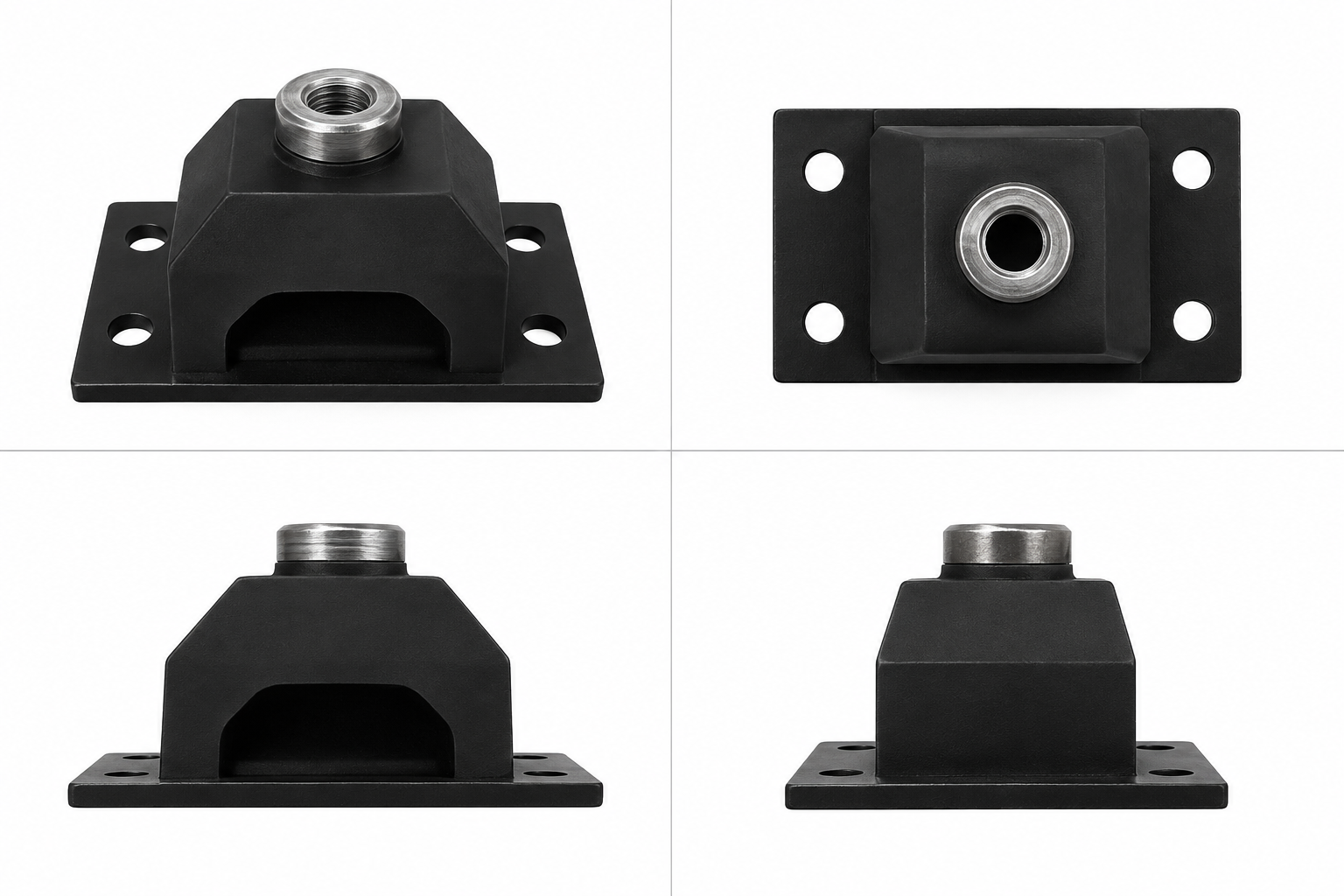
What Makes the WH Type Rubber Vibration Isolator Effective for Marine Equipment?
The WH Type Rubber Vibration Isolator is specifically designed for marine machinery applications where both vertical vibration isolation and lateral shear resistance are essential. Its rubber-metal construction provides elastic support and vibration damping, helping reduce mechanical vibration transmission and structure-borne noise in shipboard installations.
The isolator features a molded rubber body, an integrated metal mounting plate, and a central threaded metal insert. The rectangular baseplate includes four mounting holes for secure attachment to marine equipment foundations. Its hollow rubber structure allows controlled deformation under vertical compression while accommodating lateral shear forces generated by machinery operation and vessel movement.
This combination of vertical load support and lateral shear resistance makes the WH series particularly suitable for marine diesel engines, shipboard generator sets, seawater circulation pumps, marine air compressors, and other auxiliary machinery.
Key Technical Features:
Lateral Shear Resistance: Accommodates horizontal forces caused by vessel movement and machinery operation.
Multi-Directional Isolation: Reduces vertical and horizontal vibration transmission.
Low Natural Frequency: 6 ± 1 Hz under rated load.
Static Deflection: 12 ± 2 mm.
Damping Ratio: Greater than 0.07.
Load Capacity: 100–450 daN.
Marine Applications: Diesel engines, generators, pumps, and auxiliary machinery.
Selection begins by calculating the static load supported by each mounting point. Divide the total equipment weight among the isolators, taking account of the center of gravity and any uneven load distribution.
Next, determine the equipment operating frequency, required isolation efficiency, available installation space, and environmental conditions. The selected isolator should operate within its rated load range and provide sufficient static deflection without exceeding allowable movement limits. For equipment with significant dynamic forces, a more detailed vibration analysis is recommended.
Rubber material selection depends on the operating environment and the mechanical properties required. Natural rubber generally offers good elasticity, resilience, and fatigue resistance, making it suitable for many vibration isolation applications.
Nitrile rubber may be considered when exposure to mineral oils or lubricants is expected. EPDM can be appropriate for applications involving weathering, ozone, or certain outdoor environments.
However, these materials are not automatically interchangeable. Their stiffness, damping characteristics, temperature limits, and chemical compatibility differ. Material availability and final performance must be confirmed before manufacturing.
The supplied WH series specifications cover rated loads from 100 daN to 450 daN, depending on the model. For example, the WH-150 has a rated load of 150 daN, while the WH-400B is rated at 450 daN.
One decanewton equals 10 newtons, so a 450 daN rating corresponds to approximately 4,500 N of force.
These values represent rated working loads, not ultimate failure loads. Engineers should also consider dynamic loading, uneven weight distribution, operating conditions, and any required safety margins.
WH rubber vibration isolators should be installed on stable, level supporting surfaces with mounting hardware compatible with the specified hole dimensions. The WH series uses a rectangular baseplate with four mounting holes and a central threaded connection.
Before installation, verify the mounting positions, equipment weight distribution, and available clearance for rubber deformation.
Avoid forcing the isolators into alignment or introducing unintended preload. Mounting bolts should be tightened according to the approved installation requirements. After installation, inspect the equipment level, static deflection, and operating vibration response.
WH rubber vibration isolators may be considered for stationary diesel generators, auxiliary engines, and selected marine machinery when their load capacity, natural frequency, and displacement characteristics match the application.
Marine installations require additional evaluation of vessel motion, equipment acceleration, corrosion exposure, and possible shock loads. Certain installations may also require mechanical restraints or application-specific approvals.
For diesel generator sets, engineers should evaluate engine excitation frequencies, startup and shutdown behavior, and the mounting system’s response to torque. Product suitability should be confirmed through application-specific calculations rather than equipment type alone.
Natural frequency is a critical parameter in determining the effectiveness of a vibration isolator. The WH series has a specified natural frequency of 6 ± 1 Hz under rated loading.
For a simplified single-degree-of-freedom system, vibration isolation begins when the excitation frequency exceeds approximately 1.414 times the natural frequency. Greater frequency separation generally improves isolation, although damping and installation conditions also influence the result.
If equipment operates near the isolator’s natural frequency, resonance may increase vibration amplitude. Therefore, engineers should evaluate the operating speed range, startup conditions, and expected excitation frequencies.
Customization may be considered when standard WH models do not meet the equipment’s installation or operating requirements. Potential modifications include rubber compound selection, mounting dimensions, threaded connections, metal surface treatments, and load characteristics.
However, changing the rubber geometry, hardness, or material formulation can significantly affect stiffness, natural frequency, damping, and service life.
For technical evaluation, customers should provide equipment weight, mounting-point arrangement, installation drawings, operating speed, environmental conditions, and required vibration isolation performance. Custom designs should be verified through appropriate engineering calculations and testing before production.
WH Type Rubber Vibration Isolator – Technical Specifications
WH Type Rubber Vibration Isolator – Performance Parameters
Model | Rated Load (daN) | Rated Static Deflection (mm) | Natural Frequency (Hz) | Damping Ratio (C/Cc) | Product Weight (kg) |
|---|---|---|---|---|---|
WH-150 | 150 | 12 ± 2 | 6 ± 1 | > 0.07 | 2.5 |
WH-150A | 100 | 12 ± 2 | 6 ± 1 | > 0.07 | 2.5 |
WH-150B | 120 | 12 ± 2 | 6 ± 1 | > 0.07 | 2.5 |
WH-250 | 250 | 12 ± 2 | 6 ± 1 | > 0.07 | 2.45 |
WH-250A | 135 | 12 ± 2 | 6 ± 1 | > 0.07 | 2.45 |
WH-250B | 200 | 12 ± 2 | 6 ± 1 | > 0.07 | 2.45 |
WH-400 | 400 | 12 ± 2 | 6 ± 1 | > 0.07 | 2.4 |
WH-400A | 340 | 12 ± 2 | 6 ± 1 | > 0.07 | 2.4 |
WH-400B | 450 | 12 ± 2 | 6 ± 1 | > 0.07 | 2.4 |
Technical Notes:
Rated Load: 1 daN = 10 N.
Rated Static Deflection: 12 ± 2 mm under rated load.
Natural Frequency: 6 ± 1 Hz.
Damping Ratio: Greater than 0.07.
Product Weight: 2.4–2.5 kg, depending on the model.
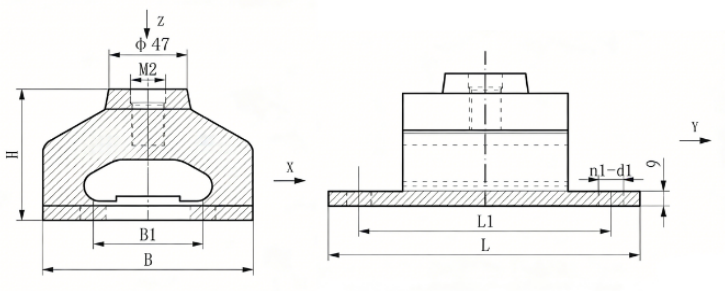
WH Type Rubber Vibration Isolator – Structural Dimensions
Unit: mm
Model | L | A | B | B1 | H | M | n-d |
|---|---|---|---|---|---|---|---|
WH-150 | 185 | 150 | 127 | 65 | 80 | 18 | 4-15 |
WH-150A | 185 | 150 | 127 | 65 | 80 | 18 | 4-15 |
WH-150B | 185 | 150 | 127 | 65 | 80 | 18 | 4-15 |
WH-250 | 185 | 150 | 127 | 65 | 80 | 22 | 4-17 |
WH-250A | 185 | 150 | 127 | 65 | 80 | 22 | 4-17 |
WH-250B | 185 | 150 | 127 | 65 | 80 | 22 | 4-17 |
WH-400 | 185 | 150 | 127 | 65 | 80 | 24 | 4-19 |
WH-400A | 185 | 150 | 127 | 65 | 80 | 24 | 4-19 |
WH-400B | 185 | 150 | 127 | 65 | 80 | 24 | 4-19 |
Note: All dimensions are in millimeters (mm). The n-d designation indicates the number and diameter of mounting holes.
If you are looking for an AMVB All-Metal Vibration Isolator, stainless steel shock mount, precision instrument vibration isolator, or multi-directional vibration isolation solution, please send us your equipment specifications and installation requirements.
Our company’s new website is now live, featuring the latest product introductions. For more details, please visit more products.
Or you can send your inquiry directly to [email protected].