
ME Series Metal Elastic Support Vibration Isolator
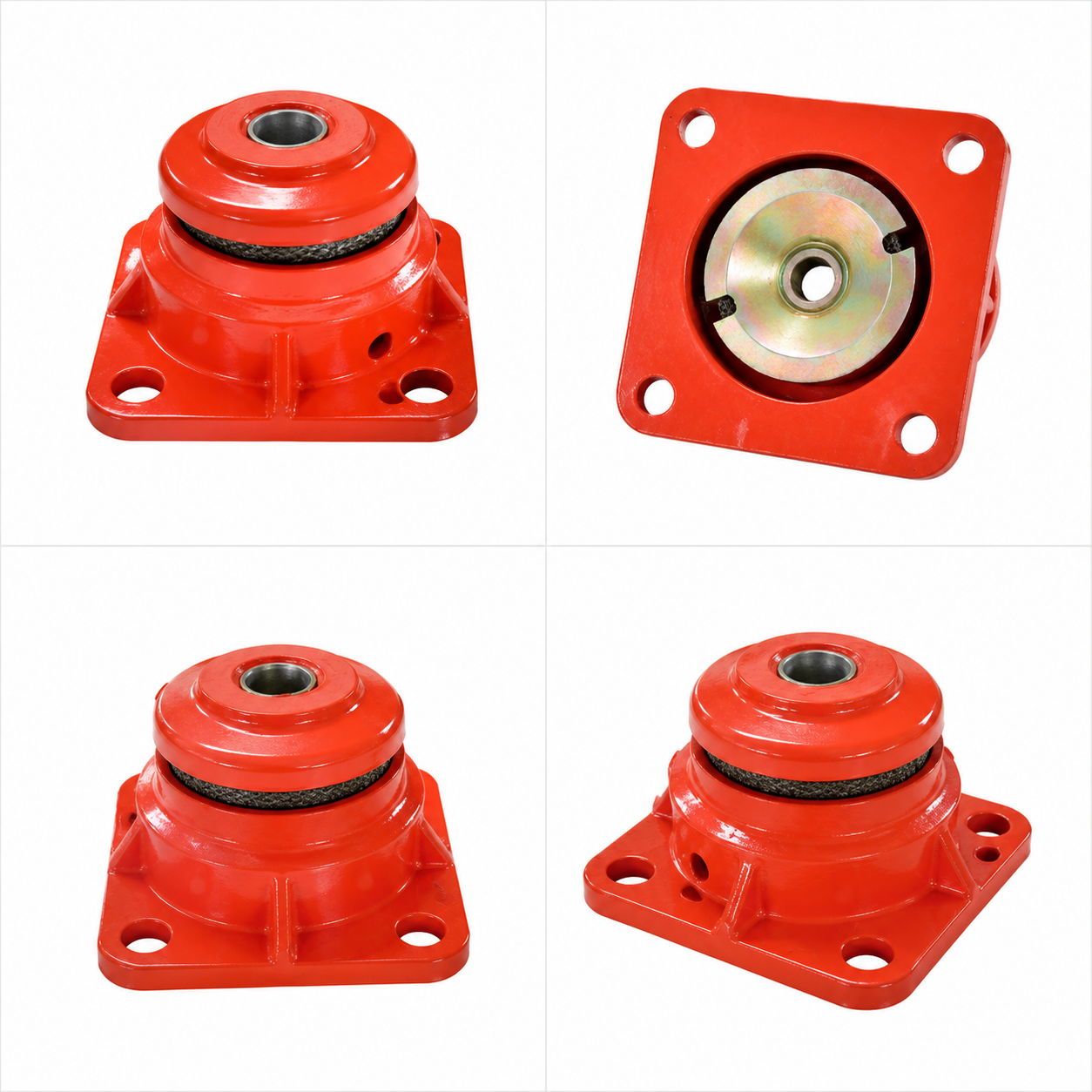
The ME Series Metal Elastic Support Vibration Isolator is designed for pipeline systems requiring both structural load support and vibration control.
It uses engineered metal elastic elements to absorb vibration energy while maintaining stable mechanical support under continuous load conditions.
Unlike rigid pipe supports, the ME Series reduces vibration transmission from engines, generators, and exhaust systems, helping to prevent fatigue damage and structural stress.
This product is suitable for marine exhaust systems, diesel generator sets, power plants, and industrial piping systems where medium to high vibration levels are present.
It is available in multiple structural configurations to match different installation and load requirements.
KEY FEATURES
Structural Advantages
- Integrated load-bearing and vibration isolation design
- High mechanical strength metal elastic structure
- Stable performance under continuous dynamic load
Functional Performance
- Reduces vibration transmission in pipeline systems
- Controls shock from engine and exhaust systems
- Improves structural fatigue resistance
Application Flexibility
- Suitable for marine and industrial environments
- Compatible with different pipeline layouts
- Multiple load capacity options available
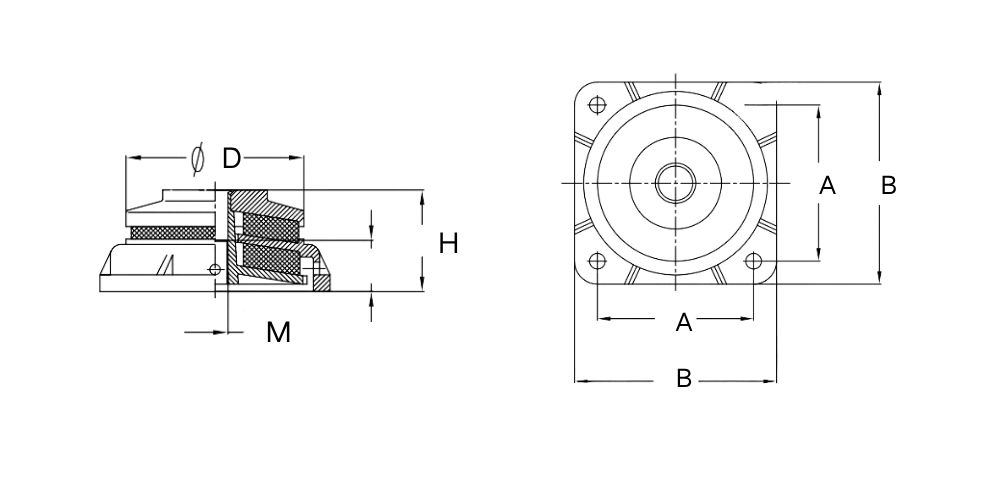
TECHNICAL DATA
Technical specifications are available in the following data table.
Please refer to load capacity, dimensions, and installation parameters for selection.
| Model | M | A | B | H | D | d1 | d2 |
|---|---|---|---|---|---|---|---|
| MEA10 | M16 | 70 | 98 | 53 | 58 | 12.5 | 8 |
| MEB12 | M16 | 100 | 130 | 71 | 90 | 12.5 | 10 |
| MEB14 | M27 | 170 | 220 | 97 | 188 | 17 | 12 |
| Model | Rated Vertical Load (N) | Vertical Deflection (mm) | Natural Frequency (Hz) | Damping Ratio | Vibration Test Standard | Weight |
|---|---|---|---|---|---|---|
| MEA10 | 300–7000 | 1.0–5.0 | 15–20 Hz (±0.3 mm) | 0.15–0.2 | MIL-STD-167-1 | 0.9 |
| MEB12 | 500–9000 | 0.8–4.0 | 18–25 Hz (±0.3 mm) | 0.15–0.2 | MIL-STD-167-1 | 2.1 |
| MEB14 | 2500–70000 | 2.5–5.8 | 18–25 Hz (±0.3 mm) | 0.15–0.2 | MIL-STD-167-1 | 13 |
APPLICATIONS
- Marine exhaust systems
- Diesel generator sets
- Power plant piping systems
- Industrial exhaust pipelines
- Engine vibration control systems
INSTALLATION PRINCIPLE
Proper installation is essential for optimal performance.
- Supports must be installed under correct tensile or compression conditions
- Load direction must follow design specifications
- Reinforcement plates should be used at mounting points
- Foundation stiffness must be sufficient to avoid deformation
Incorrect installation may reduce vibration isolation efficiency and shorten service life.
MATERIALS
The ME Series is manufactured using high-strength metal elastic components designed for durability, fatigue resistance, and long-term stability.
Materials are selected to ensure:
- High load resistance
- Vibration fatigue resistance
- Stable long-term performance
Frequently Asked Questions
1. What is the main function of the ME Series?
The ME Series Metal Elastic Vibration Isolator is designed to provide both reliable load support and effective vibration isolation for pipeline systems and mechanical equipment.
It supports the static weight of pipelines, engines, or auxiliary equipment while simultaneously reducing the transmission of vibration and noise to the surrounding structure. By utilizing the elastic deformation characteristics of metal elements, it can absorb dynamic forces generated during operation.
This dual function makes it especially suitable for systems where structural integrity and vibration control are equally critical, such as marine engines, generator sets, and exhaust piping systems.
2. Can it replace rigid pipe supports?
In many vibration-sensitive applications, the ME Series can serve as an effective alternative to traditional rigid pipe supports.
Rigid supports are designed to firmly hold pipelines in place, but they also transmit vibration and shock directly to the supporting structure. This can lead to increased noise levels, structural fatigue, and even damage over time.
The ME Series isolator, on the other hand, introduces controlled flexibility into the system. It reduces vibration transmission while still maintaining sufficient load-bearing capacity, making it a preferred solution in systems where vibration control and equipment protection are important.
3. What type of vibration can it handle?
The ME Series is engineered to handle medium to high levels of vibration typically generated by mechanical equipment such as diesel engines, generators, compressors, and exhaust systems.
These vibrations may include continuous operational vibration, low-frequency structural vibration, and transient shock loads during start-up or shutdown. The metal elastic structure is particularly effective in environments where rubber components may degrade due to high temperature or oil exposure.
Its performance makes it suitable for demanding industrial and marine environments where vibration levels are relatively high and consistent.
4. Is it suitable for continuous operation systems?
Yes, the ME Series is specifically designed for long-term operation under dynamic load conditions.
The use of metal elastic components ensures excellent durability, fatigue resistance, and stability over extended service periods. Unlike some traditional materials, metal elements can maintain their mechanical properties under repeated loading cycles without significant degradation.
This makes the ME Series ideal for continuous-duty systems such as marine propulsion systems, power generation units, and industrial processing lines where equipment operates for long hours without interruption.
5. How does it reduce vibration?
The ME Series reduces vibration through the controlled elastic deformation of its metal components.
When vibration occurs, the metal structure flexes slightly, absorbing and dissipating vibration energy instead of transmitting it directly to the supporting structure. This process effectively reduces vibration amplitude and minimizes resonance effects within the system.
In addition, the isolator helps to decouple the vibration source from the surrounding structure, which significantly reduces noise transmission and protects nearby equipment from vibration-induced damage.
6. Can it be used in marine environments?
Yes, the ME Series is widely used in marine environments and is well-suited for shipboard applications.
Marine systems present challenging conditions, including continuous vibration, high humidity, temperature variations, and exposure to corrosive elements such as salt air. The metal construction of the ME Series provides excellent resistance to these conditions when properly treated or coated.
It is commonly applied in marine diesel engine exhaust systems, onboard piping systems, and auxiliary machinery, where reliable vibration isolation and structural support are essential.
7. What happens if wrong load selection is used?
Selecting an incorrect load capacity can significantly affect the performance and lifespan of the vibration isolator.
If the load is too low relative to the isolator’s rated capacity, the system may not achieve sufficient deformation, resulting in poor vibration isolation efficiency. Conversely, if the load exceeds the design capacity, the isolator may experience excessive deformation, leading to structural damage, reduced service life, or even failure.
Proper load calculation, including static load and dynamic factors, is essential to ensure optimal performance and long-term reliability.
8. Does installation affect performance?
Yes, proper installation is critical to achieving the designed performance of the ME Series isolator.
Incorrect installation—such as misalignment, uneven load distribution, or improper fastening—can reduce vibration isolation efficiency and may introduce additional stress into the system. It can also lead to premature wear or failure of the isolator.
To ensure optimal results, installation should follow technical guidelines, including correct positioning, load alignment, and secure but not overly rigid connections.
9. Can it handle thermal expansion?
The ME Series provides a certain degree of structural flexibility, which helps accommodate limited thermal expansion and contraction in pipeline systems.
While it is not primarily designed as a dedicated expansion compensator, its elastic properties allow it to absorb minor movements caused by temperature changes. This helps reduce stress concentration at connection points and improves overall system stability.
For systems with significant thermal displacement, it is typically recommended to use the isolator in combination with expansion joints or other dedicated compensation devices.
10. Is customization available?
Yes, the ME Series can be customized to meet specific project requirements.
Customization options typically include load capacity, dimensions, connection types, and structural design. This flexibility allows the isolator to be adapted for different equipment types, installation conditions, and performance requirements.
Custom solutions are particularly valuable in complex systems such as marine engineering or industrial plants, where standard products may not fully meet the operational or spatial constraints.
We are a professional manufacturer specializing in rubber vibration isolators and rubber products, with over 30 years of experience. Our products feature a wide range of rubber materials and diverse designs, and we offer OEM, ODM, and custom-made solutions based on samples to meet customer requirements.
Due to limited information on our website, please contact us at [email protected] for more detailed drawings and technical specifications.