
VP Rubber Elastic Support
The VP Rubber Elastic Support is a specially designed vibration isolation component for the stable support and positioning of vertical exhaust piping systems. Engineered with a durable rubber-metal composite structure, it combines reliable load-bearing performance with effective vibration isolation to help reduce structure-borne noise and mechanical vibration transmission.
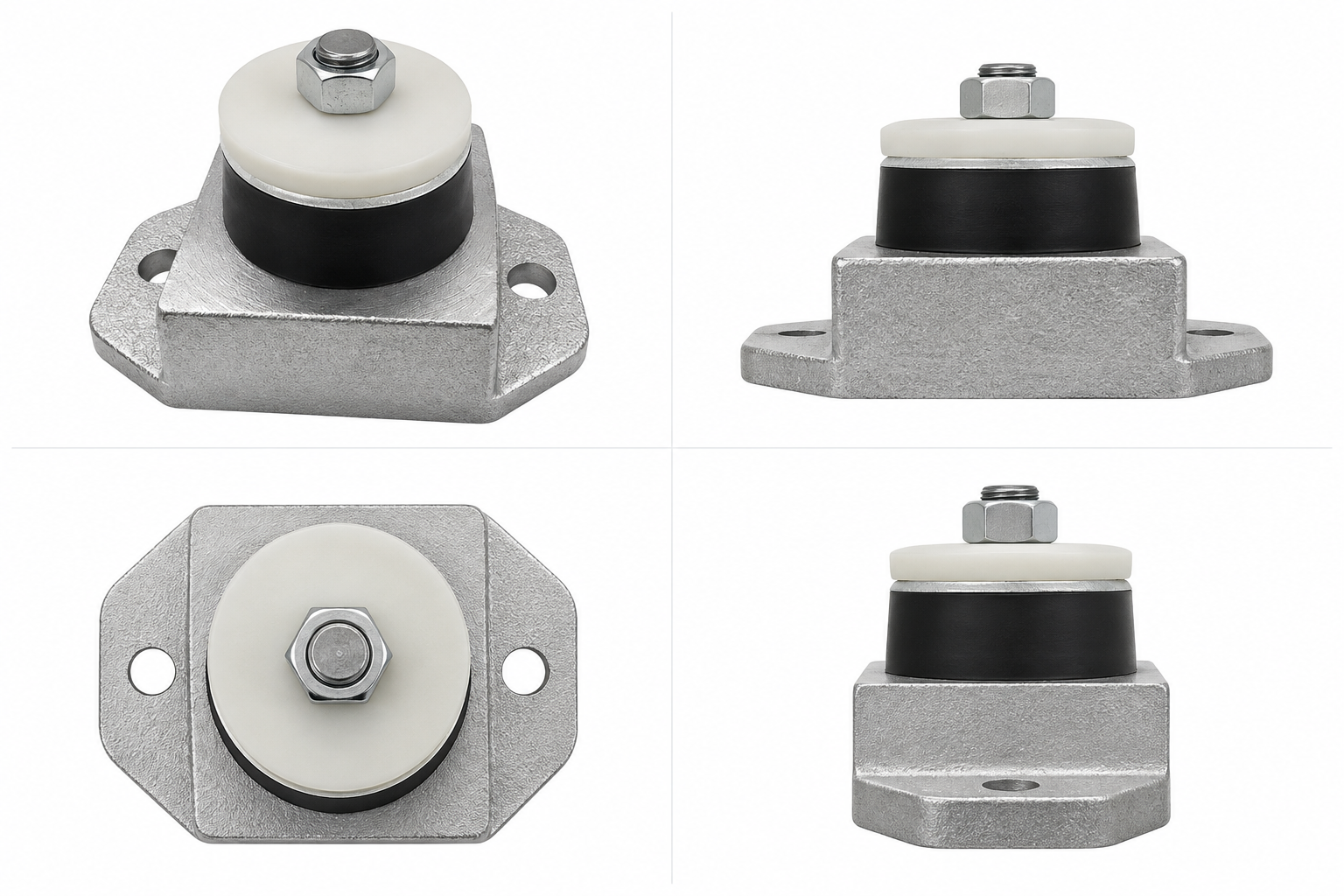
VP Rubber Elastic Support for Vertical Exhaust Piping
The VP Rubber Elastic Support is particularly suitable for vertical exhaust pipes connected to diesel engines, generator sets, marine propulsion systems, and industrial exhaust equipment. By reducing vibration transmission between the piping and supporting structures, it helps protect connected equipment, minimize mechanical stress, and improve the overall reliability and durability of the exhaust system.
Key Features and Benefits
Effective Vibration Isolation: Reduces vibration transmission from exhaust piping to supporting structures.
Reliable Load-Bearing Capacity: Provides stable support for vertically installed exhaust pipes.
Temperature and Aging Resistance: Rubber materials can be selected according to operating temperature and environmental requirements.
Oil Resistance: Optional oil-resistant rubber compounds are available for applications involving oil exposure.
Optional Thermal Insulation: Insulating pads help reduce heat transfer and protect rubber components in high-temperature environments.
Durable Construction: Rubber-metal composite design provides structural stability and long-term resilience under suitable operating conditions.
Industrial Applications: Suitable for diesel generator exhaust systems, marine exhaust piping, power generation equipment, and industrial ventilation installations.
Selection begins with determining the total supported load, including pipe weight, insulation, attachments, and any additional forces transmitted to the mounting points. Divide the load among the supports according to the actual structural arrangement rather than assuming equal distribution.
Next, verify the maximum rated load, available installation space, mounting dimensions, and threaded connection. For vibration-sensitive applications, the support’s dynamic stiffness and the excitation frequencies should also be evaluated to determine whether effective isolation can be achieved.
Rubber selection depends on temperature, oil exposure, environmental conditions, and mechanical loading. Natural rubber may provide useful elasticity, while nitrile rubber is commonly considered where oil resistance is important. EPDM offers good resistance to weathering and certain elevated-temperature environments, although it is generally unsuitable for petroleum oil exposure.
No rubber compound should be selected solely from its generic material name. The actual compound formulation, continuous operating temperature, compression characteristics, and compatibility with the installation environment must be confirmed before production.
The listed VP series includes models with maximum load capacities ranging from 500 kg to 2,450 kg. VP-025 is rated up to 500 kg, VP-026 up to 1,000 kg, VP-027 up to 1,500 kg, VP-030 up to 2,000 kg, and VP-210 up to 2,450 kg.
These figures should not automatically be treated as recommended continuous working loads. Engineers must evaluate load distribution, safety factors, dynamic forces, operating temperature, and potential lateral or tensile loads before confirming a suitable model.
Installation should begin with a structural assessment of the pipe support locations and the forces transmitted through the exhaust system. The metal base should be secured to a suitable supporting structure using correctly sized fasteners.
The support should be aligned with the intended loading direction, avoiding unintended bending or eccentric loading. Pipe thermal expansion must also be accommodated through the overall support design.
After installation, engineers should verify load distribution, fastener security, clearance, and the condition of the rubber element.
They may reduce vibration transmission when their stiffness and loading characteristics are appropriate for the excitation frequencies. However, rubber supports do not automatically provide effective isolation across all frequencies.
The isolation performance depends primarily on the relationship between the excitation frequency and the supported system’s natural frequency. Near resonance, vibration can be amplified rather than reduced.
For diesel generator applications, engineers should consider engine operating speed, firing-related excitation, piping resonance, support stiffness, and structural transmission paths before selecting the isolation arrangement.
Yes, they can be considered for exhaust applications when the support arrangement provides adequate thermal protection and the rubber element remains within its specified operating temperature.
Exhaust gas temperature is not the same as the temperature experienced by the rubber support. Heat transfer through metal connections, radiation, and ambient engine room conditions must all be considered.
Thermal insulating pads can help reduce heat transfer, but their effectiveness depends on material properties, thickness, contact geometry, and operating conditions. Temperature verification is recommended for demanding installations.
Customization may be evaluated when standard mounting dimensions, load capacities, or connection arrangements do not meet project requirements.
Potential modifications include mounting plate dimensions, bolt-hole patterns, threaded connections, rubber compound selection, and thermal insulation arrangements, subject to engineering and manufacturing feasibility.
For technical evaluation, customers should provide equipment or pipe weight, support quantity, dimensional drawings, operating temperature, installation orientation, and vibration requirements.
Where available, vibration frequency data, acceleration measurements, and environmental exposure information can help determine whether a standard or customized solution is appropriate.
VP Rubber Elastic Support – Technical Specifications
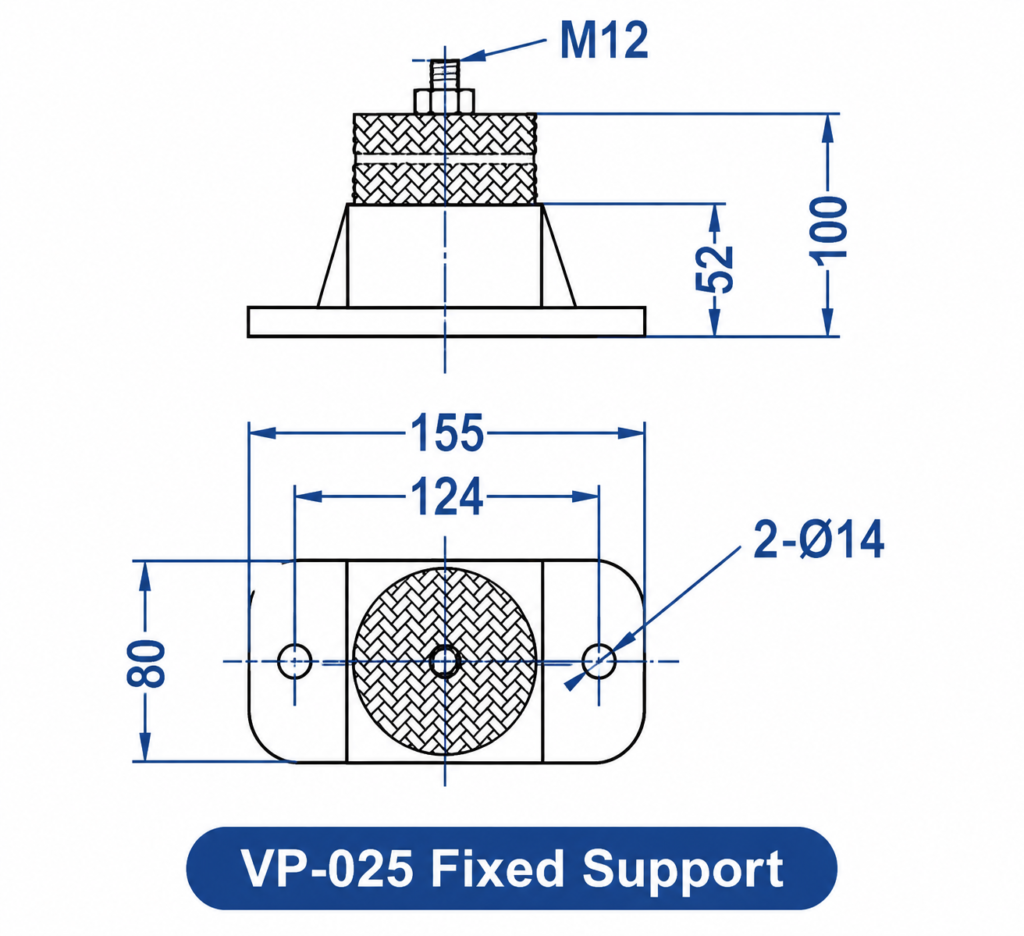
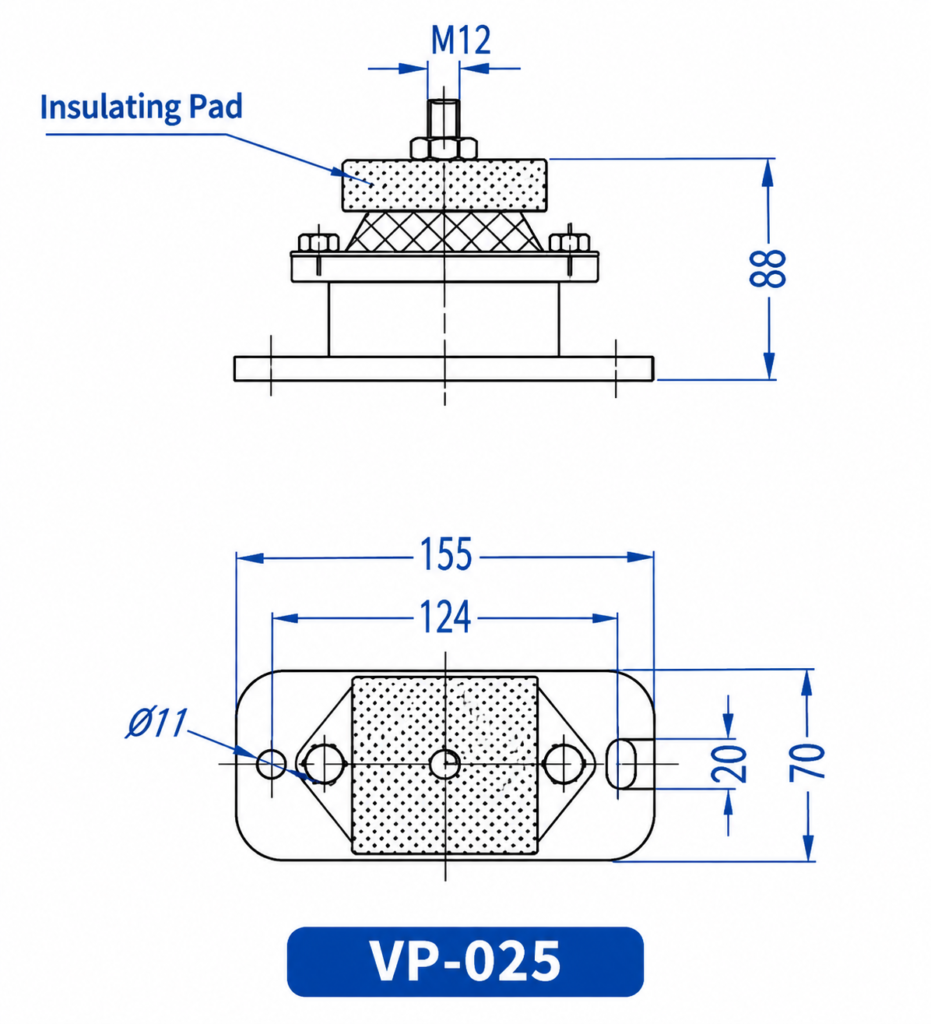
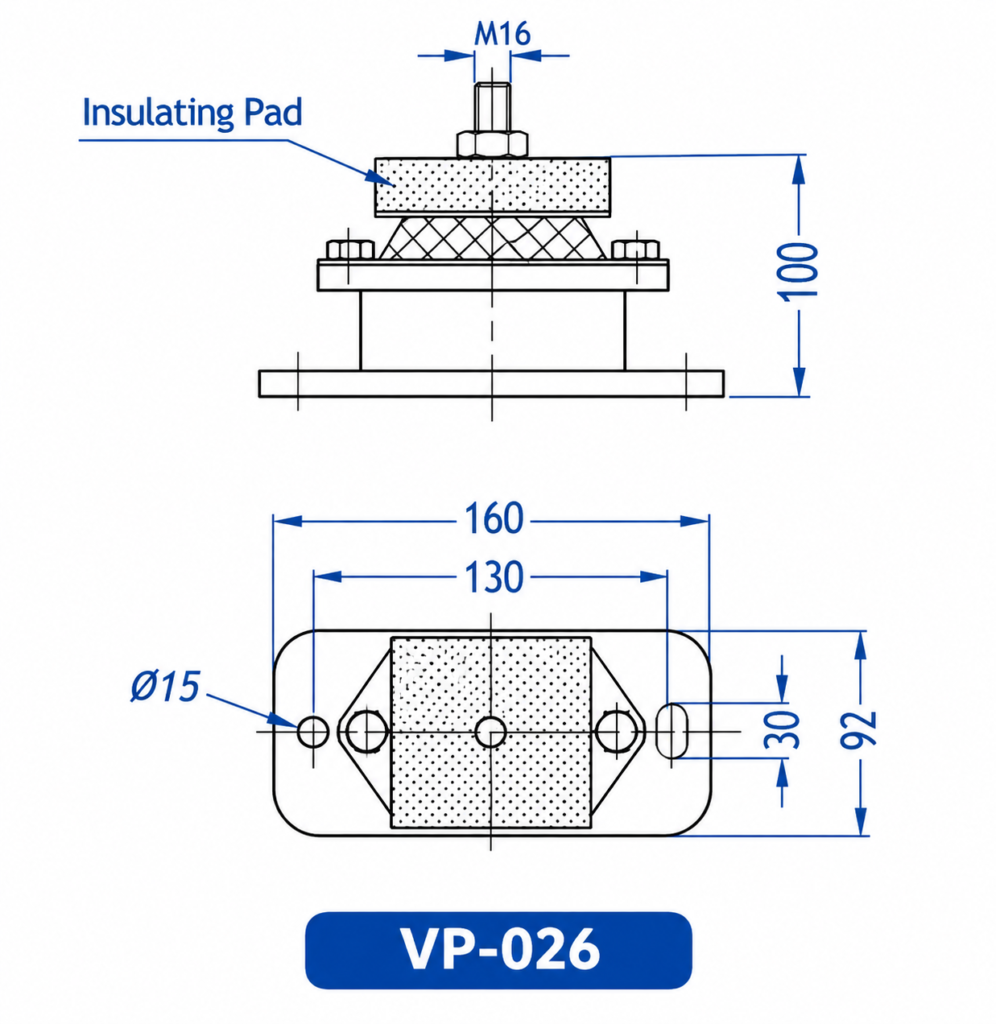
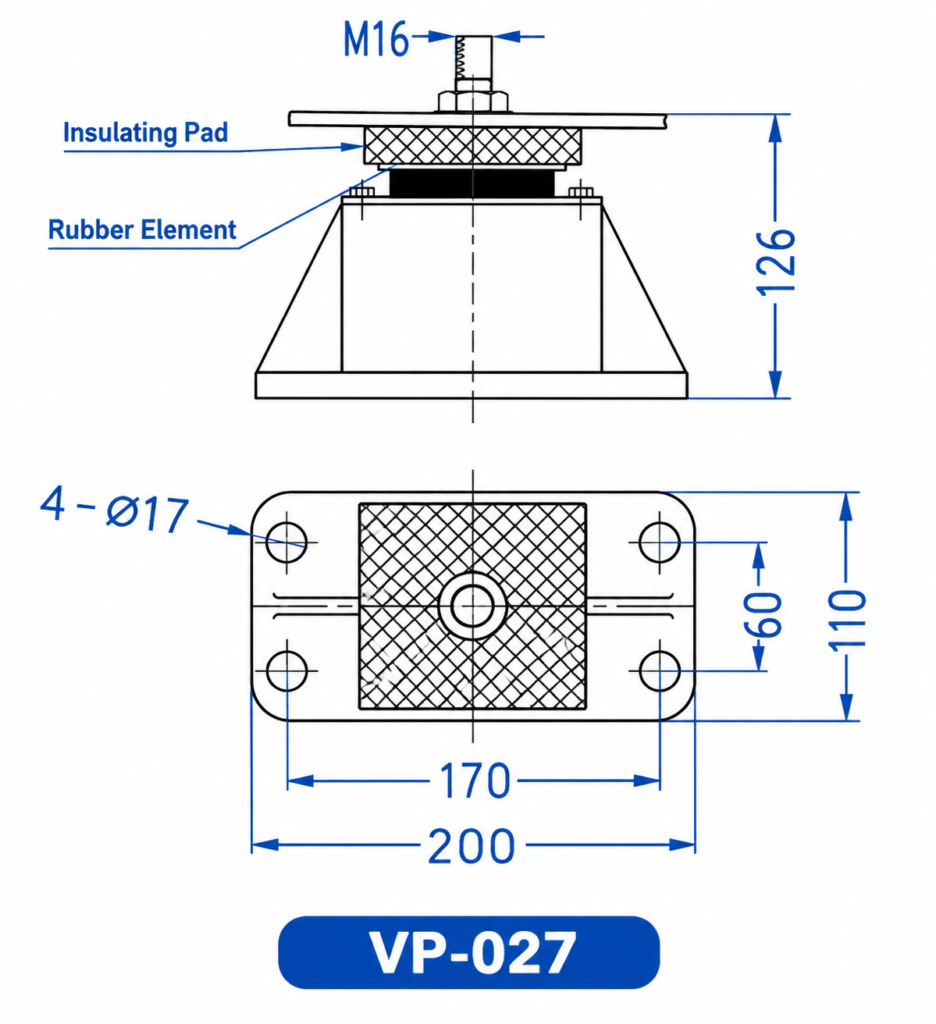
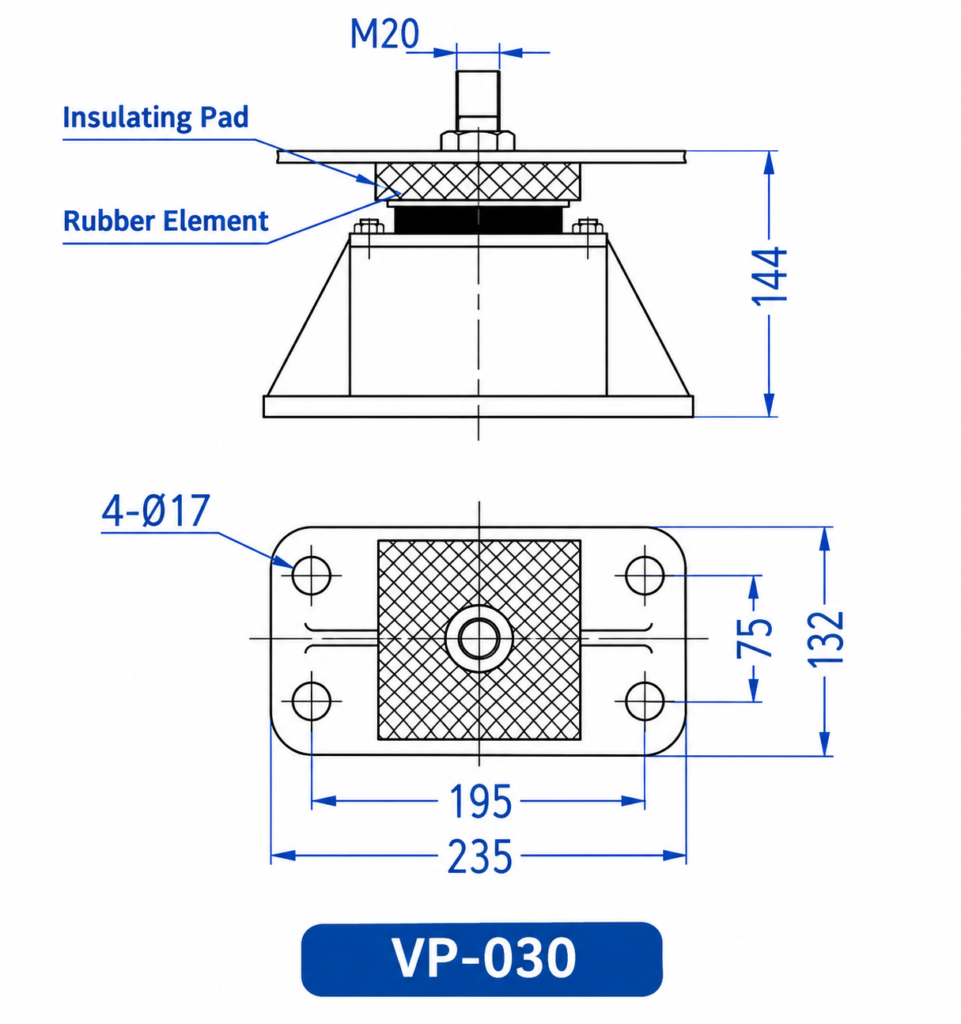
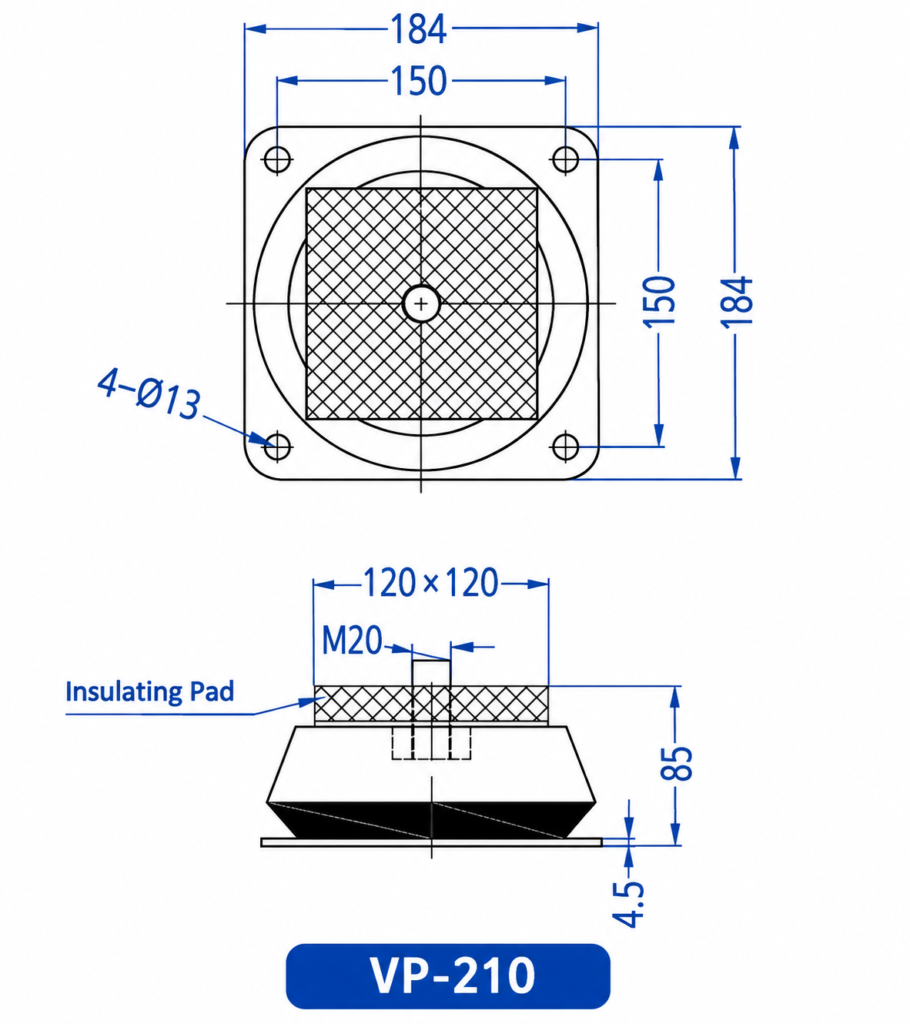
VP Rubber Elastic Support – Technical Specifications
Dimensions: mm | Maximum load: kg
Model | A | B | C | D | E | F | M | Max. Load (kg) |
|---|---|---|---|---|---|---|---|---|
VP-025 | 100 | 52 | 155 | 124 | 80 | 2-Ø14 | M12 | 500 |
VP-025 | 80 | — | 155 | 124 | 70 | Ø11 | M12 | 500 |
VP-026 | 100 | — | 160 | 130 | 92 | Ø15 | M16 | 1000 |
VP-027 | 126 | — | 200 | 170 | 110 | 4-Ø17 | M16 | 1500 |
VP-030 | 144 | — | 235 | 195 | 132 | 4-Ø17 | M20 | 2000 |
VP-210 | 85 | — | 184 | 150 | 184 | 4-Ø13 | M20 | 2450 |
Notes:
All dimensions are in millimeters (mm).
Maximum load capacity is expressed in kilograms (kg).
“—” indicates that the dimension is not specified.
Ø indicates hole diameter; M indicates metric thread size.
If you are looking for an AMVB All-Metal Vibration Isolator, stainless steel shock mount, precision instrument vibration isolator, or multi-directional vibration isolation solution, please send us your equipment specifications and installation requirements.
Our company’s new website is now live, featuring the latest product introductions. For more details, please visit more products.
Or you can send your inquiry directly to [email protected].