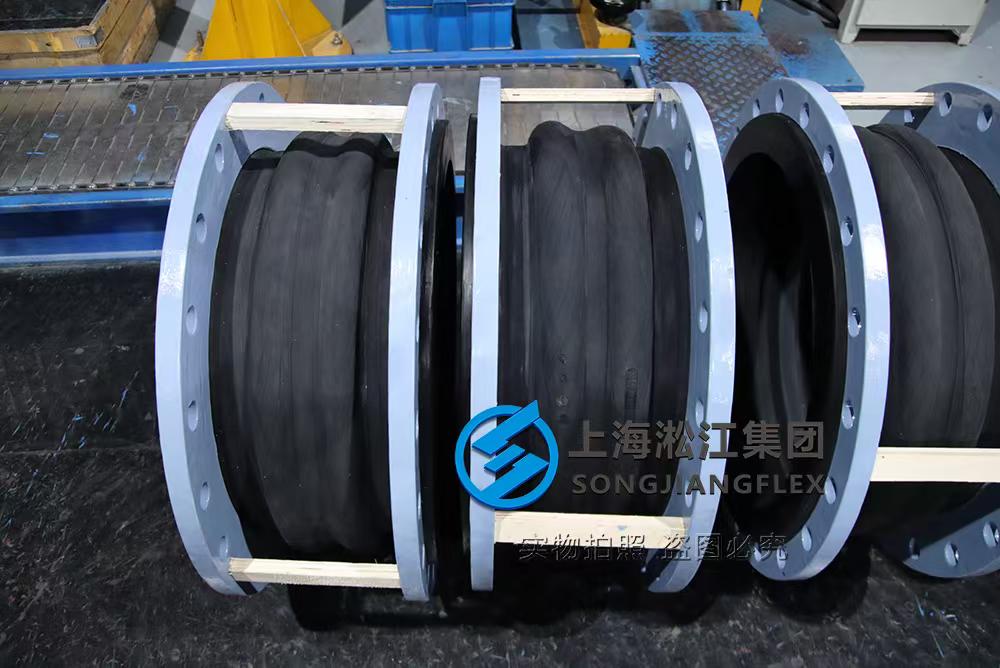
Large-diameter industrial piping systems require more than a standard flexible connector. When pipelines carry large volumes of cooling water, seawater, process water, or chemical media, the rubber expansion joint must handle not only vibration and thermal movement but also pressure thrust and complex piping displacement.
For these demanding applications, a Hand-Wrapped Rubber Expansion Joint with Control Rods provides a customized solution combining a reinforced rubber body with an external movement-control system.
Unlike conventional molded rubber joints, hand-wrapped expansion joints can be manufactured for large diameters, non-standard face-to-face lengths, special movement requirements, and customized operating conditions. The addition of control rods provides further protection against excessive extension or compression.
What Is a Hand-Wrapped Rubber Expansion Joint?
A hand-wrapped rubber expansion joint is manufactured by manually building multiple layers of rubber and reinforcement material around a forming structure.
The construction may include:
- inner rubber lining
- multiple rubber reinforcement layers
- high-strength synthetic cord fabric
- embedded reinforcing rings where required
- outer protective rubber cover
- full-face rubber sealing sections
- carbon steel or stainless steel flanges
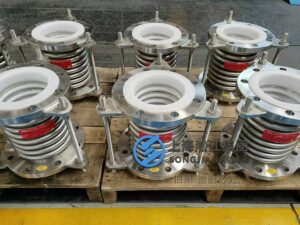
- external control rod assemblies
Compared with fixed-size molded joints, the hand-built process offers much greater dimensional flexibility. This makes it particularly suitable for large-bore and custom-engineered piping systems.
Hand-built rubber expansion joints are commonly engineered for cooling-water systems, desalination plants, mining pipelines, chemical processing systems, and other large industrial piping applications.
Why Add Control Rods?
Internal pressure inside a pipeline creates axial pressure thrust.
As the diameter and pressure increase, the resulting thrust can become significant. If the piping system does not provide adequate restraint, excessive movement may overstretch the rubber body or transmit unwanted loads to connected equipment.
The external control rod system acts as an additional mechanical safeguard.
Its main functions include:
Limiting excessive axial extension – helping prevent the rubber body from being pulled beyond its designed movement.
Controlling excessive compression – when the control unit is designed for this function.
Protecting the rubber bellows – reducing the risk of damage caused by abnormal pipeline movement.
Providing secondary restraint – particularly useful when the piping anchor system experiences an abnormal condition.
Improving installation security – especially for large-diameter or dynamically loaded piping systems.
Control rods should not simply lock the rubber joint rigidly. They are normally adjusted according to the allowable movement required by the expansion joint and piping system.
Where Are Large Hand-Wrapped Rubber Expansion Joints Used?
Power Plant Cooling Water Systems
Large thermal and combined-cycle power plants use extensive cooling-water networks.
Typical connected equipment includes:
main circulating water pumps, condenser cooling-water boxes, auxiliary cooling-water pumps, cooling towers, surface condensers, heat exchangers, turbine auxiliary cooling systems, and large intake/discharge headers.
Hand-wrapped rubber expansion joints can be installed at pump connections, condenser interfaces, and large-diameter cooling-water pipelines to absorb vibration and accommodate calculated movement.
Seawater Intake and Desalination Systems
Large-diameter rubber joints are also suitable for:
seawater intake pumps, vertical turbine pumps, reverse-osmosis pretreatment systems, seawater filtration units, RO membrane feed systems, brine discharge pipelines, seawater heat exchangers, and desalination intake/outfall pipelines.
A DN1400 hand-built seawater rubber expansion joint, for example, can combine a wide-arch construction with multiple external control rods for large-bore seawater service.
Pumping Stations
Municipal and industrial pumping stations often contain:
horizontal split-case pumps, vertical turbine pumps, booster pumps, raw-water pumps, cooling-water pumps, drainage pumps, flood-control pumps, and process-water circulation pumps.
Pump vibration and start-stop pressure changes can create dynamic loads in connected piping.
A flexible rubber connection helps reduce vibration transmission, while correctly engineered control rods help protect the expansion joint against excessive movement.
Chemical and Process Plants
Depending on the selected rubber compound, hand-wrapped expansion joints can also be considered for:
chemical circulation pumps, process reactors, storage tank inlet/outlet lines, scrubber circulation systems, process-water systems, acid/alkali transfer pipelines, wastewater treatment systems, and chemical dosing installations.
Rubber materials can be selected according to the actual medium. Typical options may include EPDM, NBR, CR, FKM, and other application-specific elastomers.
For highly corrosive media, PTFE-lined designs may also be considered.
Why Is Hand-Wrapped Construction Better for Large Diameters?
Large industrial pipelines often have requirements that cannot be satisfied by standard molded products.
The required diameter may be unusual. The face-to-face length may need to match an existing pipeline. The movement may be greater than a standard molded joint can accommodate.
Hand-wrapped manufacturing provides greater customization of:
diameter, overall length, arch geometry, number of arches, rubber material, reinforcement layers, wall structure, flange dimensions, and control rod configuration.
Multiple-arch designs can also be produced when greater movement capacity is required. Industry hand-built designs may use multiple arches specifically to increase movement capability or accommodate difficult alignment conditions.
Applications Under Vacuum Conditions
Some large piping systems operate under negative pressure rather than positive pressure.
Typical examples include pump suction lines, condenser water systems, large intake pipelines, vacuum process lines, and certain cooling-water circuits.
For these applications, the hand-wrapped structure can incorporate additional reinforcement such as steel rings or other internal support structures according to the required vacuum condition.
The vacuum requirement must be clearly specified during the design stage because a joint designed only for positive internal pressure should not automatically be assumed suitable for full vacuum.
FAQ
1. Are control rods mandatory for every hand-wrapped rubber expansion joint?
Not every application requires the same control rod arrangement. The requirement depends on the pipe diameter, internal pressure, movement, anchor arrangement, equipment connection, and piping-system design.
However, control rods become increasingly important in large-diameter, higher-pressure, unstable, or inadequately anchored piping systems.
They can provide protection against excessive extension and help manage abnormal movement. For large-diameter custom expansion joints, we strongly recommend reviewing the complete pipeline arrangement before deciding whether control rods can be omitted.
2. Can the control rods be adjusted after installation?
Yes, but the adjustment must follow the expansion joint design.
The nuts on a control rod are not simply tightened as much as possible. The required clearance depends on whether the assembly is designed as a control rod, limit rod, or continuous tie rod system.
A control rod generally permits designed movement until the preset limit is reached, while a true tie-rod arrangement may continuously restrain axial pressure thrust.
Incorrect adjustment can restrict the required movement or allow excessive displacement, so the installation setting should follow the manufacturer’s drawing and piping design.
3. How large can a hand-wrapped rubber expansion joint be manufactured?
Hand-wrapped manufacturing is particularly suitable for very large and non-standard diameters because it is not restricted in the same way as conventional molded production.
Large custom expansion joints can be manufactured according to the actual project dimensions. However, as diameter increases, the engineering requirements become more important.
The manufacturer needs to consider working pressure, vacuum requirement, movement, face-to-face length, reinforcement structure, flange strength, pressure thrust, transportation, installation, and control rod arrangement.
Therefore, large-diameter expansion joints should always be treated as engineered products rather than simply enlarged versions of small molded joints.
4. What information is required for a custom hand-wrapped expansion joint?
Please provide the medium, operating temperature, working and design pressure, DN or actual pipe OD, face-to-face length, axial movement, lateral movement, angular movement, flange standard, vacuum requirement, number of units, and installation drawing.
For large-diameter projects, we also recommend providing the position of the pump, valve, pipe anchors, guides, supports, and connected equipment.
This information allows us to determine the rubber material, reinforcement structure, arch design, flange configuration, and appropriate control rod arrangement.
Built for Large and Demanding Piping Systems
A Hand-Wrapped Rubber Expansion Joint with Control Rods is more than an oversized rubber connector.
It is a customized flexible piping component designed around the actual project conditions.
From power plant circulating-water pumps and surface condensers to seawater intake systems, desalination plants, large pumping stations, chemical processing equipment, and industrial cooling-water networks, hand-wrapped construction provides the flexibility required for large and non-standard piping systems.
The external control rod system adds another level of protection by helping keep movement within the intended operating range.
For custom selection, please send us your pipe diameter, medium, temperature, pressure, installation length, movement requirements, flange standard, and pipeline drawing.
Our company’s new website is now live, featuring the latest product introductions. For more details, please visit https://shsjflex.com/
Email: [email protected]