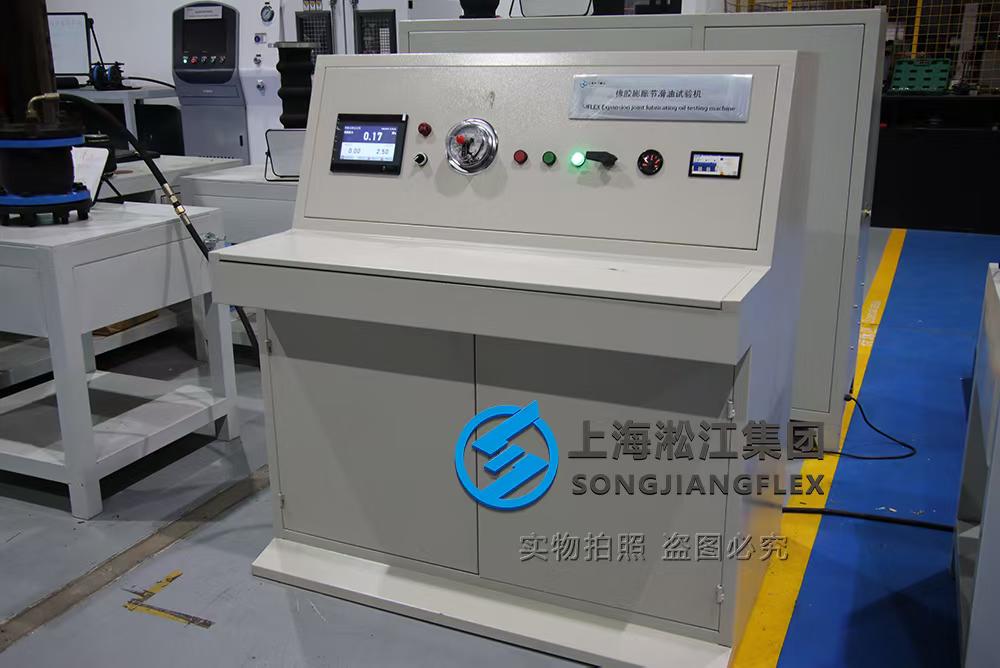
A rubber expansion joint may look simple from the outside, but when it is installed in a lubricating oil pipeline, its reliability depends on much more than appearance.
Rubber compound compatibility, reinforcement structure, flange sealing, pressure resistance, bonding quality, and dimensional stability all affect the performance of the finished product.
That is why we believe a product designed for demanding oil-service piping deserves demanding verification.
At our factory, oil-resistant rubber expansion joints are being tested on a lubricating-oil pressure testing machine. During the test, the joint is filled with the specified test medium and pressurized under controlled conditions while its sealing condition, deformation, flange area, and overall structural behavior are carefully inspected.
For us, testing is not simply the final step before shipment. It represents our confidence in the product we manufacture.
Why Is Lubricating Oil Service Different from Water Service?
Not every rubber compound is suitable for petroleum-based oils.
In a water pipeline, the inner rubber layer is primarily required to withstand water, pressure, temperature, and mechanical movement. In a lubricating oil system, the rubber is continuously exposed to petroleum-based fluids, making oil resistance and elastomer compatibility critical factors.
For this reason, oil-service rubber expansion joints are commonly designed using appropriately formulated NBR (Nitrile Rubber) or other oil-resistant elastomers according to the actual medium and temperature.
Material selection should consider not only the term “lubricating oil,” but also:
- oil type and formulation
- operating temperature
- working pressure
- additives in the lubricant
- continuous or intermittent exposure
- expected service life
- external environmental conditions
This is why we always ask customers to provide the actual operating medium before selecting the rubber material.
What Does a Pressurized Oil Test Check?
The purpose of pressure testing is not simply to determine whether the rubber expansion joint “breaks” or “does not break.”
During a controlled pressure test, several areas can be inspected simultaneously.
Sealing Performance
The joint is checked for visible leakage around the rubber body, flange sealing surfaces, molded transition areas, and other critical locations.
Even a small leakage point may become a serious problem after installation, particularly in machinery rooms or oil circulation systems.
Structural Stability
The rubber body is observed while internal pressure is applied.
Engineers look for abnormal bulging, excessive deformation, irregular arch expansion, separation, or other unexpected structural behavior.
The purpose is to confirm that the complete joint behaves as expected under the specified test condition.
Flange and Sealing Area
The flange connection is another important inspection point.
The rubber sealing face must remain properly positioned while pressure is applied. The relationship between the rubber flange, metal flange, bolts, and test equipment is carefully checked for leakage or abnormal displacement.
Overall Product Integrity
A finished rubber expansion joint consists of more than the visible outer rubber layer.
Depending on its construction, it may incorporate an inner rubber tube, reinforcement fabric or tire cord, rubber reinforcement layers, embedded reinforcing elements, outer cover, and flange structure.
ASTM F1123, for example, covers minimum requirements for the construction, materials, performance, and dimensions of arch-type non-metallic expansion joints and recognizes hydrostatic testing as a production test when specified.
For us, pressure testing is therefore an important part of verifying the finished assembly rather than judging quality by appearance alone.
Where Are Lubricating-Oil Rubber Expansion Joints Used?
Oil-resistant rubber expansion joints can be used in many industrial and marine lubrication systems when the rubber compound and structural design are compatible with the actual operating conditions.
Typical equipment includes:
marine main engine lubricating oil systems, auxiliary diesel engine lubrication systems, diesel generator lubrication systems, gas engine lube-oil systems, turbine lubrication skids, gearbox lubrication units, bearing lubrication systems, hydraulic lubrication stations, compressor lubrication systems, and industrial circulating-oil systems.
They may also be used around:
lubricating oil circulation pumps, main lube-oil pumps, standby oil pumps, oil coolers, plate heat exchangers, duplex oil filters, oil purification units, oil storage tanks, day tanks, bearing oil supply manifolds, oil return lines, and skid-mounted lubrication packages.
In these systems, pumps, engines, compressors, and other rotating machinery can transmit vibration into connected rigid piping.
A correctly selected oil-resistant rubber expansion joint provides a flexible connection that can help absorb vibration, accommodate limited pipeline movement, and reduce mechanical loads transferred through the piping system.
Marine Engine Lubricating Oil Systems
Marine applications are an important example.
A ship’s main engine or auxiliary engine may use a lubricating oil system containing circulation pumps, pre-lubrication pumps, oil coolers, filters, separators, storage tanks, and supply/return pipelines.
Continuous engine vibration can be transmitted through these pipes.
Installing an appropriately designed rubber expansion joint at a suitable location can provide flexibility between vibrating machinery and connected piping.
However, marine applications should also consider oil temperature, pressure, fire-safety requirements, classification requirements, flange standards, and installation arrangement before final product selection.
Generator and Power Equipment Applications
Lubricating-oil flexible joints can also be used around diesel generator sets, emergency generators, gas engines, industrial engines, turbine auxiliary lubrication systems, and large rotating equipment.
For generator applications, typical locations may include oil pump connections, lubrication skids, oil cooler piping, and other auxiliary circulation lines.
Because these systems often operate for long periods, material compatibility and pressure reliability are particularly important.
Quality Control Is More Than a Final Pressure Test
A pressure test is important, but it cannot replace the complete manufacturing quality-control process.
A reliable rubber expansion joint begins with:
rubber material selection → reinforcement design → forming and molding → vulcanization → flange preparation → dimensional inspection → visual inspection → pressure testing → final inspection.
For special oil-service products, we pay particular attention to the compatibility between the internal rubber layer and the actual process medium.
This is also why customers should clearly identify whether the medium is lubricating oil, diesel fuel, hydraulic oil, fuel oil, water-glycol fluid, or another process liquid. Different media may require different elastomer formulations.
Why Do We Take Testing Seriously?
Because the rubber expansion joint installed at the customer’s site becomes part of a complete piping system.
A failure does not affect only the joint itself. It may influence pumps, engines, surrounding equipment, maintenance schedules, and plant operation.
Our goal is therefore not simply to manufacture a rubber joint that looks correct.
We want to know how it behaves when pressure is applied.
We want to inspect the sealing areas.
We want to observe the rubber body.
And we want to verify the product before it leaves our factory.
That is what factory testing means to us: confidence built through verification.
FAQ
1. Why use lubricating oil for a rubber expansion joint pressure test?
When required by a customer’s specification or an agreed inspection procedure, using the actual or a representative service medium can provide additional application-oriented verification.
For an oil-service rubber expansion joint, the test allows the manufacturer to observe the completed product while it is exposed to a relevant medium under controlled pressure.
The inspection can include leakage, flange sealing, rubber-body deformation, arch behavior, and overall structural stability.
However, the test medium, test pressure, holding time, temperature, and acceptance criteria should be agreed before testing. A lubricating-oil test should not automatically be considered a substitute for a hydrostatic test required by a particular project standard.
2. Which rubber material is suitable for lubricating oil?
NBR is commonly considered for petroleum-based lubricating oils because of its oil resistance, but the final material cannot be selected from the word “oil” alone.
Different lubricating oils contain different base oils and additive packages. Temperature also has a significant influence on elastomer performance.
For higher temperatures or more demanding chemical conditions, other elastomers such as FKM may need to be evaluated.
Therefore, customers should provide the exact lubricating oil type, operating temperature, working pressure, and any available fluid specification before final material confirmation.
3. Can an ordinary EPDM rubber expansion joint be used for lubricating oil?
Generally, a standard EPDM joint should not automatically be selected for petroleum-based lubricating oil service.
EPDM is widely used for water, hot water, weathering, and many HVAC applications, but petroleum oils and hydrocarbon fluids are an important material-compatibility limitation.
For lubricating oil pipelines, an appropriately formulated NBR oil-resistant rubber expansion joint is often a more suitable starting point. The actual compound should still be confirmed against the specific lubricant and operating temperature.
4. Does every rubber expansion joint need a pressure test?
Testing requirements depend on the product specification, customer requirements, project standard, pressure rating, and application.
For example, ASTM F1123 addresses non-metallic expansion joints and provides for hydrostatic production testing when required by the purchaser.
For critical applications such as marine engine lubrication, diesel generator systems, oil circulation skids, and industrial lubrication units, project-specific inspection and testing requirements should be confirmed before production.
The objective is to ensure that the finished product is evaluated according to the actual service requirements rather than relying only on visual inspection.
Tested Before It Reaches Your Pipeline
For us, manufacturing an oil-resistant rubber expansion joint does not end when molding and assembly are complete.
Testing allows us to verify what we manufacture.
Whether the product will be installed in a marine diesel engine lubrication system, generator lube-oil line, compressor lubrication skid, turbine oil system, gearbox lubrication unit, or industrial circulating-oil pipeline, we want to understand the actual application first and manufacture accordingly.
If you have an oil-service project, please provide the medium, oil type, temperature, working pressure, pipe size, flange standard, installation length, required movement, quantity, and application equipment.
Our company’s new website is now live, featuring the latest product introductions. For more details, please visit https://shsjflex.com/
Email: [email protected]