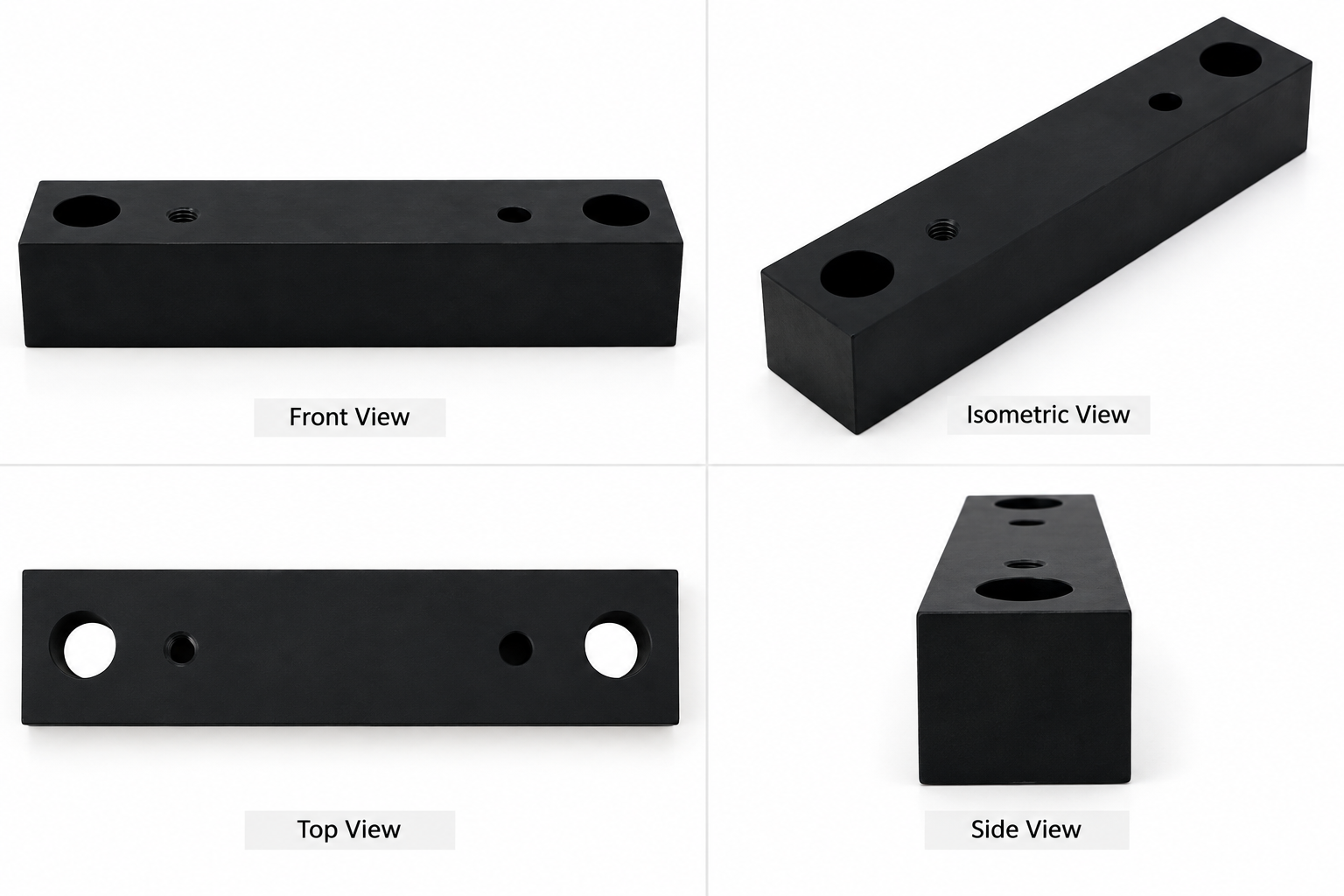
Custom Oil-Resistant NBR Vibration Isolation Strips for Electric Motors, Pumps, Fans, and Industrial Drive Systems
Industrial electric motors are essential components in modern manufacturing facilities, powering everything from centrifugal pumps and ventilation fans to gear reducers, hydraulic power units, and automated production machinery. However, continuous motor operation can generate mechanical vibration that affects equipment stability, structural integrity, and workplace noise levels.
Choosing the right rubber motor mount is an important part of industrial vibration control, particularly when equipment operates continuously or is installed on steel frames, concrete foundations, or shared machinery platforms.
The DSM Motor Vibration Isolation Strip is a compact rubber-metal vibration damping solution designed for selected industrial motor installations. Manufactured using oil-resistant NBR (Nitrile Butadiene Rubber) and cold-drawn steel components, this product provides elastic support, vibration damping, and mechanical stability.
With a rubber hardness of 60–65 Shore A, DSM vibration isolation strips can be customized to accommodate different motor frame sizes, mounting arrangements, and operating requirements.
For equipment manufacturers, maintenance engineers, and industrial project contractors, DSM rubber motor mounts offer a practical option for reducing structure-borne vibration while maintaining a compact installation design.
Why Do Industrial Electric Motors Need Vibration Isolation?
Every rotating electric motor generates some level of dynamic force during operation. Even a properly installed and balanced motor may produce vibration due to electromagnetic excitation, residual rotor imbalance, bearing movement, or changing operating loads.
When a motor is mounted directly onto a rigid steel structure or concrete foundation, these dynamic forces can be transmitted into surrounding equipment.
Common consequences of excessive motor vibration include increased structural noise, loosening of mounting fasteners, accelerated bearing wear, coupling misalignment, and vibration transmission to nearby machinery.
These problems can become more significant in manufacturing plants where multiple motor-driven machines operate simultaneously.
A properly designed motor vibration isolation system introduces an elastic element between the equipment and its supporting structure.
DSM rubber vibration isolation strips perform this function by using the elastic and damping properties of nitrile rubber to help reduce mechanical vibration transmission.
What Makes DSM NBR Rubber Motor Mounts Different?
Unlike conventional flat rubber pads, DSM motor vibration isolation strips incorporate a rubber-metal composite structure with defined mounting holes and reinforced connection points.
This design makes them suitable for selected industrial installations requiring mechanical fastening, dimensional consistency, and compact vibration damping components.
Oil-Resistant NBR Rubber Construction
The DSM strip uses nitrile rubber, a synthetic elastomer commonly selected for applications involving petroleum-based oils, lubricants, and mechanical fluids.
NBR is particularly useful in industrial environments where motors operate near gearboxes, hydraulic systems, and lubricated mechanical assemblies.
Its oil resistance helps maintain material suitability in applications where ordinary rubber compounds may be affected by oil exposure.
However, compatibility should always be confirmed against the specific lubricant, chemical composition, and operating temperature.
Rubber Hardness of 60–65 Shore A
The DSM vibration isolation strip uses rubber with a hardness range of 60–65 Shore A.
This hardness range provides a balance of elastic deformation and load-supporting characteristics for suitably selected applications.
Rubber hardness influences the stiffness and compression behavior of the isolation element, but it does not independently determine vibration isolation performance.
The actual isolation characteristics depend on the rubber geometry, dynamic stiffness, static loading, and operating frequency.
Cold-Drawn Steel Reinforcement
DSM vibration isolation strips incorporate cold-drawn steel components to support mechanical connections and provide reinforcement within the rubber-metal assembly.
Metal sleeves and threaded connection components can help establish controlled fastening arrangements, depending on the specific product design.
The final mounting configuration must be checked to avoid unwanted rigid vibration transmission paths.
Compact Rectangular Installation Design
The rectangular strip design makes DSM vibration mounts suitable for applications where installation height and available space are limited.
Compared with larger spring-based isolation systems, compact rubber mounting strips can be integrated into selected motor bases, machinery frames, and equipment support assemblies without requiring extensive changes to the overall equipment layout.
Which Electric Motors Are Suitable for DSM Vibration Isolation Strips?
DSM rubber motor mounts are designed for selected electric motor installations, including motors using IEC IM B35 mounting configurations.
The IM B35 arrangement combines mounting feet with a flange connection, making it common in industrial motor-driven machinery.
Potential applications include three-phase induction motors, industrial AC motors, variable-frequency drive motors, and electric motors connected to gearboxes or pumps.
DSM motor vibration isolation strips can also be considered for motors with IP54 enclosure protection ratings.
It is important to distinguish these two classifications: IM B35 identifies the mechanical mounting arrangement, while IP54 describes the motor enclosure’s protection against dust and water ingress.
Neither designation alone establishes the required vibration isolator stiffness or load capacity.
Before selecting DSM strips, engineers should confirm the motor weight, mounting hole dimensions, shaft alignment requirements, and mechanical connections to the driven equipment.
Industrial Applications of DSM Motor Vibration Isolation Strips
1. Centrifugal Pump Motor Mounting Systems
Industrial pumping systems frequently operate continuously in water treatment plants, manufacturing facilities, and HVAC installations.
Typical equipment includes horizontal end-suction centrifugal pumps, close-coupled centrifugal pump assemblies, horizontal split-case water pumps, chilled water circulation pumps, cooling tower condenser water pumps, and industrial process water transfer pumps.
Motor vibration may be transmitted through the pump baseplate into supporting steel structures or concrete foundations.
DSM rubber vibration isolation strips can be considered for properly engineered motor and pump mounting systems where compact rubber damping components are appropriate.
For rigidly coupled pump and motor assemblies, both components should generally be assessed as one mechanical system to maintain correct shaft alignment.
2. Industrial Ventilation and Exhaust Fan Motors
Ventilation systems often generate vibration from rotating fans, drive motors, bearings, and belt transmission components.
Applications include centrifugal exhaust fans, industrial dust collection blowers, paint booth ventilation fans, textile workshop extraction systems, HVAC air handling units, industrial furnace combustion air fans, and cooling tower fan motor assemblies.
When installed in a suitable support arrangement, DSM vibration isolation strips can help reduce the transmission of motor-generated vibration into surrounding structural components.
For large fans with significant aerodynamic forces or low operating frequencies, engineers should compare rubber isolation strips with spring vibration isolators or other vibration control solutions.
3. Gear Reducers and Industrial Conveyor Drives
Gear motors and transmission systems are widely used in automated production lines.
DSM rubber motor mounts may be considered for helical gear reducer motor assemblies, worm gearbox drives, belt conveyor drive systems, chain conveyor motors, packaging machine transmissions, roller conveyor drive units, and automated warehouse material handling equipment.
These applications may involve continuous rotational vibration, gear mesh excitation, and variable mechanical loads.
The rubber-metal construction of DSM strips can provide damping and support where the mounting arrangement is designed to accommodate elastic movement.
For equipment requiring precise gear or coupling alignment, the complete drivetrain should be evaluated before adding flexible mounts.
4. Hydraulic Power Units and Machine Tool Auxiliary Systems
Hydraulic power units are commonly installed in CNC machining centers, injection molding machines, metal forming equipment, and automated manufacturing systems.
Typical applications include CNC hydraulic pump motor assemblies, injection molding machine hydraulic stations, industrial press hydraulic power packs, automated clamping systems, machine tool lubrication pump motors, and metalworking coolant circulation systems.
Motor and pump vibration can travel into machine frames, particularly when the hydraulic unit is mounted on a steel platform.
DSM NBR vibration isolation strips may help reduce structure-borne vibration when their load capacity, stiffness, and installation arrangement are appropriate.
For precision machining equipment, excessive elastic movement must be avoided because it may affect machine stability or positioning accuracy.
5. Industrial Compressors and Vacuum Pump Motors
Compressed air and vacuum systems are important utilities in manufacturing facilities.
Potential applications include rotary screw compressor auxiliary motors, vacuum pump drive motors, refrigeration equipment auxiliary motors, compressed air treatment systems, industrial blower motor assemblies, and packaging vacuum system motors.
The oil-resistant NBR construction of DSM strips is useful for consideration in machinery environments where lubricants and mechanical oils may be present.
However, compressors can generate substantial pulsating forces, and some installations require specialized vibration isolation systems.
A detailed assessment should be completed before choosing DSM rubber mounts for equipment with significant dynamic loading.
6. Food Processing, Packaging, and Textile Machinery
Electric motors used in processing and production equipment can also generate vibration that travels into supporting structures.
Examples include food packaging conveyor motors, industrial mixing machine drives, bottle filling line auxiliary motors, textile spinning machine motors, industrial sewing equipment drive assemblies, paper converting machine motors, and automated labeling machine transmissions.
For these applications, DSM rubber motor mounting strips may help reduce vibration transmission and support stable equipment operation.
Where equipment is exposed to food ingredients, aggressive cleaning agents, or sanitary washdown processes, material compatibility and hygienic design requirements must be evaluated separately.
How Does Motor Speed Affect Rubber Vibration Isolation?
Motor operating speed is one of the most important factors when selecting vibration isolation components.
For rotating equipment, the fundamental rotational frequency can be estimated using:
Frequency (Hz) = Motor Speed (RPM) ÷ 60
For example, a motor operating at 1,500 RPM has a rotational frequency of approximately 25 Hz.
A motor operating at 3,000 RPM has a rotational frequency of approximately 50 Hz.
However, industrial motors may also generate vibration at other frequencies due to electrical excitation, bearing defects, gear meshing, belt drives, or connected machinery.
The natural frequency of the supported equipment and its vibration isolation system must be considered in relation to these excitation frequencies.
When the excitation frequency approaches the system’s natural frequency, resonance may occur, resulting in increased vibration amplitude.
Therefore, DSM rubber motor mounts should be selected according to the actual dynamic requirements rather than relying only on motor frame size or rubber hardness.
How to Customize DSM Motor Vibration Isolation Strips for OEM Equipment
Original Equipment Manufacturers (OEMs) frequently require vibration isolation components that match specific motor frames and equipment designs.
Standard rubber mounts may not always provide the required mounting hole spacing, installation height, or load capacity.
Shanghai Songjiang Vibration Absorber Co., Ltd. supports the development of customized DSM motor vibration isolation strips for industrial equipment manufacturers and engineering contractors.
Customization can include overall strip length, width, height, mounting hole diameter, threaded insert specifications, metal reinforcement configuration, rubber material selection, and load-related design requirements.
For example, a manufacturer developing a motor-driven conveyor assembly may require a compact NBR vibration isolation strip with mounting holes positioned to match an existing steel frame.
A pump equipment manufacturer may need a rubber-metal mounting strip designed around a specific baseplate arrangement and motor frame size.
A machinery maintenance contractor may require replacement vibration damping strips matching the dimensions of existing components.
In each case, the selection process should begin with accurate technical information, including supported equipment weight, mounting dimensions, operating speed, and environmental conditions.
Why Is Proper Installation Important for Motor Vibration Isolation?
Even a well-designed rubber motor mount may perform poorly if installed incorrectly.
Incorrect mounting can introduce excessive compression, uneven loading, unwanted metal-to-metal contact, or mechanical instability.
Before installation, the supporting surface should be inspected to confirm that it is level, structurally sound, and compatible with the mounting arrangement.
The isolation strips should be positioned according to the intended load distribution.
Fasteners must be installed in accordance with the approved mounting design, avoiding unintended compression or rigid bypass paths that reduce isolation performance.
For motor-driven equipment with couplings, belts, or connected piping, alignment should be checked before and after installation.
After commissioning, vibration measurements can be used to assess whether the isolation system is performing as intended.
Frequently Asked Questions About DSM Motor Vibration Isolation Strips
Can DSM rubber motor mounts be used for continuous-duty industrial motors?
DSM motor vibration isolation strips can be considered for continuous-duty electric motor installations when the mounting system is properly designed for the operating conditions.
Continuous operation introduces sustained static loading and repeated dynamic deformation into the rubber component.
Over time, rubber materials may experience changes in stiffness, permanent deformation, or aging depending on temperature, loading, chemical exposure, and environmental conditions.
For this reason, engineers should verify the expected compression, operating temperature, dynamic loading, and maintenance requirements before selecting the product.
The NBR material used in DSM strips provides useful oil resistance for many industrial motor environments, but long-term performance must be assessed according to the actual operating conditions.
Are DSM vibration isolation strips suitable for motors installed on steel platforms?
DSM rubber vibration isolation strips may be suitable for selected motor installations on steel platforms, but the flexibility of the supporting structure must be considered.
Steel platforms and elevated machinery frames can have their own natural frequencies.
If the motor excitation frequency approaches one of these structural frequencies, the platform may experience amplified vibration.
Installing rubber isolation strips without evaluating the platform’s dynamic behavior may not solve the problem and could introduce additional resonance conditions.
For critical installations, engineers should review the motor operating speed, support frame stiffness, equipment weight distribution, and existing vibration measurements.
A properly designed vibration isolation arrangement should consider both the mounted equipment and its supporting structure.
How does NBR compare with EPDM rubber for motor vibration isolation?
NBR and EPDM are both commonly used industrial elastomers, but they have different chemical resistance characteristics.
NBR is generally preferred for applications involving many petroleum-based oils, lubricants, and hydrocarbon fluids.
EPDM is often selected for applications requiring resistance to weathering, ozone, hot water, and certain environmental conditions.
For industrial electric motors operating near lubricated gearboxes or hydraulic equipment, NBR can be a practical material choice.
For outdoor installations involving significant sunlight and ozone exposure, EPDM may offer advantages depending on the application.
However, the final material selection should consider fluid compatibility, operating temperature, mechanical loading, and environmental exposure rather than relying on a single material property.
Can DSM motor vibration isolation strips replace damaged rubber mounting pads?
DSM rubber motor mounts may be used as replacement components when their dimensions, mechanical properties, and load capacities are compatible with the original installation.
Before replacing an existing rubber mount, maintenance personnel should identify the original component’s mounting geometry, rubber thickness, hardness, supported load, and installation arrangement.
A replacement with the same external dimensions may still behave differently if its rubber stiffness or internal reinforcement structure is different.
For equipment requiring precise alignment, the replacement component should also maintain an appropriate installed height under load.
Where original drawings are unavailable, photographs, dimensional measurements, and equipment operating information can help determine whether a customized DSM strip is suitable.
How can engineers determine whether a DSM vibration isolation strip is effective?
The most reliable approach is to evaluate the equipment’s vibration characteristics before and after installation under comparable operating conditions.
Vibration measurements can be taken at the motor housing, mounting base, and supporting structure.
These measurements may include vibration velocity, acceleration, displacement, and frequency spectrum data.
A reduction in vibration measured at the supporting structure can indicate improved isolation, provided that operating conditions remain comparable.
However, vibration reduction at one measurement point does not necessarily mean that all equipment vibration has decreased.
The motor itself may experience different movement after isolation, and the mounting system must remain mechanically stable.
For critical industrial applications, vibration performance should be evaluated together with shaft alignment, equipment stability, and operational reliability.
What technical information should customers provide when ordering customized DSM motor mounts?
Customers should provide the motor model, frame size, supported weight, operating speed, mounting dimensions, and required quantity.
Installation drawings are particularly useful because they show the mounting hole positions, available space, and relationship between the motor and supporting structure.
For equipment operating under unusual conditions, additional information such as temperature, oil exposure, vibration frequency, dynamic forces, and required service life should also be supplied.
If the DSM strip is intended to replace an existing product, photographs and dimensional measurements of the original mount can help clarify the requirements.
Providing complete technical information allows the manufacturer to review the application more efficiently and reduce the risk of selecting an unsuitable vibration isolation component.
Why Work with Songjiang for Custom Industrial Rubber Motor Mounts?
Shanghai Songjiang Vibration Absorber Co., Ltd. manufactures industrial vibration control products for a wide range of machinery applications.
Our product range includes rubber vibration mounts, spring vibration isolators, air spring isolation systems, and customized rubber-metal vibration damping components.
For DSM motor vibration isolation strips, our engineering team can assist customers with dimensional review, material selection, mounting configuration, and customized manufacturing requirements.
We support industrial equipment manufacturers, engineering contractors, machinery maintenance companies, and international distributors seeking vibration control components for specific applications.
By combining technical consultation with customized manufacturing capabilities, we aim to provide practical and reliable vibration isolation solutions for modern industrial machinery.
Contact Us for Custom DSM Motor Vibration Isolation Strips
Are you looking for an oil-resistant rubber motor mount manufacturer or a customized vibration isolation strip for your industrial equipment?
Shanghai Songjiang Vibration Absorber Co., Ltd. welcomes inquiries from equipment manufacturers, industrial distributors, maintenance contractors, and engineering companies worldwide.
Send us your motor specifications, equipment drawings, mounting dimensions, and operating requirements for technical review and quotation.
Our company’s new website is now live, featuring the latest product introductions. For more details, please visit https://shsjflex.com/
Email: [email protected]
Website: https://shsjflex.com/