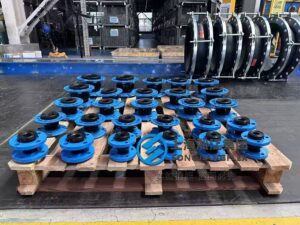
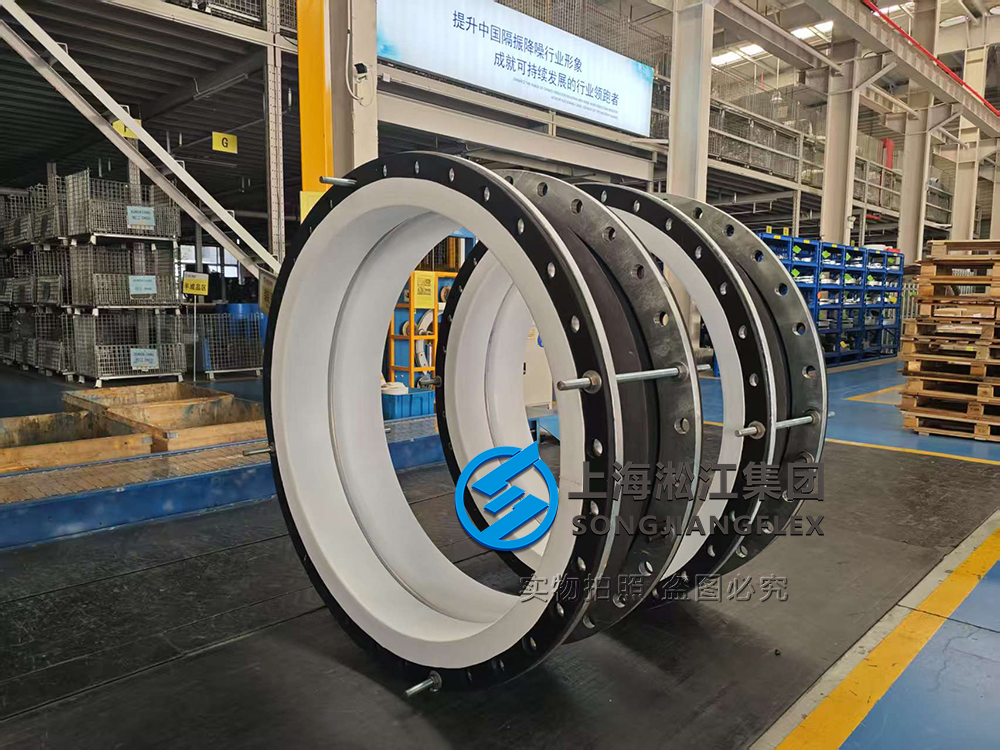
A PTFE-Lined Hand-Wrapped Rubber Expansion Joint is a specialized flexible piping component designed for industrial systems that require a combination of chemical resistance, vibration isolation, and movement accommodation. It combines a polytetrafluoroethylene (PTFE) inner liner with a hand-wrapped rubber body and suitable end connections to meet demanding process piping requirements.
Unlike conventional rubber expansion joints, this design incorporates a PTFE lining to provide a chemically resistant contact surface for compatible process media. The hand-wrapped manufacturing process is particularly useful for certain large-diameter or non-standard configurations where customized construction may be required.
How Does the Product Work?
A PTFE-lined hand-wrapped rubber expansion joint forms a flexible connection between adjacent sections of piping or between equipment and piping. Its flexible rubber body can accommodate specified axial, lateral, and angular movements, depending on the design. It can also help reduce the transmission of mechanical vibration and structure-borne noise through connected pipework.
The PTFE liner provides a barrier between the conveyed medium and the underlying rubber construction. This arrangement can be beneficial when the process medium is chemically aggressive or when the exposed rubber surface would not provide adequate compatibility.
The actual performance depends on the complete assembly, including the liner, rubber compound, reinforcement, flange design, operating conditions, and installation arrangement.
Key Materials and Construction Features
PTFE inner liner: PTFE is widely used for its chemical resistance and low-friction surface. However, compatibility must be verified against the specific chemical concentration, temperature, pressure, and operating conditions. The liner’s thickness, continuity, and attachment to the rubber body should be confirmed during engineering review.
Hand-wrapped rubber body: The rubber body is constructed through a controlled wrapping and bonding process. Depending on the application, the rubber compound and reinforcement arrangement can be selected to meet the required flexibility, pressure resistance, and environmental conditions. EPDM, NBR, CR, and other elastomers may be considered where appropriate, subject to media compatibility and operating requirements.
Flanged connections: Flanges connect the expansion joint to the pipeline or equipment. Materials, drilling patterns, pressure ratings, and facing dimensions should be matched to the mating flanges and applicable piping specifications. Carbon steel, stainless steel, and other suitable materials may be considered according to the service environment.
Reinforcement layers: Reinforcing fabric and other structural components contribute to pressure containment and dimensional stability. Their configuration must be engineered for the intended operating pressure, vacuum conditions, movement, and service life.
What Are the Main Technical Benefits?
- Chemical resistance: The PTFE contact surface can help protect the underlying rubber construction when the process medium is compatible with PTFE.
- Vibration isolation: The flexible rubber body can reduce the transmission of vibration from pumps, motors, compressors, and other rotating equipment.
- Movement accommodation: The joint can accommodate specified piping movements caused by thermal expansion, equipment displacement, and installation tolerances.
- Customized construction: Hand-wrapped manufacturing can support selected large-diameter and non-standard designs, subject to manufacturing feasibility.
- Reduced piping stress: When correctly selected and installed, the joint can help accommodate movement and reduce unwanted loads associated with piping misalignment.
It is important to distinguish flexibility from structural support. A rubber expansion joint is not automatically a substitute for pipe anchors, guides, thrust restraints, or dedicated pressure-bearing supports. The complete piping system must be assessed to ensure safe operation.
2. Industrial Applications and Equipment Compatibility
PTFE-lined hand-wrapped rubber expansion joints are considered for industrial piping systems where chemical compatibility, flexibility, vibration control, or customized dimensions are important. Their suitability depends on the actual process conditions rather than the industry name alone.
Chemical Processing and Acid Transfer Systems
Chemical processing plants may use these joints in compatible acid transfer lines, chemical circulation pipelines, dosing systems, and process liquid connections. Potential applications include connections around chemical transfer pumps, centrifugal process pumps, metering pumps, and chemical storage tank discharge lines.
For sulfuric acid, hydrochloric acid, phosphoric acid, and other aggressive chemicals, selection must account for concentration, temperature, impurities, pressure, and operating cycles. PTFE offers broad chemical resistance, but the complete joint—including reinforcement, rubber backing, flange materials, and sealing interfaces—must be evaluated for the actual medium.
Industrial Pumps and Rotating Machinery
In industrial water treatment, chemical production, and process manufacturing, flexible joints may be installed near horizontal centrifugal pumps, vertical inline pumps, end-suction pumps, and process circulation pumps. They can help isolate vibration transmitted through connected pipework while accommodating specified installation movements.
The joint must not be expected to correct substantial piping misalignment or support unsupported pipe loads. Pump alignment, pipe supports, anchor locations, and the manufacturer’s installation requirements remain essential.
Exhaust, Ventilation, and Industrial Gas Systems
Selected applications may include compatible process exhaust ducting, chemical fume extraction systems, industrial scrubber connections, and gas-handling equipment. Possible connected equipment includes centrifugal exhaust fans, induced-draft fans, scrubber circulation systems, and industrial air-handling assemblies.
Gas composition, condensate formation, temperature, pressure or vacuum, and potential permeation must be considered before selecting a PTFE-lined rubber construction. A standard configuration should not be assumed suitable for every exhaust gas or high-temperature application.
Water Treatment, Pharmaceutical, and Manufacturing Facilities
PTFE-lined flexible connections may also be evaluated for compatible chemical dosing skids, wastewater treatment equipment, process filtration systems, and selected pharmaceutical manufacturing utilities.
For semiconductor facilities, precision manufacturing equipment, and automated production lines, engineers should assess whether the joint meets the required chemical compatibility, cleanliness, dimensional stability, and vibration-control objectives. Where the process involves ultrapure water, sanitary service, or strict contamination limits, additional material qualification and cleanliness requirements may apply.
Engineering Information Required for Selection
Before specifying a PTFE-lined hand-wrapped rubber expansion joint, engineers should establish the nominal diameter, face-to-face length, flange standard, operating and design pressure, temperature range, conveyed medium, movement requirements, and installation environment.
Vacuum service deserves particular attention because negative pressure can cause a flexible joint to deform or collapse if its construction is not designed for the required vacuum level. Reinforcement, internal support arrangements, and the overall geometry may need to be reviewed.
A properly engineered specification helps ensure that the product matches the process conditions and the mechanical requirements of the piping system.
Frequently Asked Questions
1. What Is the Difference Between a PTFE-Lined and a Standard Rubber Expansion Joint?
A standard rubber expansion joint exposes its selected rubber compound to the conveyed medium, whereas a PTFE-lined design provides a PTFE contact surface. This can improve chemical compatibility for applications in which the medium is unsuitable for direct contact with the rubber compound. However, the liner does not eliminate the need to evaluate the backing rubber, reinforcement, flanges, and seals. The appropriate design depends on chemical concentration, temperature, pressure, movement, and other operating conditions.
2. Which Chemicals Can a PTFE-Lined Rubber Expansion Joint Handle?
PTFE is resistant to many acids, alkalis, and industrial chemicals, making it a potential choice for chemical transfer and process piping applications. Nevertheless, no universal compatibility statement can guarantee suitability for every chemical mixture or operating condition. Concentration, temperature, impurities, exposure duration, and permeation requirements must be considered. Customers should provide the exact chemical name, concentration, operating temperature, and design pressure so that the liner and complete joint construction can be evaluated.
3. Can a PTFE-Lined Hand-Wrapped Rubber Expansion Joint Be Used Under Vacuum?
Vacuum service may be possible when the expansion joint is specifically designed and manufactured for the required negative pressure. The suitability depends on the joint diameter, length, rubber construction, reinforcement, liner arrangement, and operating temperature. Internal support rings or other anti-collapse features may be necessary in certain applications. Buyers should specify the required vacuum level and whether it is continuous or intermittent. A standard positive-pressure design should never be assumed suitable for full-vacuum service without engineering confirmation.
4. How Do I Select the Correct Size and Pressure Rating?
Selection starts with the nominal pipe diameter, required face-to-face length, flange drilling, operating pressure, design pressure, and temperature range. Engineers must also evaluate axial, lateral, and angular movements, the conveyed medium, and any pressure fluctuations or vacuum conditions. The expansion joint’s allowable movements and pressure rating must be verified for the selected configuration. Accurate piping drawings and mating-flange details help prevent dimensional mismatches and reduce installation problems.
5. Can This Product Reduce Pump Vibration and Piping Noise?
A flexible rubber expansion joint can help reduce the transmission of vibration and structure-borne noise between connected equipment and piping. It may be considered for centrifugal pumps, chemical dosing pumps, process circulation pumps, and other compatible systems. Its effectiveness depends on the vibration frequency, joint stiffness, piping layout, equipment operating conditions, and installation quality. It does not replace a properly designed vibration isolation system, and unsuitable pipe supports or excessive pressure thrust can compromise performance.
6. What Installation Precautions Are Required?
The joint should be installed according to its approved drawing and the manufacturer’s instructions. Confirm flange alignment, face-to-face dimensions, gasket requirements, bolt tightening procedures, and flow direction if specified. Avoid twisting the joint, forcing it into position, or using it to compensate for excessive misalignment. Provide appropriate pipe supports, guides, anchors, and pressure-thrust restraints where required. The installation must also remain within the specified movement limits and account for thermal expansion and operating loads.
7. Can a PTFE-Lined Hand-Wrapped Rubber Expansion Joint Be Customized?
Customization may be available for selected large diameters, face-to-face lengths, flange materials, rubber compounds, liner configurations, reinforcement arrangements, and movement requirements. Manufacturing feasibility depends on the required dimensions, pressure and vacuum conditions, process medium, and construction details. For an accurate technical review, provide a dimensioned drawing, piping specifications, chemical information, operating conditions, and required quantity. Any special requirements, such as full-vacuum resistance, unusual flange standards, or non-standard liner thickness, should be identified before quotation.
Conclusion and Technical Inquiry
A PTFE-Lined Hand-Wrapped Rubber Expansion Joint can be a practical solution for compatible industrial piping systems requiring chemical resistance, vibration isolation, and customized flexibility. Correct material selection and engineering assessment are essential to achieving reliable service.
For a technical recommendation or quotation, please provide your pipe diameter, face-to-face length, operating pressure and temperature, conveyed medium, movement requirements, flange specifications, equipment details, and drawings. These details will help determine a suitable configuration for your application.
Email: [email protected]
Our company’s new website is now live, featuring the latest product introductions. For more details, please visit https://shsjflex.com/