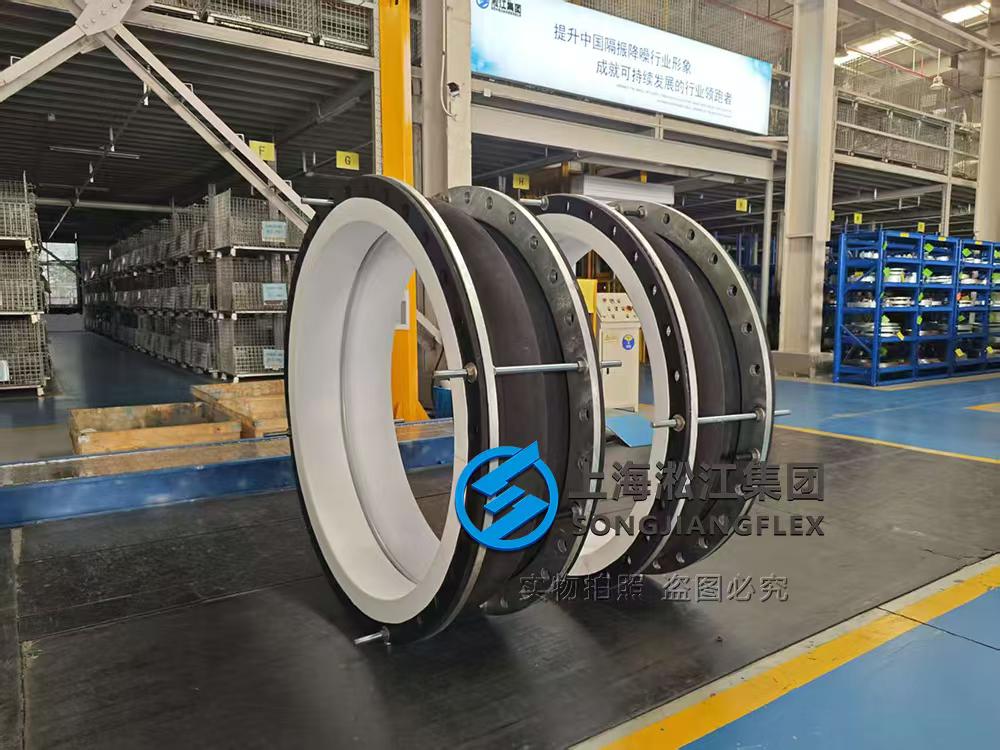
In pharmaceutical manufacturing, pipeline components must meet demanding requirements for chemical resistance, sealing reliability, mechanical flexibility, and process safety. Unlike conventional industrial water pipelines, pharmaceutical processing systems may transport corrosive chemical intermediates, active pharmaceutical ingredients (APIs), cleaning solutions, organic solvents, and highly sensitive process fluids.
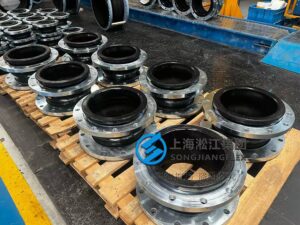
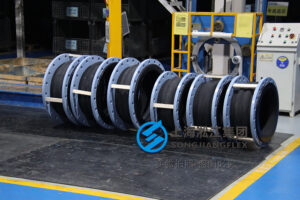
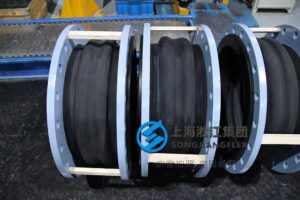
Recently, Shanghai Songjiang Vibration Absorber Co., Ltd. undertook a customized PTFE-lined rubber expansion joint project for pharmaceutical plant piping applications. The project focused on providing chemical-resistant flexible connectors manufactured according to the customer’s specific pipeline dimensions, operating conditions, equipment connections, and material requirements.
Rather than simply selecting a standard rubber expansion joint from a catalog, our engineering team evaluated the requirements of pharmaceutical processing equipment and developed a customized solution combining a PTFE internal lining with a reinforced rubber expansion joint structure.
The objective was to provide a reliable flexible pipeline connection that could resist the specified chemical medium while accommodating vibration, thermal expansion, and limited piping movement.
Why Do Pharmaceutical Plants Require PTFE-Lined Rubber Expansion Joints?
Pharmaceutical production involves complex chemical processes, including synthesis, reaction, extraction, purification, crystallization, filtration, solvent recovery, and chemical cleaning.
During these processes, pipeline systems may be exposed to aggressive chemical substances that are unsuitable for ordinary rubber materials.
For example, an API manufacturing facility may operate glass-lined reactors, stainless steel reaction vessels, chemical transfer pumps, filtration systems, and solvent recovery equipment. The pipelines connecting these machines may transport different chemical media during separate production stages.
Conventional EPDM or NBR rubber expansion joints can perform well in compatible applications, but they are not universally resistant to pharmaceutical solvents, chemical intermediates, or concentrated cleaning chemicals.
A PTFE-lined rubber expansion joint provides an alternative construction.
The internal polytetrafluoroethylene (PTFE) lining serves as the primary chemical-contact surface, while the reinforced rubber body provides mechanical flexibility.
This combination offers several potential advantages:
-
Chemical resistance against a broad range of compatible acids, alkalis, solvents, and pharmaceutical processing chemicals.
-
Reduced direct exposure of the rubber body to aggressive process fluids.
-
Accommodation of specified axial, lateral, and angular pipeline movements.
-
Reduction of vibration transmission from pumps and associated equipment.
-
Reduced mechanical stress on connected pipeline components when properly installed.
-
Customized flange connections and installation dimensions for existing pharmaceutical equipment.
PTFE-lined flexible connections are particularly relevant to chemical processing systems where corrosion resistance and mechanical flexibility must be considered together.
Custom Pharmaceutical Expansion Joint Order: Designed Around Customer Requirements
For this pharmaceutical piping project, the central requirement was not simply to supply a rubber expansion joint with a PTFE liner.
The customer required a product that could be integrated into the existing pharmaceutical processing pipeline without compromising the specified chemical compatibility, installation dimensions, or operating conditions.
Our engineering approach therefore began with an evaluation of the customer’s technical requirements.
1. Pharmaceutical Process Medium and Chemical Compatibility
The first consideration was the actual chemical medium passing through the expansion joint.
Pharmaceutical facilities may process hydrochloric acid, sulfuric acid, sodium hydroxide, acetic acid, ethanol, isopropyl alcohol, acetone, and other organic solvents or chemical intermediates.
These substances can have significantly different effects on elastomers, sealing materials, and pipeline components.
For this reason, the PTFE lining was selected as the proposed chemical-contact barrier, subject to verification against the customer’s actual process chemistry.
Our engineers also consider chemical concentration, possible mixed-media exposure, operating temperature, cleaning procedures, and process duration.
This is particularly important for pharmaceutical manufacturing because the compatibility of a flexible connector must be evaluated against the complete process, not just one chemical listed on a material specification.
2. Customized PTFE Lining Structure
The internal PTFE lining is one of the most important components of the expansion joint.
For pharmaceutical chemical service, the lining must provide a continuous and appropriately sealed contact surface between the transported medium and the expansion joint body.
Depending on the customer’s requirements, our manufacturing team can evaluate different PTFE lining thicknesses and construction methods.
For selected customized designs, a nominal PTFE lining thickness of approximately 1–3 mm, or a thicker construction where technically justified, may be considered.
The final thickness must be determined by the joint geometry, pressure, temperature, chemical medium, movement requirements, and manufacturing feasibility.
Particular attention is given to the lining transition around the flange sealing surfaces, where poor construction could create leakage paths or expose the rubber body to the chemical medium.
For pharmaceutical applications, the customer may also require additional consideration of lining continuity, surface condition, cleaning accessibility, and material traceability.
3. Rubber Body and Reinforcement Design
Although the PTFE liner provides the primary chemical-contact surface, the rubber body remains essential to the mechanical performance of the expansion joint.
Depending on the operating conditions, EPDM or another suitable elastomer may be evaluated for the outer rubber structure.
Reinforcing fabric layers are incorporated into the construction to support the required pressure and movement performance.
The reinforcement arrangement is determined according to factors such as:
-
Nominal pipeline diameter and installation length.
-
Operating and design pressure.
-
Maximum operating temperature.
-
Required axial compression and extension.
-
Lateral displacement and angular deflection.
-
Pressure cycling and equipment vibration.
-
Negative-pressure or vacuum conditions.
For applications involving vacuum, additional reinforcement or a specifically engineered vacuum-resistant structure may be required.
4. Custom Flanges and Installation Dimensions
Pharmaceutical plants frequently use equipment supplied by different international manufacturers.
Consequently, the piping connections may follow different dimensional standards.
Shanghai Songjiang can evaluate customized flanged expansion joints according to customer drawings and applicable connection standards, including EN 1092-1 PN10/PN16, ASME B16.5 Class 150, JIS, and other specified flange arrangements.
Flange material options may include carbon steel, stainless steel 304, or stainless steel 316L, depending on the application.
The face-to-face installation length, bolt-hole configuration, flange dimensions, and connection arrangement are reviewed before manufacturing.
This customized approach is especially valuable when replacing an existing flexible connector in a pharmaceutical production line, where modifying the original piping layout could increase installation time and production downtime.
Where Are PTFE-Lined Rubber Expansion Joints Used in Pharmaceutical Manufacturing?
Pharmaceutical production plants contain a wide range of specialized processing equipment.
The following equipment represents relevant applications where PTFE-lined flexible connections may be evaluated, provided the joint meets the required process conditions and hygienic classification.
API Synthesis Reactors and Glass-Lined Reaction Vessels
Active Pharmaceutical Ingredient manufacturing frequently uses chemical reaction equipment to carry out synthesis, neutralization, solvent-based reactions, and intermediate processing.
Typical equipment includes:
-
Glass-lined chemical synthesis reactors.
-
Stainless steel 316L batch reactors.
-
Agitated reaction vessels.
-
Pharmaceutical intermediate synthesis tanks.
-
Hydrogenation reactor auxiliary piping.
-
Neutralization reaction tanks.
-
Jacketed pharmaceutical reactors.
-
API crystallization reactors.
-
Solvent-based reaction vessels.
-
Reactor feed and discharge pump systems.
In these systems, flexible connectors may be installed at suitable positions between process equipment and associated rigid piping.
For example, a glass-lined reactor connected to a chemical circulation pump may experience mechanical vibration and temperature-related pipeline movement.
A properly designed PTFE-lined expansion joint can help reduce the transmission of these mechanical forces to connected piping and equipment nozzles.
This is particularly relevant to glass-lined processing equipment, where excessive external nozzle loads can damage sensitive equipment connections.
Pharmaceutical Chemical Transfer and Metering Pump Systems
Chemical transfer pumps are widely used throughout pharmaceutical manufacturing facilities.
Relevant equipment includes:
-
Magnetic-drive chemical transfer pumps.
-
PTFE-lined centrifugal chemical pumps.
-
Fluoroplastic-lined centrifugal pumps.
-
Stainless steel sanitary centrifugal pumps.
-
Diaphragm metering pumps.
-
Chemical dosing pumps.
-
Solvent transfer pumps.
-
Acid and alkali dosing skids.
-
Reactor circulation pumps.
-
Pharmaceutical intermediate transfer pumps.
-
Chemical unloading pump stations.
-
Solvent recovery circulation pumps.
Pump operation can generate vibration that travels through rigid pipeline connections.
Where the process medium and installation requirements permit, a PTFE-lined rubber flexible connector can be considered for the pump suction or discharge pipeline.
The purpose is to reduce vibration transmission while providing the necessary chemical-resistant wetted surface.
However, the expansion joint must be selected according to the pump pressure, operating temperature, allowable nozzle loads, and piping support arrangement. It must not be used as a substitute for proper pipeline anchoring or support.
Pharmaceutical Filtration and Purification Equipment
Filtration and purification are essential stages in pharmaceutical manufacturing, especially during API processing and chemical intermediate separation.
Potential associated equipment includes:
-
Agitated nutsche filter dryers (ANFD).
-
Pressure nutsche filters.
-
Pharmaceutical filter presses.
-
Cartridge filtration housings.
-
Activated carbon filtration units.
-
Solvent clarification filtration systems.
-
Pharmaceutical intermediate filtration skids.
-
Crystallization slurry transfer systems.
-
Solvent-resistant filtration pumps.
-
Mother liquor collection tanks.
-
API purification vessels.
-
Chemical filtration circulation systems.
In selected chemical-service piping, PTFE-lined rubber expansion joints may provide flexible connections between filtration equipment, pumps, and processing vessels.
For instance, an agitated nutsche filter dryer may be connected to chemical transfer piping that handles solvent-containing process liquids.
If vibration isolation or pipeline movement compensation is required, a customized chemical-resistant expansion joint may be evaluated.
For highly sanitary or product-contact filtration systems, however, a conventional flanged rubber expansion joint may not be appropriate. Cleanability, drainability, internal geometry, and applicable pharmaceutical material requirements must be assessed before selection.
Pharmaceutical Solvent Recovery and Distillation Systems
Solvent recovery systems are widely used in API manufacturing to recover valuable processing chemicals and reduce solvent consumption.
Associated equipment may include:
-
Pharmaceutical solvent recovery distillation columns.
-
Batch distillation vessels.
-
Vacuum distillation systems.
-
Falling-film evaporators.
-
Rotary evaporator auxiliary systems.
-
Solvent condensers.
-
Shell-and-tube heat exchangers.
-
Solvent collection tanks.
-
Vacuum receiver vessels.
-
Solvent circulation pumps.
-
Distillation reboiler circulation systems.
-
Chemical vapor recovery units.
These systems may experience temperature fluctuations, negative pressure, and exposure to organic solvents.
A customized PTFE-lined rubber expansion joint may be suitable for selected liquid-phase piping connections, depending on the solvent composition and operating conditions.
Particular attention must be given to vacuum resistance, solvent permeation, electrostatic hazards, and the temperature limitations of the complete expansion joint assembly.
For high-temperature vapor lines or demanding vacuum applications, a PTFE bellows, metal expansion joint, or another engineered flexible connector may be more suitable.
CIP Chemical Cleaning and Pharmaceutical Utility Systems
Cleaning-in-place (CIP) systems are used to clean processing equipment and pipelines without complete disassembly.
Typical equipment includes:
-
Automated CIP cleaning skids.
-
Caustic solution preparation tanks.
-
Acid cleaning solution tanks.
-
CIP chemical dosing pumps.
-
CIP return pumps.
-
Cleaning solution circulation pumps.
-
Pharmaceutical equipment washing systems.
-
Chemical neutralization tanks.
-
Cleaning chemical storage vessels.
-
CIP solution heat exchangers.
PTFE-lined rubber expansion joints may be considered for compatible chemical preparation, transfer, and auxiliary cleaning lines.
However, suitability for a CIP system does not automatically establish suitability for sterilization-in-place (SIP).
SIP systems can involve elevated temperatures and repeated thermal cycling, which require separate assessment of the PTFE lining, rubber body, reinforcement, and sealing design.
Similarly, purified water (PW), water for injection (WFI), and sterile product-contact pipelines often require specialized hygienic components with validated materials, cleanability, and documentation.
For these critical systems, pharmaceutical-grade sanitary hoses or other validated connections may be preferable to conventional rubber expansion joints.
How Does the PTFE Lining Protect Pharmaceutical Process Pipelines?
The key feature of a PTFE-lined rubber expansion joint is the separation of chemical resistance and mechanical flexibility into two complementary material functions.
The PTFE liner forms the principal wetted barrier, while the rubber and reinforcement layers provide the flexible structural body.
PTFE is widely used in chemical processing because it exhibits excellent resistance to many aggressive chemical substances.
It is particularly useful where conventional rubber materials may experience swelling, hardening, deterioration, or chemical attack.
However, the performance of a PTFE-lined expansion joint depends on more than the chemical resistance of PTFE itself.
The complete assembly must also account for liner deformation, temperature-related expansion, pressure cycling, vacuum resistance, sealing integrity, and mechanical movement.
For pharmaceutical applications, lining continuity is especially important.
If the PTFE lining is damaged, poorly sealed, or incorrectly manufactured, the chemical medium may reach the rubber reinforcement structure.
This could compromise the reliability of the flexible connector and potentially introduce contamination risks into the process.
Therefore, our customized manufacturing approach emphasizes proper lining construction, flange sealing geometry, and inspection of the finished assembly.
What Technical Information Is Required for a Custom Pharmaceutical Expansion Joint?
Before preparing a final quotation and manufacturing drawing, our engineering team requests the customer’s detailed operating parameters.
| Technical requirement | Information requested |
|---|---|
| Nominal diameter | DN size or actual pipe dimensions |
| Installation length | Required face-to-face dimension |
| Process medium | Exact chemical name and composition |
| Chemical concentration | Percentage or concentration range |
| Operating temperature | Normal and maximum temperatures |
| Working pressure | Normal and maximum design pressure |
| Vacuum conditions | Minimum absolute pressure, if applicable |
| PTFE lining | Required thickness and material specifications |
| Rubber material | EPDM or other specified elastomer |
| Flange standard | EN, ASME, JIS, or customer drawing |
| Movement | Axial, lateral, and angular displacement |
| Equipment connection | Pump, reactor, filter, tank, or process skid |
| Documentation | Required material, inspection, and test records |
For pharmaceutical applications, we also ask whether the expansion joint will be installed in a direct product-contact pipeline, chemical auxiliary system, or non-critical process utility.
This distinction is important because pharmaceutical product-contact applications may require specific regulatory documentation, extractables and leachables evaluation, material traceability, and cleaning validation.
By collecting these requirements before manufacturing, we can evaluate a custom configuration that matches the actual installation rather than relying on a general-purpose standard product.
Quality Inspection and Documentation for Pharmaceutical Projects
Quality control is an important consideration when manufacturing chemical-resistant expansion joints for pharmaceutical processing facilities.
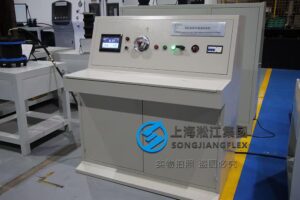
Depending on the purchase order and agreed inspection requirements, relevant inspection activities may include dimensional verification, visual examination, flange inspection, pressure testing, and PTFE lining inspection.
For customized PTFE-lined rubber expansion joints, particular attention may be given to:
-
PTFE lining continuity and visible surface condition.
-
Flange sealing-face geometry.
-
Rubber body appearance and reinforcement integrity.
-
Overall installation length and flange dimensions.
-
Bolt-hole alignment.
-
Pressure-test performance according to the approved procedure.
-
Product identification and traceability.
Where required by the customer, applicable documentation may include material certificates, inspection reports, pressure-test records, dimensional drawings, and certificates of conformity.
Additional pharmaceutical-specific documentation, such as FDA-related material declarations, USP Class VI test evidence, or extractables and leachables information, must be reviewed and agreed upon before order confirmation.
These requirements are not automatically satisfied merely because a product contains PTFE.
Our objective is to help customers define the necessary technical and quality requirements before manufacturing begins.
Why Choose Shanghai Songjiang for Customized Pharmaceutical Piping Connections?
Shanghai Songjiang Vibration Absorber Co., Ltd. specializes in manufacturing vibration isolation products, rubber expansion joints, flexible pipe connectors, and customized pipeline compensation components.
With more than 30 years of manufacturing experience in vibration isolation and flexible connection technology, we support customers requiring both standard products and application-specific designs.
For pharmaceutical chemical piping projects, our customized service focuses on matching the expansion joint to the actual process conditions.
Our capabilities include evaluating different rubber materials, PTFE lining constructions, non-standard installation lengths, customized flange dimensions, and application-specific reinforcement arrangements.
We also support drawing-based manufacturing for customers who need replacement expansion joints corresponding to existing equipment dimensions.
For pharmaceutical equipment manufacturers, engineering contractors, process piping suppliers, and maintenance teams, this approach can help simplify the procurement of specialized chemical-resistant flexible connectors.
Whether the application involves an API synthesis reactor, chemical transfer pump, solvent recovery system, filtration skid, or pharmaceutical chemical dosing pipeline, our team can review the customer’s drawings and operating requirements to determine a suitable solution.
FAQ: PTFE-Lined Rubber Expansion Joints for Pharmaceutical Plants
1. Why is a PTFE-lined rubber expansion joint preferred over an ordinary rubber expansion joint in pharmaceutical chemical pipelines?
The main difference is the material directly exposed to the process medium.
A conventional rubber expansion joint typically uses an elastomeric inner surface, such as EPDM, NBR, or another rubber compound.
These materials have different chemical compatibility characteristics. A rubber material that performs well in water or a mild chemical solution may not be suitable for certain organic solvents, concentrated acids, or pharmaceutical intermediates.
A PTFE-lined rubber expansion joint incorporates a chemically resistant PTFE layer on the internal surface.
This reduces direct contact between the process fluid and the rubber body.
For pharmaceutical chemical processing, this can be advantageous when the pipeline transports several compatible chemical substances or when the process conditions require a more chemically resistant wetted surface.
Nevertheless, PTFE lining does not automatically make the expansion joint suitable for every pharmaceutical application.
The complete joint must still be evaluated for chemical compatibility, pressure, temperature, movement, cleanliness, and any applicable regulatory requirements.
2. Can PTFE-lined rubber expansion joints be used in API manufacturing equipment?
Yes, they may be used in selected API manufacturing applications, particularly in chemical transfer and auxiliary process piping where the operating conditions are compatible with the expansion joint design.
Typical examples include pipelines connected to chemical synthesis reactors, solvent transfer pumps, intermediate storage tanks, chemical dosing systems, and solvent recovery equipment.
API manufacturing often involves chemical reactions, solvent extraction, filtration, crystallization, and purification.
During these stages, the pipeline system may transport aggressive chemical media while experiencing pump vibration or thermal movement.
A customized PTFE-lined rubber expansion joint can provide chemical resistance and mechanical flexibility at appropriate connection points.
However, the installation location must be carefully classified.
For direct API product-contact service, the customer may require evidence of material suitability, cleanability, extractables and leachables performance, and compliance with applicable pharmaceutical quality requirements.
If the proposed joint cannot satisfy these requirements, a validated sanitary PTFE-lined hose assembly or another specialized connection should be considered instead.
3. Can PTFE-lined rubber expansion joints withstand pharmaceutical cleaning chemicals and CIP processes?
PTFE has excellent resistance to many chemicals commonly associated with industrial cleaning, including various acids, alkaline solutions, and selected cleaning agents.
For this reason, PTFE-lined rubber expansion joints may be considered for certain pharmaceutical CIP chemical preparation and transfer systems.
However, CIP suitability must be determined from the actual cleaning procedure.
The customer should provide the cleaning chemical composition, concentration, operating temperature, circulation pressure, cleaning duration, and frequency of cleaning cycles.
These parameters are important because the PTFE liner, rubber body, and reinforcement structure may respond differently to repeated chemical and thermal exposure.
For example, a joint operating continuously at moderate temperature may have a different service life from one exposed to frequent hot cleaning cycles.
The cleaning process must also be evaluated for drainability and potential product-retention areas.
A PTFE-lined rubber expansion joint should not be described as automatically suitable for pharmaceutical CIP or SIP systems without reviewing the complete assembly and cleaning validation requirements.
4. What is the difference between a PTFE-lined rubber expansion joint and a PTFE bellows expansion joint?
Both products use PTFE to provide chemical resistance, but their structural designs and mechanical characteristics are different.
A PTFE-lined rubber expansion joint generally consists of an internal PTFE lining supported by a reinforced rubber body.
The rubber structure provides flexibility and can help reduce vibration transmission while accommodating specified pipeline movement.
A PTFE bellows expansion joint uses a formed PTFE flexible element, rather than relying on a conventional reinforced rubber body for its principal movement structure.
PTFE bellows may be considered for applications requiring a different movement configuration, chemical resistance, or specialized process conditions.
However, neither design is universally superior.
The selection depends on operating pressure, vacuum conditions, temperature, required movement, fatigue considerations, installation space, and process cleanliness.
For pharmaceutical projects, the choice must also consider whether the flexible connector is suitable for the intended product-contact classification.
5. Can Shanghai Songjiang manufacture PTFE-lined rubber expansion joints according to customer drawings?
Yes. We support customized expansion joint manufacturing based on customer-provided drawings and confirmed technical specifications.
Many pharmaceutical plants use imported processing equipment with non-standard pipeline dimensions.
For these projects, customers may require a replacement flexible connector that matches the existing installation length, flange dimensions, and bolt-hole arrangement.
Our engineering team can review the original drawing or dimensional information and evaluate a corresponding customized design.
Customization may include the nominal diameter, face-to-face length, PTFE lining construction, rubber material, flange standard, flange material, reinforcement structure, and control rod arrangement.
Before production, the customer and manufacturer should confirm the final technical drawing and all relevant operating parameters.
For chemically aggressive applications, we also review the process medium, concentration, temperature, pressure, and vacuum conditions before confirming the material selection.
6. How can a PTFE-lined rubber expansion joint help reduce vibration in pharmaceutical pump piping?
Pharmaceutical chemical transfer pumps generate mechanical vibration during operation.
When a pump is connected directly to rigid piping, some vibration may be transmitted into the surrounding pipeline system.
A correctly selected flexible expansion joint can help reduce the transmission of certain mechanical vibrations and accommodate limited relative movement.
This may be useful around chemical centrifugal pumps, magnetic-drive pumps, solvent transfer pumps, and circulation pump systems.
However, the actual vibration isolation performance depends on the expansion joint stiffness, pipeline arrangement, operating pressure, excitation frequency, and supporting structure.
An expansion joint alone cannot guarantee a specific vibration reduction percentage.
For demanding applications, the pump foundation, vibration isolators, pipe supports, anchors, and flexible connectors should be considered as part of the complete vibration control system.
7. Are PTFE-lined rubber expansion joints suitable for vacuum conditions in pharmaceutical solvent recovery systems?
Some specially designed PTFE-lined rubber expansion joints can operate under negative pressure or vacuum conditions, but this capability must be verified for the specific product.
Vacuum service can create external pressure loads that tend to deform or collapse the flexible structure.
The PTFE lining and rubber body must therefore be designed to withstand the specified differential pressure.
Depending on the construction, vacuum reinforcement or other design modifications may be necessary.
Pharmaceutical solvent recovery systems may operate under vacuum to reduce boiling temperatures or improve solvent separation.
For these applications, the customer should provide the minimum absolute operating pressure, maximum temperature, chemical medium, and expected operating cycles.
Our engineering team can then evaluate whether a reinforced PTFE-lined rubber expansion joint is appropriate or whether a different flexible connection would provide a more reliable solution.
8. What should pharmaceutical customers confirm before ordering customized PTFE-lined rubber expansion joints?
The most important step is to provide accurate operating information.
The customer should confirm the exact chemical medium, concentration, temperature, pressure, vacuum conditions, installation dimensions, flange standard, and required movement.
It is also important to identify the equipment connected to the pipeline.
For example, an expansion joint installed on a chemical transfer pump may have different mechanical requirements from one connected to a glass-lined reactor or solvent recovery vessel.
Customers should also specify whether the application is direct product-contact, chemical auxiliary service, or non-critical utility piping.
Any requirements for material certification, pharmaceutical regulatory documentation, inspection, testing, cleaning validation, or traceability should be communicated before manufacturing.
With complete technical information, our engineering team can evaluate the appropriate PTFE lining, rubber construction, flange configuration, and reinforcement design, helping reduce the risk of incorrect material selection and installation problems.
Looking for a Customized PTFE-Lined Rubber Expansion Joint Manufacturer?
Pharmaceutical chemical piping requires more than a standard flexible connection.
The correct expansion joint must combine chemical compatibility, reliable sealing, appropriate mechanical flexibility, and compatibility with the customer’s processing equipment.
Shanghai Songjiang Vibration Absorber Co., Ltd. provides customized PTFE-lined rubber expansion joints for selected pharmaceutical chemical processing applications, including API synthesis equipment, chemical transfer systems, reactor circulation pipelines, filtration equipment, solvent recovery systems, and auxiliary chemical handling facilities.
We welcome inquiries from pharmaceutical equipment manufacturers, engineering contractors, process piping suppliers, and industrial maintenance companies.
Please send us your technical drawings, required dimensions, chemical medium, operating temperature, pressure, and quantity.
Our team will review the application and provide a suitable technical proposal and quotation based on your specific requirements.
Contact Us
Shanghai Songjiang Vibration Absorber Co., Ltd.
Our company’s new website is now live, featuring the latest product introductions. For more details, please visit https://shsjflex.com/
Email: [email protected]
We specialize in customized rubber expansion joints, PTFE-lined flexible connectors, chemical-resistant pipe joints, vibration isolators, and industrial piping solutions.