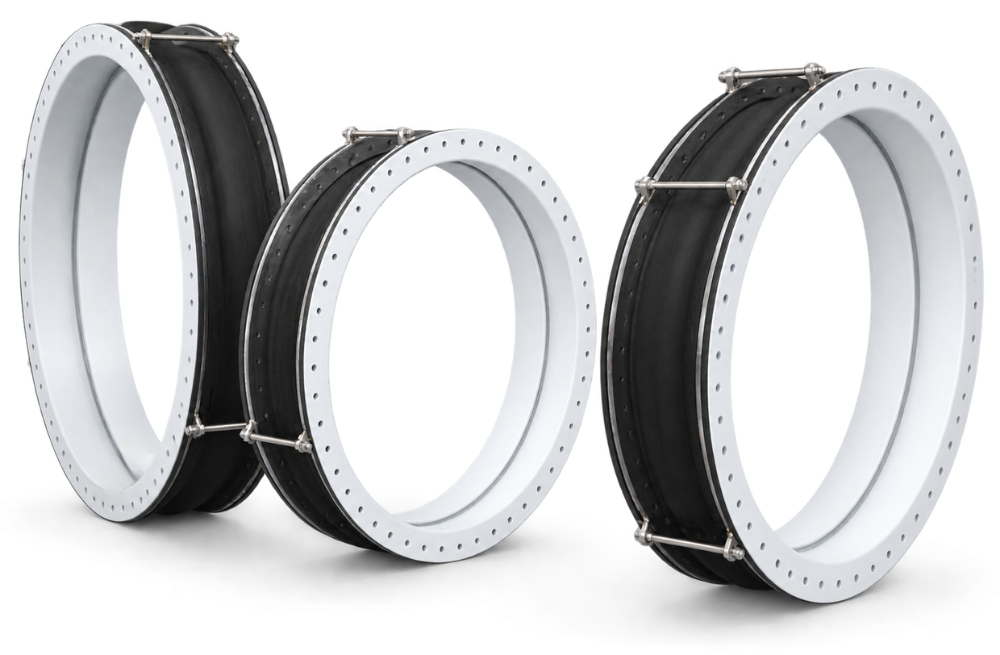
Why Do Crude Oil Pipeline Projects Require Customized Expansion Joints?
Crude oil transportation systems rely on carefully engineered piping components to maintain reliable fluid transfer under changing operating conditions. In large-scale oil pipeline projects, engineers must consider pipeline dimensions, operating pressure, temperature fluctuations, fluid composition, mechanical vibration, and installation constraints when selecting a suitable expansion joint.
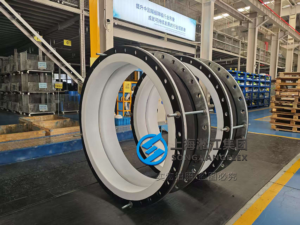
A PTFE-Lined Hand-Wrapped Rubber Expansion Joint may be considered for selected pipeline connections where its flexible construction, internal lining, and customized dimensions meet the application requirements. However, suitability for crude oil service must be established through an assessment of the actual oil composition, operating conditions, and the compatibility of every component in contact with the medium.
Understanding the Requirements of Russian Oil Pipeline Projects
Pipeline projects in Russia and other regions with demanding climatic conditions may require equipment that accommodates installation tolerances, temperature variations, and challenging operating environments. Depending on the project location and pipeline design, engineers may also need to consider low ambient temperatures, seasonal changes, and the temperature of the transported oil.
For a customized expansion joint, the initial engineering review should establish several critical parameters:
- Nominal pipe diameter and required face-to-face length.
- Operating pressure, design pressure, and possible pressure surges.
- Minimum and maximum operating temperatures.
- Crude oil composition, including water content, sulfur compounds, and other relevant constituents.
- Required axial, lateral, and angular movements.
- Flange standards, drilling patterns, and connection materials.
- Environmental exposure, installation conditions, and maintenance requirements.
These details help determine whether a PTFE-lined hand-wrapped rubber construction is appropriate or whether another type of expansion joint would be more suitable.
Why Consider a PTFE-Lined Hand-Wrapped Construction?
The WCR-PTFE type combines a PTFE inner lining with a hand-wrapped rubber body and flanged connections. This construction can be considered for selected customized piping applications requiring a flexible connection and a chemically resistant internal surface.
PTFE is widely used in industrial chemical-handling systems because of its broad chemical resistance. PTFE-lined rubber expansion joints are also used in selected petrochemical applications to accommodate piping movement and help isolate mechanical vibration. Their suitability depends on the complete design and operating conditions, rather than the liner material alone. <Cite refs={[“turn564529search0″,”turn564529search8”]}/>
For crude oil service, engineers should not assume that PTFE is necessary or that the liner alone guarantees compatibility. Crude oil composition varies considerably between sources. The rubber compound, reinforcement, flange sealing surfaces, and other wetted components must all be evaluated against the actual medium.
Customized Dimensions for Large-Diameter Pipeline Connections
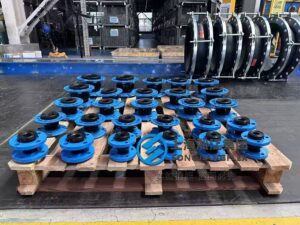
Large-diameter pipelines frequently require connection components that match existing equipment layouts and project-specific flange dimensions. Standard catalog products may not meet the required installation length, connection arrangement, or movement requirements.
Hand-wrapped manufacturing can support selected non-standard dimensions, subject to manufacturing feasibility. During customization, engineers should verify the joint’s overall length, flange outside diameter, bolt-hole arrangement, rubber body construction, and reinforcement configuration.
Where a pipeline includes pumps, transfer stations, filtration equipment, or other machinery, the expansion joint’s position should also be reviewed in relation to pipe supports, anchors, and guides.
A flexible joint must not be used to support the weight of a pipeline or compensate for excessive misalignment. Pressure thrust and other mechanical loads must be addressed through appropriate piping-system design.
2. How Can a Customized Expansion Joint Support Oil Transportation Systems?
A properly selected flexible connector can help accommodate specified movement and reduce the transmission of vibration through compatible pipeline connections. Its application should be evaluated according to the function of the equipment and the conditions at the installation point.
Crude Oil Transfer Pump Stations
Crude oil transfer stations may contain horizontal centrifugal pumps, multistage centrifugal pumps, electric motors, strainers, filtration equipment, and associated pipeline assemblies.
At selected pump connections, a flexible expansion joint can help reduce vibration transmission and accommodate limited piping movement. The design must account for pump operating conditions, pressure fluctuations, pipe alignment, and the loads imposed on connected equipment.
The joint should not be expected to correct pump misalignment or replace appropriate pipe supports and anchors.
Pipeline Manifolds and Processing Facilities
Pipeline manifolds, oil storage terminals, separation facilities, and refinery inlet systems contain interconnected pipes, valves, and equipment. Temperature changes and operational switching may produce movement or transient loading in certain sections of the system.
A customized expansion joint may be considered where the piping analysis identifies a need for flexibility. Engineers should confirm that the joint can withstand the specified pressure, temperature, movement, and fluid exposure.
For applications involving abrasive contaminants, sour service, or unusual chemical constituents, additional material and construction reviews may be necessary.
Installation in Cold-Climate Environments
For Russian projects exposed to low ambient temperatures, the minimum design temperature should be clearly specified. Engineers must distinguish between the ambient temperature, the transported fluid temperature, and the minimum temperature the product may experience during shutdown or storage.
The selected rubber compound, reinforcement, flange materials, and sealing arrangement must remain suitable for the anticipated conditions. Low-temperature performance should be verified rather than inferred from the product category.
Engineering Review Before Production
Before manufacturing a customized WCR-PTFE expansion joint, the project team should review the technical drawing, process conditions, connection dimensions, and applicable inspection requirements.
A complete specification helps prevent errors involving flange compatibility, installation length, movement capacity, and material selection. It also allows the manufacturer to confirm whether the requested construction is feasible for the intended service.
Frequently Asked Questions
1. Can a PTFE-Lined Rubber Expansion Joint Be Used in a Crude Oil Pipeline?
Potentially, but the application must be assessed individually. Crude oil varies in composition and may contain water, dissolved gases, sulfur compounds, and other constituents that affect material selection. Engineers should verify compatibility with the PTFE liner, rubber body, reinforcement, and flange sealing surfaces. Operating pressure, temperature, movement, and transient conditions must also be reviewed. A PTFE lining should not automatically be considered necessary or sufficient for every crude oil pipeline.
2. What Information Is Required for a Custom Oil Pipeline Expansion Joint?
The manufacturer generally needs the nominal diameter, face-to-face length, flange standard, operating and design pressure, temperature range, and crude oil composition. Required axial, lateral, and angular movements should also be specified. For projects in cold climates, the minimum design and storage temperatures may be important. A dimensioned drawing, piping layout, installation location, and applicable project specifications help engineers evaluate the proposed design before confirming feasibility and quotation.
3. Can Hand-Wrapped Rubber Expansion Joints Be Manufactured in Large Diameters?
Hand-wrapped construction can accommodate selected large-diameter and non-standard configurations, depending on the manufacturer’s capabilities and the requested design. Customization may involve the overall length, flange dimensions, reinforcement arrangement, and rubber compound. However, increasing the diameter can affect pressure resistance, movement capacity, and manufacturing complexity. The manufacturer should review the complete specification and confirm the achievable dimensions, applicable pressure rating, and testing requirements before production.
4. Does the PTFE Lining Protect Against All Crude Oil Components?
No material should be assumed universally suitable for every crude oil composition and operating condition. PTFE offers broad chemical resistance, but compatibility of the complete assembly must still be established. The rubber backing, reinforcement, flange materials, and sealing surfaces may have different limitations. Engineers should identify relevant constituents, operating temperatures, and any cleaning chemicals used during maintenance. Where the oil contains unusual contaminants or aggressive components, additional material compatibility review may be necessary.
5. Can an Expansion Joint Reduce Vibration from Oil Transfer Pumps?
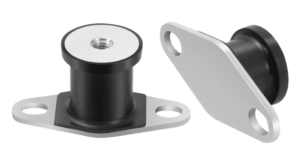
A suitably selected rubber expansion joint can help reduce the transmission of mechanical vibration through connected piping. Its effectiveness depends on the vibration characteristics, joint stiffness, installation arrangement, and pipe support configuration. It cannot replace proper pump alignment, foundation design, or vibration isolation mounts. Engineers should also evaluate pressure thrust and piping loads to ensure that the joint is not exposed to forces beyond its design limits.
6. What Flange Details Should Be Confirmed Before Ordering?
Important details include the flange standard, nominal pressure class, outside diameter, bolt-hole quantity and diameter, bolt-circle diameter, facing type, and material. The mating flange dimensions must be compatible with the expansion joint’s end connections. Face-to-face length and available installation space should also be confirmed. Providing an approved drawing is preferable to relying solely on nominal pipe diameter because flange configurations can differ between standards and project specifications.
7. How Can Engineers Confirm the Joint Is Suitable for Low-Temperature Service?
Engineers should identify the minimum ambient, operating, shutdown, and storage temperatures that the joint may experience. These values should be distinguished because the product may encounter different conditions during operation and maintenance. The rubber compound, reinforcement, flange materials, and sealing surfaces must be reviewed for the specified temperature range. Any required low-temperature testing or documentation should be agreed upon before manufacturing, and suitability should be confirmed for the complete assembly.
Request a Customized Pipeline Expansion Joint
Customized WCR-PTFE hand-wrapped rubber expansion joints may be considered for selected oil transportation and petrochemical piping applications when the material construction and operating conditions are compatible.
For a technical evaluation and quotation, please provide your pipeline diameter, face-to-face length, crude oil specifications, pressure and temperature requirements, movement data, flange drawings, and required quantity.
Email: [email protected]
Our company’s new website is now live, featuring the latest product introductions. For more details, please visit https://shsjflex.com/