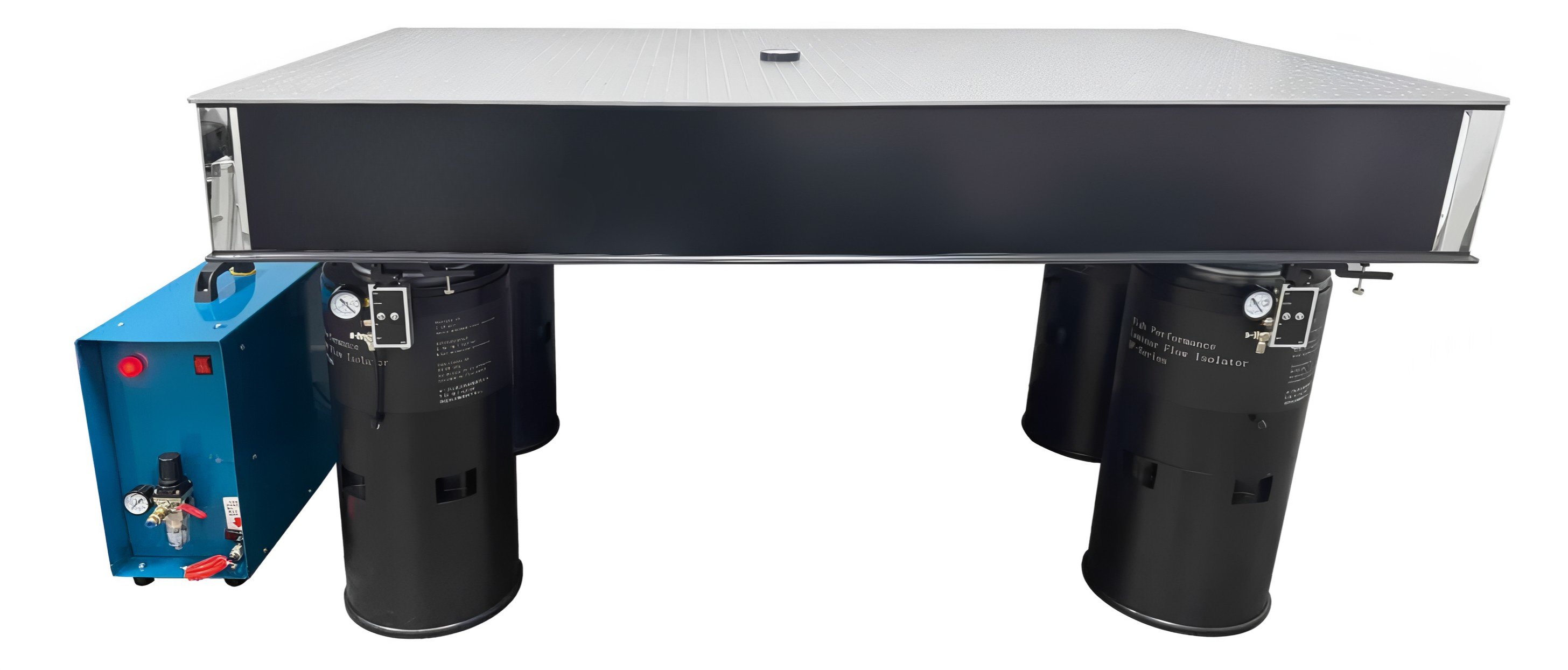
In modern precision engineering and scientific research, even microscopic vibrations can significantly affect measurement accuracy and experimental results. This is especially critical in fields such as semiconductor inspection, laser interferometry, and nano-scale imaging systems.
The high-precision air floating vibration isolation optical table with honeycomb bonded structure is designed to solve these challenges by providing ultra-low frequency vibration isolation and extremely stable support conditions.
Applications in High-End Precision Equipment
This type of optical platform is widely used in advanced industrial and scientific systems, including:
- Semiconductor wafer defect inspection systems
- Electron beam lithography alignment platforms
- Femtosecond laser micro-processing systems
- Atomic Force Microscopes (AFM)
- Scanning Electron Microscopes (SEM)
- Optical interferometry measurement systems
- Aero-engine blade precision inspection equipment
- High-end coordinate measuring machines (CMM)
- Non-destructive testing (NDT) ultrasonic imaging platforms
These systems require extremely stable vibration isolation to maintain measurement accuracy at micro- and nano-scale levels.
Why Air Floating Vibration Isolation Is Essential?
Compared with traditional rubber mounts or mechanical spring isolators, air floating systems provide significantly better performance in low-frequency vibration control.
The triple-line pendulum air spring system combined with a hybrid chamber design allows the platform to maintain stability even under varying loads. This results in:
- Lower natural frequency (1.0–1.5 Hz)
- Better horizontal vibration isolation
- Faster automatic leveling response
- Improved long-term stability
This makes it suitable for precision optical systems, nano-metrology equipment, and semiconductor manufacturing tools.
Honeycomb Bonded Structure Advantage
The tabletop is built using a honeycomb composite structure instead of traditional welded steel construction.
This design provides several engineering advantages:
- No welding stress deformation
- High rigidity with low weight
- Uniform stress distribution
- Long-term structural stability
- Improved damping characteristics
The internal honeycomb core is typically made from aluminum, stainless steel, or galvanized materials with a density of around 250 kg/m³, ensuring both strength and stability.
Precision and Technical Performance
- Natural frequency: 1.0–1.5 Hz (vertical & horizontal)
- Repositioning accuracy: ±0.05 mm
- Surface roughness: 0.8–1.6 μm
- Anti-vibration grade: VC-D class
- Grid spacing: 25 mm × 25 mm (M6 threaded holes)
- Noise level: 50 dB silent air pump system
FAQ – Technical Understanding of Air Floating Optical Tables
Q1: Why is low natural frequency so important in vibration isolation systems?
Low natural frequency allows the system to avoid resonance with most environmental vibrations. In industrial environments, vibration frequencies are usually above 5 Hz, so reducing the system’s natural frequency to around 1 Hz ensures effective isolation.
This is particularly important for laser interferometers, electron microscopes, and nano-positioning systems where even tiny vibrations can distort results.
Q2: What makes honeycomb structures better than solid steel tables?
Solid steel plates are heavy and rigid, but they often suffer from internal stress accumulation and deformation over time.
Honeycomb structures distribute force evenly across multiple internal cells, reducing localized stress while maintaining high stiffness. This results in better long-term stability and improved vibration damping performance.
Q3: How does the triple-line pendulum air spring system work?
The system uses compressed air as an elastic medium, forming a flexible support layer. The triple-line pendulum structure enhances horizontal vibration isolation, while the hybrid chamber design adjusts pressure dynamically based on load changes.
This ensures stable performance even when equipment weight varies.
Q4: What types of equipment benefit most from this platform?
This system is commonly used in:
- Optical interferometers
- Nano-scale measurement systems
- Semiconductor bonding and inspection machines
- Precision laser cutting systems
- Micro-electronic packaging equipment
- Cell imaging and biological microscopy systems
These applications require extreme environmental stability.
Contact Information
For technical consultation, customization, or engineering support:
Email: [email protected]
Website: www.shsjflex.com
We support OEM/ODM customization and global project cooperation.