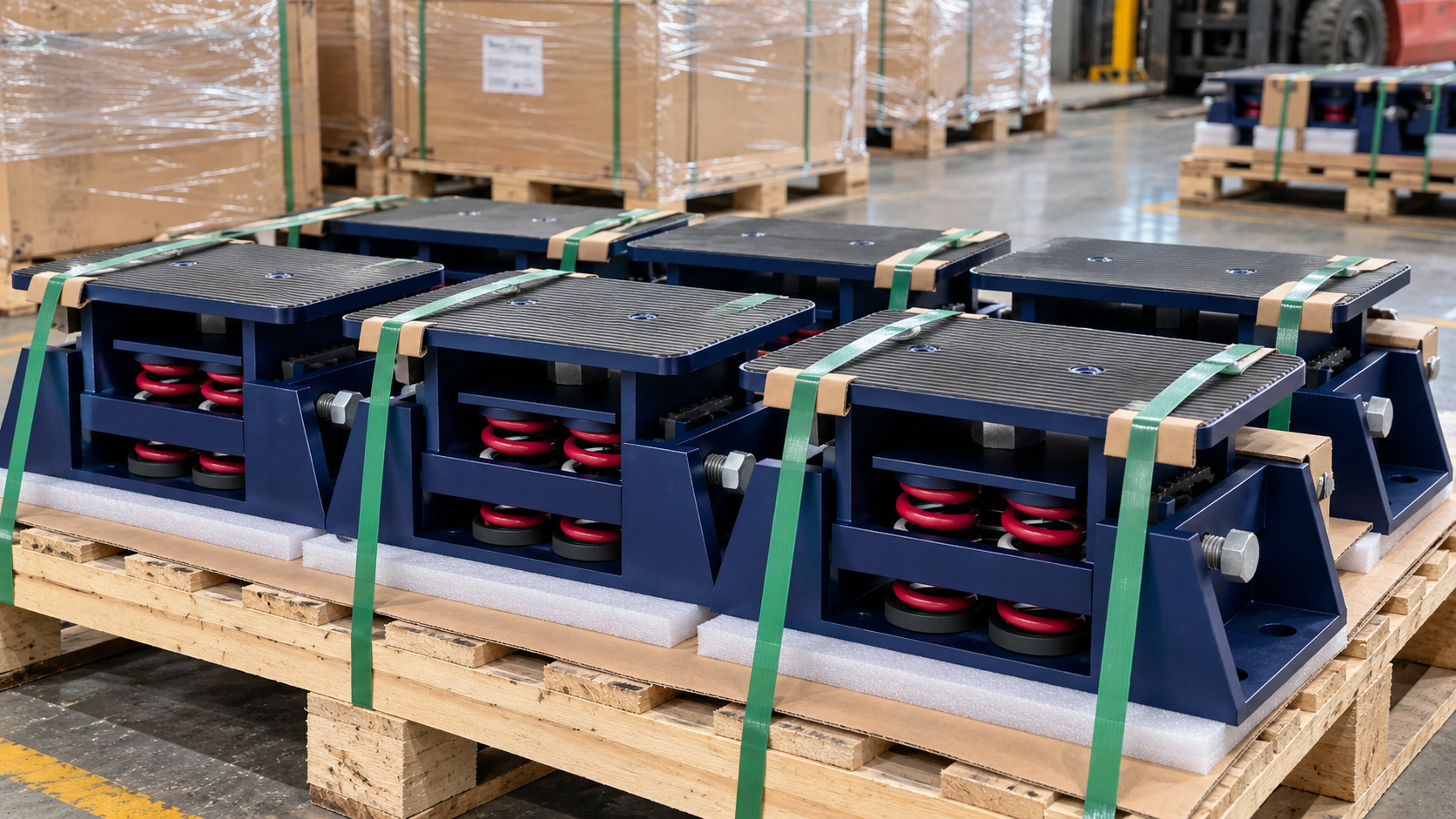
DZT Seismic Spring Isolators Customized for a Japanese Customer
A batch of DZT Seismic Damped Spring Vibration Isolators is being prepared for shipment to a customer in Japan, highlighting the importance of earthquake-resistant vibration isolation solutions for industrial equipment.
Japan is one of the world’s most seismically active countries, making equipment stability and seismic restraint important considerations for industrial facilities, commercial buildings, and mechanical equipment installations.
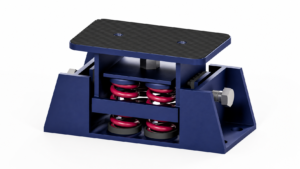
For this order, the DZT seismic spring isolator was selected as a solution combining heavy-duty vibration isolation with a reinforced side-plate protection structure.
Unlike conventional open-type spring mounts, the DZT series features anti-overturning side plates designed to restrict excessive horizontal movement and help reduce the risk of equipment overturning during earthquakes.
Custom Manufacturing and Seismic Protection Design
The DZT isolator incorporates a heavy-duty steel housing, internal load-bearing springs, adjustable lateral rubber damping blocks, and anti-slip rubber pads.
Its reinforced side plates are particularly valuable for installations in earthquake-prone regions because they provide additional mechanical restraint during seismic disturbances.
The upper mounting plate includes equipment connection holes, while the lower base incorporates foundation anchoring holes.
Adjustable leveling nuts allow installation height correction when equipment weight distribution causes inconsistent static deflection.
The DZT series is available in 11 specifications, with individual load capacities ranging from 720 kg to 12,600 kg, natural frequencies below 5.1 Hz, and damping ratios of 0.04–0.10.
These characteristics make the product suitable for engineering evaluation in applications requiring both vibration isolation and seismic restraint.
Factory Inspection and Shipment Preparation
Before shipment, DZT seismic vibration isolators should undergo appropriate dimensional and visual inspections according to the approved product specifications.
Important inspection items include mounting dimensions, steel housing condition, spring installation, lateral damping components, leveling mechanisms, and mounting hole arrangements.
For international transportation, suitable protective packaging helps prevent surface damage and movement during handling.
Wooden pallets or export wooden cases can be selected according to product weight, order quantity, and transportation requirements.
2. Why Are DZT Seismic Isolators Suitable for Japanese Industrial Projects?
Japan’s industrial infrastructure includes extensive HVAC installations, manufacturing facilities, power generation equipment, and critical mechanical systems.
These applications often require effective vibration reduction during normal operation while maintaining equipment stability under seismic loading.
Rooftop Cooling Towers and HVAC Chillers
Typical applications include counterflow cooling towers, crossflow cooling towers, centrifugal water-cooled chillers, screw compressor chillers, and large rooftop air-conditioning units.
The DZT series helps reduce operating vibration transmitted to supporting structures, while its reinforced side plates provide additional lateral restraint.
Emergency Generator Sets and Industrial Machinery
Diesel generator sets, gas engine generators, industrial compressors, and motor-driven equipment can also benefit from properly selected seismic vibration isolation systems.
For installations in earthquake-prone areas, engineers should evaluate equipment weight, center of gravity, operating speed, mounting arrangement, and foundation anchoring requirements.
Frequently Asked Questions (FAQ)
1. Why Do Japanese Customers Purchase DZT Seismic Spring Vibration Isolators?
Japanese industrial projects often require careful consideration of seismic restraint because earthquakes can generate significant horizontal forces on mechanical equipment.
The DZT series combines spring vibration isolation with reinforced side-plate protection. This design helps control normal operating vibration while providing additional restraint against excessive lateral displacement.
For rooftop HVAC equipment, generators, and industrial machinery, this combination can be beneficial. Final suitability must be confirmed against the project’s applicable seismic design and anchoring requirements.
2. What Is the Load Capacity of DZT Seismic Spring Isolators?
The DZT series consists of 11 models with rated load capacities ranging from 720 kg to 12,600 kg per isolator.
The correct model should be selected based on the actual operating load at each mounting position.
Engineers should consider equipment weight distribution, center of gravity, operating speed, and static deflection requirements. Different support positions may require different isolator capacities when the equipment weight is unevenly distributed.
3. How Does the Anti-Overturning Side-Plate Structure Work?
The reinforced side plates provide mechanical restraint that helps limit excessive lateral displacement of the supported equipment.
During normal operation, the internal springs reduce vibration transmission. During seismic disturbances, the protective structure helps restrict large movements that could otherwise contribute to equipment instability.
However, seismic resistance depends on the complete installation, including anchor bolts, foundation strength, equipment geometry, and design earthquake forces. Project-specific engineering verification is required.
4. Can DZT Seismic Isolators Be Customized for Japanese Equipment?
Customization can be evaluated according to equipment drawings, mounting dimensions, load distribution, installation height, and special engineering requirements.
Customers may provide detailed drawings showing equipment mounting positions, foundation connection arrangements, and available installation space.
The manufacturer can then review whether standard DZT models are suitable or whether modifications are necessary.
Any changes affecting structural strength, spring performance, or seismic restraint must undergo technical evaluation before manufacturing.
5. What Materials Are Used in DZT Seismic Vibration Isolators?
The DZT isolator incorporates a steel structural housing, load-bearing coil springs, lateral rubber damping blocks, and bonded rubber pads on its upper and lower mounting surfaces.
The steel components provide structural support, while the springs carry the equipment load and reduce vibration transmission.
Rubber components contribute damping, friction, and noise reduction. Specific steel grades, rubber compounds, coatings, and corrosion protection requirements should be confirmed during technical review.
6. How Are DZT Seismic Spring Isolators Prepared for International Shipment?
Before export, the products should be inspected according to approved technical drawings and order requirements.
Dimensional accuracy, mounting holes, spring installation, and the condition of the steel housing should be checked.
Protective packaging helps prevent mechanical damage during transportation. Depending on product weight and quantity, the isolators can be packed using wooden pallets or export cases.
The final packing method should also consider handling conditions and the destination country’s import requirements.
7. What Information Should Japanese Buyers Provide for a DZT Quotation?
Customers should provide equipment weight, dimensions, operating speed, mounting point locations, and required quantity.
For seismic applications, the project location, design seismic requirements, foundation details, and equipment center of gravity are also important.
Technical drawings help confirm mounting compatibility and any customization needs.
With this information, the manufacturer can evaluate the appropriate model, installation arrangement, and technical requirements before preparing a detailed quotation.
Conclusion: DZT Seismic Spring Isolators for Japan
The DZT Seismic Damped Spring Vibration Isolator provides an effective combination of heavy-duty spring isolation, adjustable damping, and reinforced side-plate protection.
Its anti-overturning structure makes it a valuable option for industrial equipment installed in Japan’s earthquake-prone regions.
For customized orders, factory quotations, or international shipment inquiries, please provide your equipment drawings, operating weight, dimensions, and technical requirements.
Email: [email protected]
Our company’s new website is now live, featuring the latest product introductions. For more details, please visit https://shsjflex.com/