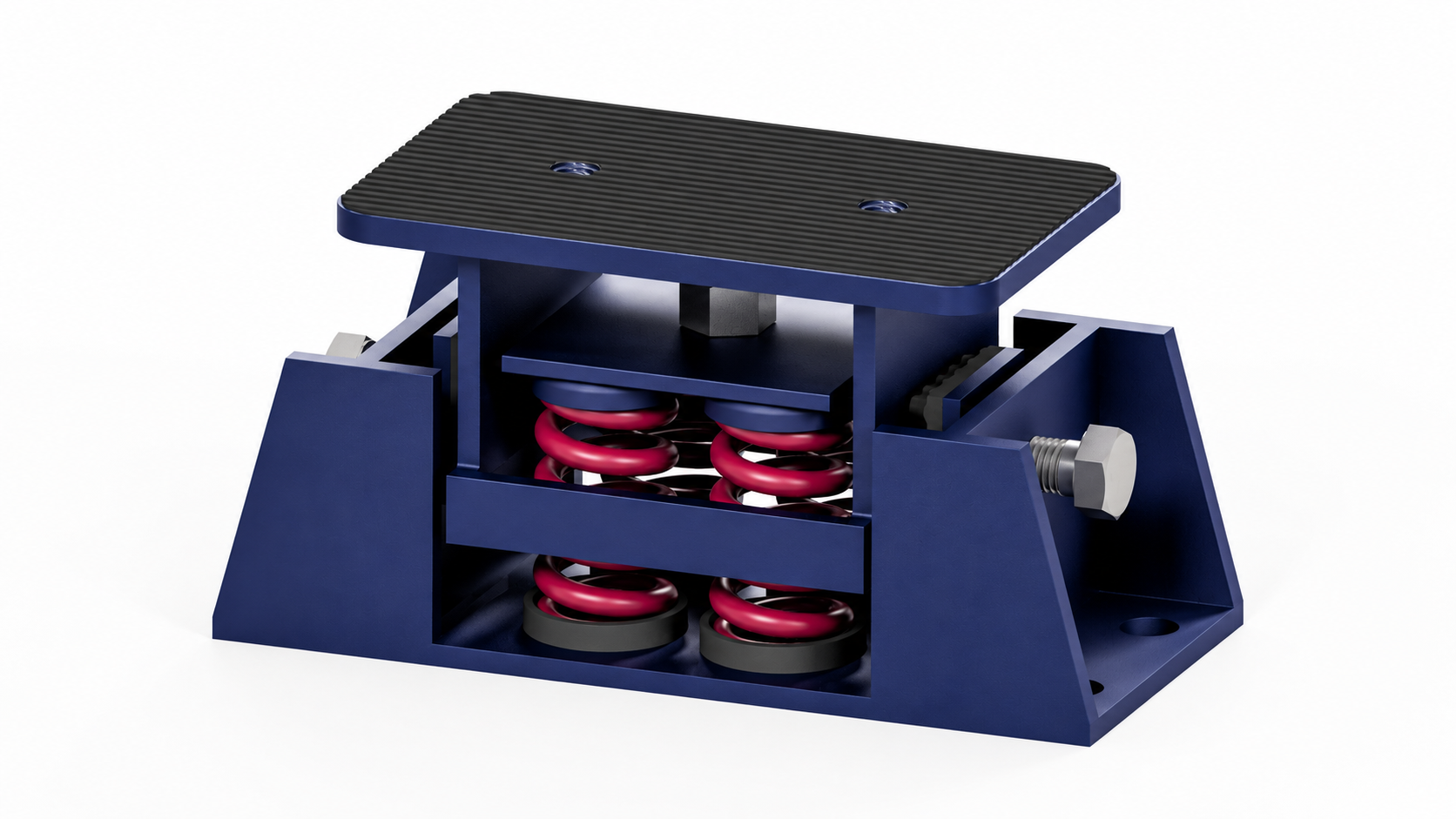
How Does the DZT Seismic Damped Spring Vibration Isolator Provide Seismic Protection?
The DZT Seismic Damped Spring Vibration Isolator is a heavy-duty vibration control device engineered for industrial equipment requiring both effective vibration isolation and enhanced seismic protection. Its most distinctive feature is the reinforced side-plate protection design, which provides lateral restraint and helps prevent equipment overturning or excessive displacement during earthquakes.
Unlike conventional spring vibration isolators that primarily control vertical vibration, the DZT series incorporates a protective steel housing with side plates, adjustable lateral rubber damping blocks, and high-strength steel springs. This combination supports equipment stability under normal operating conditions while providing additional restraint during seismic disturbances.
The upper and lower mounting surfaces are fitted with bonded sound-insulating, anti-slip rubber pads. These pads help reduce structure-borne noise, improve contact stability, and minimize vibration transmission between machinery and supporting structures.
The lateral rubber damping blocks allow adjustment of the damping resistance, helping control horizontal movement. The upper mounting plate includes bolt holes for equipment attachment, while the lower base incorporates foundation anchoring holes for secure installation.
An additional advantage is the adjustable leveling mechanism. When uneven loading or differences between the equipment’s center of gravity and the vibration isolation system’s stiffness center cause inconsistent static deflection, the leveling nuts can be adjusted to achieve a uniform installation height.
DZT Seismic Spring Isolator Technical Specifications
| Parameter | Specification |
|---|---|
| Product Name | DZT Seismic Damped Spring Vibration Isolator |
| Product Type | Heavy-Duty Seismic Spring Vibration Isolator |
| Available Models | 11 Specifications |
| Load Capacity | 720–12,600 kg per Isolator |
| Natural Frequency | Below 5.1 Hz |
| Damping Ratio | 0.04–0.10 |
| Recommended Equipment Speed | Above 700 RPM |
| Seismic Protection | Reinforced Side-Plate Restraint |
| Damping Mechanism | Adjustable Lateral Rubber Damping Blocks |
| Mounting Surfaces | Sound-Insulating Anti-Slip Rubber Pads |
| Height Adjustment | Adjustable Leveling Nuts |
| Installation | Equipment and Foundation Bolt Connections |
Key Engineering Advantage: The reinforced side-plate structure provides an additional mechanical restraint path that helps limit excessive lateral displacement and reduce the risk of equipment overturning during seismic events.
However, seismic performance depends on the complete installation, including equipment geometry, center of gravity, foundation anchoring, and design earthquake loads. Project-specific engineering verification is required.
2. Where Are DZT Seismic Damped Spring Vibration Isolators Used?
The DZT series is particularly suitable for heavy industrial machinery, HVAC equipment, and vibration-sensitive installations in earthquake-prone regions. Its combination of spring isolation, lateral damping, and seismic restraint makes it useful where both vibration reduction and equipment stability are important.
Cooling Towers and HVAC Chiller Systems
DZT seismic spring isolators can be installed beneath industrial cooling towers, centrifugal water-cooled chillers, screw compressor chillers, and large air-conditioning units.
For rooftop cooling towers, seismic restraint is especially important because elevated installations may experience significant lateral movement during earthquakes. The reinforced side plates help control excessive movement while the spring elements reduce normal operating vibration transmitted into the building structure.
Generator Sets and Industrial Power Equipment
Diesel generator sets, gas generator packages, engine-driven alternators, and industrial power generation equipment can produce substantial dynamic forces during operation.
Heavy-duty seismic spring mounts help reduce vibration transmission to concrete foundations and adjacent structures. Their lateral restraint design also provides additional protection for equipment installed in regions subject to seismic activity.
Industrial Test Benches and Laboratory Equipment
The DZT series can be considered for motor test benches, dynamometer platforms, mechanical endurance testing machines, and vibration-sensitive laboratory installations.
Its adjustable leveling mechanism helps compensate for uneven equipment loading, while the damping components assist in controlling unwanted movement.
Pumps, Compressors, and Mechanical Equipment
Other potential applications include centrifugal pump skids, large ventilation fan assemblies, industrial compressor packages, and mechanical equipment platforms.
For these applications, isolator selection should consider operating speed, dynamic forces, equipment weight distribution, piping connections, and foundation requirements.
Frequently Asked Questions (FAQ)
1. How Do I Select the Correct DZT Seismic Spring Vibration Isolator?
Selection begins with determining the total operating weight of the equipment, including motors, fluids, supporting frames, and accessories. The load at each mounting position should then be calculated based on the equipment’s center of gravity and support arrangement.
The DZT series provides 11 load specifications ranging from 720 kg to 12,600 kg per isolator. Engineers should also evaluate operating speed, required static deflection, installation height, seismic design loads, and foundation conditions before selecting a suitable model.
2. What Materials Are Used in DZT Seismic Damped Spring Isolators?
The DZT isolator incorporates a steel structural housing, load-bearing coil springs, rubber damping blocks, and bonded rubber pads on the upper and lower mounting surfaces.
The steel components provide structural support and lateral restraint, while the springs carry the equipment load and provide vibration isolation. Rubber components contribute damping, friction, and noise reduction.
Specific steel grades, spring materials, rubber compounds, surface coatings, and corrosion protection options should be confirmed against the selected model’s technical documentation and environmental requirements.
3. What Is the Maximum Load Capacity of a DZT Seismic Spring Isolator?
The DZT series consists of 11 models with individual rated load capacities ranging from 720 kg to 12,600 kg.
The correct model must be selected according to the actual load supported at each mounting point rather than simply dividing the total equipment weight by the number of isolators.
Uneven load distribution can result from an offset center of gravity or asymmetric equipment construction. The selected isolators must operate within their specified load ranges while providing suitable static deflection and adequate seismic restraint.
4. How Should DZT Seismic Vibration Isolators Be Installed?
DZT isolators should be positioned beneath designated equipment support points on a structurally suitable foundation. The lower mounting holes are used for foundation anchoring, while the upper mounting holes connect the isolators to the equipment frame.
After positioning, the leveling nuts can be adjusted to achieve the required installation height and balanced support conditions.
Engineers should verify anchor bolt specifications, foundation strength, equipment alignment, and clearance around the seismic restraint components. Installation should follow approved drawings and applicable seismic design requirements.
5. Can DZT Seismic Spring Isolators Reduce Both Vertical and Horizontal Vibration?
Yes. The coil springs primarily provide vertical vibration isolation, while the lateral rubber damping blocks contribute resistance to horizontal movement.
The DZT series has a stated natural frequency below 5.1 Hz and a damping ratio of 0.04–0.10. Actual isolation performance depends on operating frequency, supported load, spring stiffness, and installation conditions.
The seismic side plates provide additional restraint against excessive movement. They should not be interpreted as active seismic control devices or as a guarantee of protection under every earthquake condition.
6. Are DZT Seismic Isolators Suitable for Rooftop Cooling Towers and Chillers?
DZT isolators are suitable candidates for rooftop cooling towers, centrifugal chillers, and other heavy HVAC equipment where both vibration isolation and seismic restraint are required.
Rooftop installations demand particular attention to lateral forces, equipment center of gravity, wind loading, and structural anchoring.
The reinforced side-plate arrangement helps limit excessive displacement, while the spring system reduces normal operating vibration. Engineers should coordinate isolator selection with structural calculations, equipment manufacturer requirements, flexible pipe connections, and the project’s applicable seismic design criteria.
7. Can DZT Seismic Damped Spring Vibration Isolators Be Customized?
Customization can be evaluated according to equipment weight, mounting dimensions, load distribution, operating speed, and project-specific seismic requirements.
Potential engineering considerations include mounting hole arrangements, installation height, damping adjustment requirements, corrosion protection, and compatibility with equipment support frames.
For special applications, customers should provide equipment drawings, individual support loads, center-of-gravity information, operating conditions, and foundation details. Any requested modifications must be technically reviewed to ensure that load capacity, vibration isolation performance, and seismic restraint requirements remain compatible.
Conclusion: Reliable Vibration Isolation with Enhanced Seismic Protection
The DZT Seismic Damped Spring Vibration Isolator combines heavy-duty spring isolation, adjustable rubber damping, and reinforced side-plate protection to help improve machinery stability in seismic-prone environments.
Its anti-overturning design makes it particularly valuable for cooling towers, generator sets, industrial HVAC equipment, and other heavy machinery requiring both vibration control and seismic restraint.
For product selection or a technical quotation, please provide your equipment weight, dimensions, installation drawings, mounting arrangement, and technical requirements. Our engineering team can assist in evaluating a suitable vibration isolation solution.
Email: [email protected]
Our company’s new website is now live, featuring the latest product introductions. For more details, please visit https://shsjflex.com/