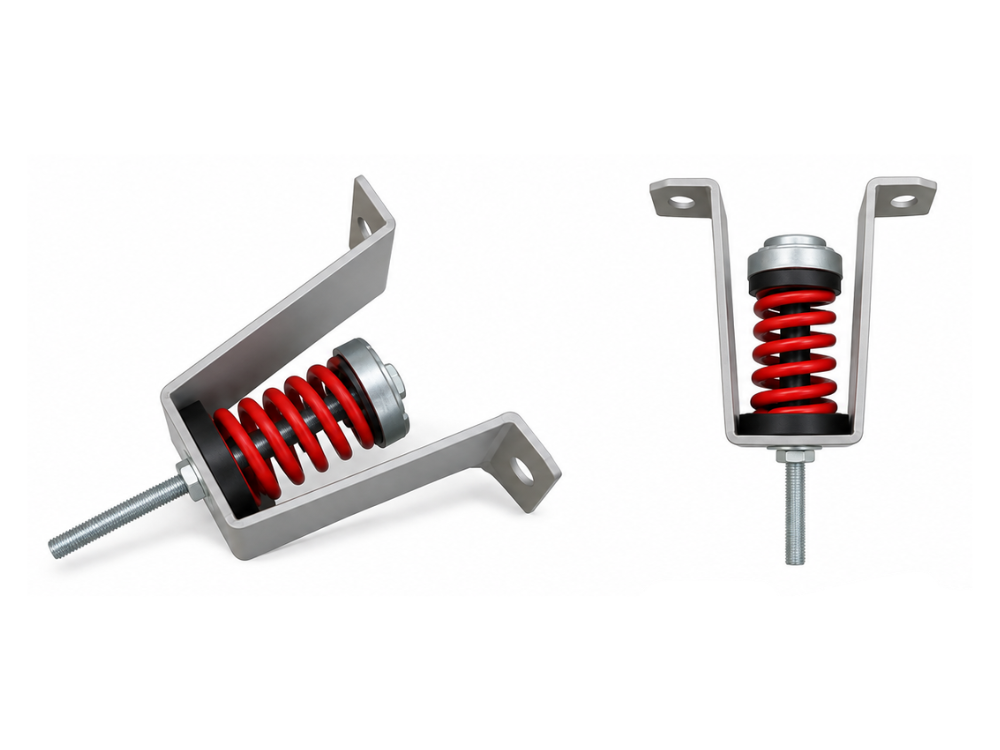
What Is a V-Type Damped Spring Hanger Vibration Isolator?
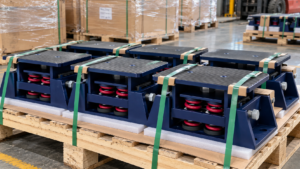
The V-Type Damped Spring Hanger Vibration Isolator is a specialized suspension-type vibration control device designed to minimize mechanical vibration transmission, reduce structure-borne noise, and improve the stability of suspended equipment.
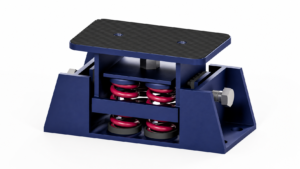
This industrial vibration isolator combines a damping spring, rubber composite isolation pads, a V-shaped metal frame, and connecting components to create a spring-rubber isolation system. The spring provides elastic support and helps isolate mechanical vibrations, while the rubber components contribute damping and reduce vibration transmission through the mounting structure.
Compared with conventional rigid suspension hangers, the V-type spring hanger provides a flexible connection between vibrating equipment and the supporting building structure. This helps prevent mechanical vibrations from spreading through ceilings, steel beams, and other structural components.
Key Structural Features and Technical Advantages
-
Damping Spring: Provides elastic support and vibration isolation for suspended mechanical loads. Proper spring selection helps control vibration transmission at operating frequencies above the isolation system’s natural frequency.
-
Rubber Composite Isolation Pads: Provide additional damping and help minimize structure-borne noise and direct metal-to-metal vibration transmission.
-
V-Shaped Metal Frame: Supports the spring assembly and provides a compact mounting structure suitable for various suspended installation arrangements.
-
Spring-Rubber Composite Design: Combines elastic isolation and damping characteristics to address mechanical vibration and structural noise.
-
Flexible Installation: Can be integrated with threaded suspension rods and suitable mounting accessories for HVAC equipment, industrial machinery, and piping systems.
-
Customizable Configuration: Spring selection, load capacity, mounting dimensions, and connection arrangements can be adapted to specific project requirements.
The performance of a spring vibration isolation hanger depends on several engineering factors, including supported load, spring stiffness, static deflection, excitation frequency, and installation conditions.
For effective vibration isolation, the isolator’s natural frequency should be sufficiently lower than the dominant operating vibration frequency. Correct loading and installation are essential to achieving the intended vibration control performance.
Where Are V-Type Spring Hanger Vibration Isolators Used?
V-Type Damped Spring Hanger Vibration Isolators are suitable for various suspended mechanical installations where vibration reduction, acoustic comfort, and structural protection are important.
HVAC Fans and Ventilation Equipment
In heating, ventilation, and air conditioning systems, spring vibration isolation hangers can reduce vibration transmission from rotating equipment into building structures.
Typical applications include:
-
Centrifugal Exhaust Fans: Backward-curved centrifugal fans, cabinet centrifugal fans, and industrial exhaust fans.
-
Axial Flow Fans: Inline axial fans, duct-mounted axial fans, and industrial ventilation fans.
-
Inline Mixed-Flow Fans: Circular duct fans used in commercial ventilation and mechanical exhaust systems.
-
Air Handling Units (AHUs): Ceiling-suspended air handling units and compact ventilation assemblies.
-
Fan Coil Units (FCUs): Ceiling-mounted fan coil units used in hotels, offices, hospitals, and commercial buildings.
-
Energy Recovery Ventilators (ERVs): Suspended ventilation equipment equipped with supply and exhaust fans.
These applications can benefit from properly selected spring hangers that limit vibration transfer through suspension rods and supporting structures.
Industrial Piping and Mechanical Equipment
Suspended piping systems may experience vibration caused by connected pumps, compressors, motors, fluid pulsation, and mechanical equipment.
V-type spring hangers can be considered for vibration isolation in:
-
Chilled water supply and return piping connected to centrifugal chillers
-
Condenser water piping connected to cooling tower circulation pumps
-
HVAC piping connected to end-suction and vertical inline centrifugal pumps
-
Industrial process piping exposed to machinery-induced vibration
-
Ventilation ductwork connected to centrifugal and axial exhaust fans
-
Suspended auxiliary machinery and small motor-driven equipment
For piping applications, engineers must also consider thermal expansion, pipe movement, support spacing, and operating loads. A vibration isolation hanger should not be treated as a substitute for a properly engineered constant-load or variable spring pipe support where significant thermal displacement must be accommodated.
Precision Equipment and Vibration-Sensitive Facilities
Selected configurations may also be used for suspended measuring instruments, laboratory equipment, and lightweight mechanical assemblies requiring vibration control.
Potential installation environments include industrial laboratories, electronic manufacturing facilities, mechanical testing areas, and building service rooms.
For highly vibration-sensitive instruments, equipment-specific vibration criteria and operating frequencies should be evaluated before selecting a spring hanger. Where necessary, additional isolation stages or specialized low-frequency isolation systems may be required.
Frequently Asked Questions (FAQ)
1. How Do I Select the Correct V-Type Damped Spring Hanger Vibration Isolator?
Selecting the appropriate isolator requires identifying the total suspended equipment weight, number of suspension points, operating speed, vibration characteristics, and installation arrangement.
The load supported by each hanger should be calculated individually, particularly when the equipment’s center of gravity is unevenly distributed. Engineers should also consider available installation height, required static deflection, and expected vibration frequencies.
For accurate product selection, customers are encouraged to provide equipment drawings, mounting positions, operating conditions, and any specific vibration isolation requirements.
2. What Materials Are Used in a V-Type Spring Vibration Isolation Hanger?
A typical V-type spring vibration isolation hanger consists of a steel spring, rubber composite isolation elements, a metal supporting frame, and connecting components.
The spring provides the primary elastic support, while the rubber elements contribute damping and help prevent direct vibration transmission through metal connections.
Material selection should consider load requirements, operating temperature, humidity, corrosion exposure, and environmental conditions. Depending on the application, suitable surface treatments and rubber compounds may be considered.
Specific material grades and protective finishes should be confirmed against the manufacturer’s technical specifications before ordering.
3. What Load Capacity Is Available for V-Type Damped Spring Hangers?
The available load capacity depends on the spring configuration, material properties, frame design, and intended operating deflection.
Each isolator should operate within its specified load range to maintain proper spring compression and avoid excessive deformation or insufficient isolation performance.
When multiple hangers support one equipment assembly, the total weight should not simply be divided equally unless the load distribution has been verified.
For customized applications, engineers should provide the equipment’s operating weight, number of suspension points, and any additional static or dynamic loads to determine a suitable configuration.
4. How Should a V-Type Damped Spring Hanger Vibration Isolator Be Installed?
Correct installation is essential for effective vibration isolation and long-term mechanical reliability.
The hanger should be connected to a structurally adequate supporting member using compatible threaded rods and mounting hardware. Suspension points must be positioned according to the equipment’s load distribution and installation drawings.
During installation, the spring assembly should remain properly aligned, and the equipment should not be allowed to contact surrounding rigid structures.
All suspension rods, fasteners, and supporting components must be checked for load suitability. Final installation should follow the approved engineering drawings and applicable safety requirements.
5. Can V-Type Spring Hangers Be Used for HVAC Fans and Pump-Connected Piping?
Yes. V-type spring hangers can be suitable for suspended HVAC fans and piping systems exposed to mechanical vibration.
For centrifugal fans, inline duct fans, and air handling units, spring hangers help reduce vibration transmission into ceiling structures and building frames.
For piping connected to centrifugal pumps, circulation pumps, or compressors, the hanger may help isolate vibration traveling through the pipe support system.
However, the complete installation should also consider flexible pipe connectors, pipe anchors, thermal movement, and equipment support arrangements to avoid unintended loads or vibration transmission paths.
6. How Does a V-Type Damped Spring Hanger Improve Vibration Isolation Performance?
A V-type spring hanger reduces vibration transmission by introducing a flexible suspension system between the vibrating equipment and the supporting structure.
The steel spring provides elastic compliance, while the rubber components contribute damping and help limit direct structural vibration paths.
Isolation effectiveness depends strongly on the relationship between the equipment’s excitation frequency and the hanger system’s natural frequency.
At frequencies sufficiently above resonance, vibration transmission can be reduced. Near resonance, however, vibration may be amplified. Therefore, spring stiffness, supported mass, damping, and operating speed must be evaluated together.
7. Can V-Type Damped Spring Hanger Vibration Isolators Be Customized?
Yes. V-type spring vibration isolation hangers can be customized according to equipment characteristics, installation restrictions, and project-specific vibration control requirements.
Possible customization options include spring selection, rated load range, frame dimensions, threaded rod connections, rubber isolation materials, and protective surface treatments.
For projects involving unusual mounting arrangements or demanding operating conditions, technical drawings and installation details should be reviewed before manufacturing.
Customers should provide equipment weight, dimensions, suspension point locations, operating speed, environmental conditions, and required vibration isolation performance to support accurate engineering evaluation and product selection.
Choose the Right V-Type Damped Spring Hanger for Your Project
The V-Type Damped Spring Hanger Vibration Isolator provides a practical spring-rubber isolation solution for suspended HVAC equipment, industrial piping, ventilation fans, and selected vibration-sensitive machinery.
With its composite isolation structure and adaptable mounting configuration, this product can help reduce mechanical vibration transmission and improve equipment installation stability when correctly selected and installed.
For product selection, technical consultation, or customized manufacturing, please provide your equipment weight, dimensions, technical drawings, operating conditions, and vibration isolation requirements.
Contact Us
Email: [email protected]
Our company’s new website is now live, featuring the latest product introductions. For more details, please visit https://shsjflex.com/