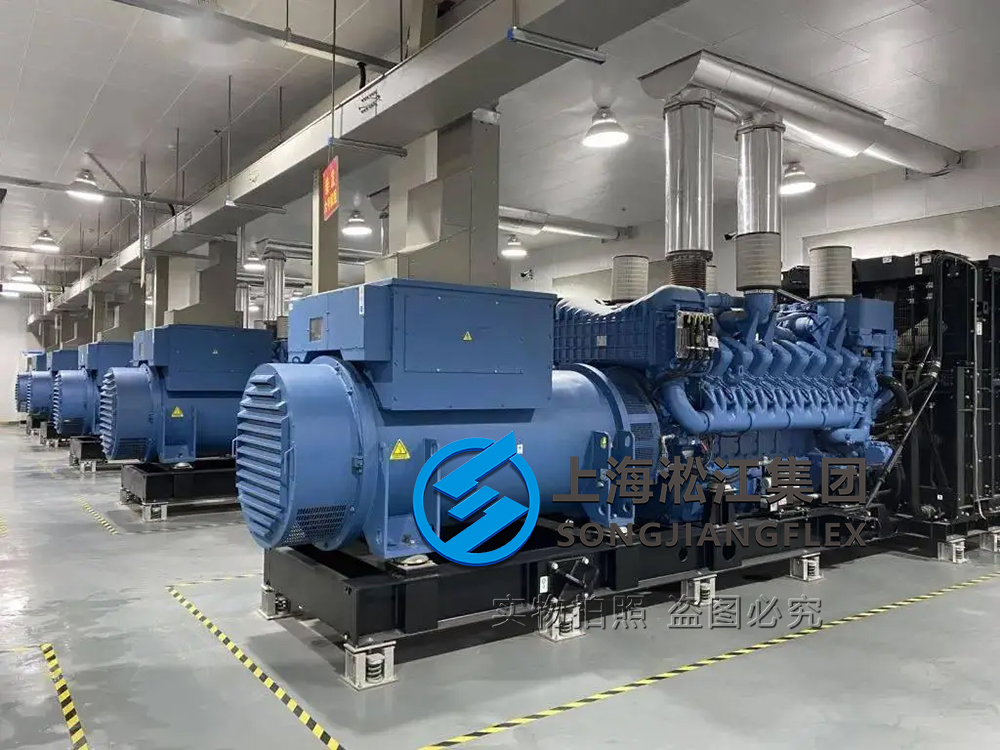
Reliable backup power is one of the most important elements of modern data center infrastructure. When utility power is interrupted, diesel generator sets must start quickly and operate reliably to support UPS systems, server racks, network equipment, cooling systems, pumps, and other mission-critical loads.
However, large diesel engines and alternators generate significant mechanical vibration during startup, shutdown, load changes, and continuous operation. Without an effective vibration isolation system, this vibration can be transmitted through the generator skid and concrete foundation into the surrounding building structure.
For this reason, SHM adjustable spring vibration isolators are widely suitable for heavy rotating machinery and generator installations where vibration transmission needs to be reduced while maintaining stable equipment support.
SHM Spring Isolators for Data Center Generator Applications
A typical data center emergency power system may contain multiple generator sets operating in parallel. Depending on the required power capacity, the installation may include:
- CAT/Caterpillar diesel generator sets
- Cummins diesel generator sets
- MTU generator sets
- Perkins-powered generator sets
- Volvo Penta diesel generators
- Mitsubishi heavy-duty generator sets
- High-voltage emergency generator sets
- Containerized generator sets
- Open-type diesel generator sets
- Soundproof generator enclosures
- Generator radiator packages
- Engine-alternator skid assemblies
- Day-tank and auxiliary fuel systems
Among these, large CAT generator sets are particularly relevant to heavy-duty vibration isolation applications. Caterpillar’s own product information for models such as the C175-16 lists spring-type linear vibration isolators, rubber anti-vibration mounts, and IBC vibration isolators among the mounting options.
For example, the CAT 3512C 60 Hz generator set has a published dry weight of approximately 13,141 kg, and Caterpillar lists spring-type vibration isolators among its mounting options. This illustrates why support load, weight distribution, isolator quantity, and installation position must all be considered rather than selecting a vibration mount only according to total generator weight.
Why Is Vibration Isolation Important in a Data Center?
A data center contains much more than IT racks. Its mechanical and electrical infrastructure can include diesel generators, chillers, cooling towers, CRAH units, AHUs, chilled-water pumps, condenser-water pumps, cooling-water pumps, plate heat exchangers, transformers, UPS equipment, switchgear, exhaust systems, ventilation fans, and fuel transfer pumps.
ASHRAE specifically notes that vibration in data centers should be considered, particularly from equipment such as air handlers, cooling towers, chillers, and generators.
A properly selected spring isolation system helps reduce structure-borne vibration transmitted from the generator base into the equipment room floor and surrounding structure. This is especially important when generator rooms are located inside buildings, on structural slabs, on podium levels, or close to vibration-sensitive technical areas.
Semantic Keywords
Relevant engineering terms for this application include diesel generator vibration isolation, generator spring mounts, adjustable spring isolator, structure-borne vibration control, generator anti-vibration mounting, mechanical equipment isolation, spring vibration damper, genset vibration control, generator foundation isolation, and data center vibration control.
Why Use an Adjustable Spring Isolator?
The SHM series uses a spring-based load-support structure combined with an adjustable mechanism.
The adjustable design is particularly useful during field installation. Even when the concrete foundation and steel generator skid appear level, small height differences can cause uneven load distribution among the isolators.
Height adjustment allows installers to correct these differences and improve the actual load distribution.
This principle is also consistent with generator installation practice described by Caterpillar. Its mounting guidance states that elevation differences between isolators should be minimized so the isolators share the equipment weight evenly.
This makes adjustable spring mounts especially useful for:
CAT C32 / C32B generator sets, CAT 3512 generator sets, CAT 3516 generator sets, CAT C175 generator sets, large standby generators, prime-power generator sets, gas engine generator sets, generator skid bases, engine test benches, compressor packages, centrifugal fans, industrial blowers, water-cooled chillers, air-cooled chillers, cooling towers, pumps, and other heavy mechanical equipment.
How Should an SHM Model Be Selected?
The first parameter is the actual operating weight, not simply the nominal or shipping weight of the equipment.
Engine oil, coolant, radiator liquid, batteries, fuel systems, accessories, exhaust components, acoustic enclosures, and additional skid-mounted equipment may change the final operating load.
The next important parameter is the number and position of support points.
For example, a 20,000 kg generator supported by eight isolators should not automatically be calculated as exactly 2,500 kg per isolator. The engine side, alternator side, radiator section, fuel tank, and accessories may create an uneven center of gravity.
Therefore, where possible, selection should be based on the load at each mounting point.
Other important parameters include:
equipment operating speed (RPM), excitation frequency, required static deflection, spring stiffness, installation floor, foundation structure, center of gravity, vibration direction, startup/shutdown movement, environmental conditions, and seismic requirements.
On-Site Installation of SHM Adjustable Spring Isolators
During installation, the SHM isolators are positioned between the generator base frame and the concrete or structural foundation.
The foundation contact surfaces should be flat and capable of supporting the load. After positioning the generator, each isolator can be adjusted progressively to level the machine and distribute the load.
Caterpillar’s own generator mounting guidance similarly emphasizes flat support surfaces, correct leveling, and balanced loading of isolators.
After installation, the complete system should also be checked for possible vibration short circuits caused by rigid connections. Exhaust piping, cooling-water piping, fuel piping, electrical conduits, cable trays, and other external connections should not unintentionally bypass the isolation system.
SHM Isolators Beyond Generator Sets
Although diesel generators are an important application, SHM adjustable spring vibration isolators can also be used for many other types of industrial and building-service equipment, including:
centrifugal chillers, screw chillers, reciprocating compressors, air compressors, cooling towers, AHUs, centrifugal fans, axial fans, induced-draft fans, forced-draft fans, HVAC equipment, cooling-water pumps, chilled-water pumps, condenser-water pumps, fire pumps, booster pump sets, vacuum pumps, industrial blowers, heat pump units, engine test benches, pump skids, compressor skids, and rotating machinery bases.
ASHRAE describes open spring isolators as using top and bottom load plates with adjustment bolts for leveling equipment, while restrained spring isolators are particularly relevant where movement control, outdoor exposure, changing equipment mass, or seismic forces must be considered.
FAQ
1. Can SHM spring isolators be used under CAT diesel generator sets?
Yes, provided that the isolator model is selected according to the actual generator configuration and load distribution. CAT generator sets vary significantly in weight, engine configuration, alternator size, radiator arrangement, base design, and operating speed. Caterpillar itself uses several vibration-isolation approaches across its generator range, including captive linear isolators, rubber mounts, spring-type isolators, and IBC isolators. Therefore, the generator model, operating weight, support-point quantity, mounting dimensions, and load distribution should be reviewed before final SHM selection.
2. What information is required to select the correct SHM model?
The most useful information includes the equipment name and model, dry and operating weight, dimensions, number of mounting points, location of each support point, center of gravity or point-load data, operating RPM, installation location, foundation type, and required vibration isolation performance. For a large generator, a GA drawing or base-frame drawing is particularly useful because it allows the engineering team to evaluate whether the load is concentrated toward the engine, alternator, or radiator side.
3. Can one generator use different SHM models at different support points?
Yes. If the load distribution is significantly uneven, different isolator capacities or spring stiffnesses can be selected for different positions. The objective is not necessarily to install identical springs everywhere; it is to achieve appropriate spring deflection and stable load support at each position. A detailed point-load calculation is therefore more reliable than simply dividing total generator weight by the number of isolators.
4. Why is adjustable height useful during installation?
Actual foundations and fabricated steel bases are rarely perfectly level. Adjustable isolators allow installers to compensate for small elevation differences, level the equipment, and help distribute the load more evenly. This reduces the risk that some springs become overloaded while others carry too little load. Correct leveling is particularly important for long, heavy generator skids.
5. Are SHM spring isolators only suitable for diesel generators?
No. The same basic vibration-control principle can be applied to many rotating and reciprocating machines. Typical applications include chillers, pumps, cooling towers, fans, compressors, blowers, HVAC equipment, industrial skids, test benches, and other mechanical equipment. Final selection should always consider the equipment’s weight, operating frequency, dynamic characteristics, and installation environment rather than relying only on equipment type.
Contact Us
Our company’s new website is now live, featuring the latest product introductions. For more details, please visit https://shsjflex.com/
Email: [email protected]