Mechanical equipment such as pumps, fans, compressors, and HVAC units continuously generates vibration during operation. If the equipment is mounted directly on a concrete floor or steel structure, vibration can travel through the equipment base into the building structure, creating structure-borne noise and potentially affecting nearby equipment.
The JSD Spring Vibration Isolator is designed to provide a simple and effective vibration isolation solution for a wide range of mechanical and industrial equipment. By combining a large-diameter steel coil spring with a resilient rubber base and an adjustable mounting structure, the JSD isolator helps reduce vibration transmission while maintaining stable equipment support.
JSD Spring Vibration Isolator Construction
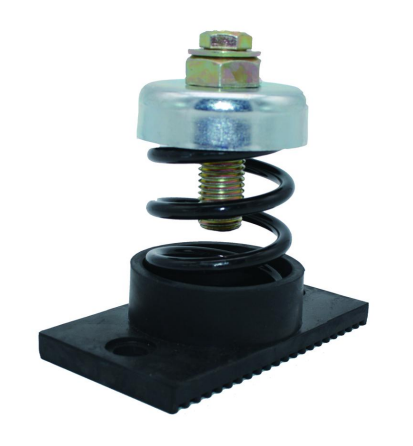
The JSD spring isolator mainly consists of an adjustable bolt, spring cover, rubber base, and single vibration-isolation coil spring.
One of the key characteristics of the design is the combination of metal and rubber isolation elements. The steel spring provides the primary low-frequency vibration isolation, while the rubber base provides an additional resilient interface between the isolator and supporting structure.
This principle is also commonly applied in HVAC vibration control. Steel springs are widely used because they can provide relatively large static deflection, while an elastomeric acoustical barrier beneath the spring can help reduce transmission of higher-frequency vibration through the steel components.
The JSD design also uses a large-outside-diameter coil spring, helping improve lateral stability and allowing the isolator to provide stable support under the designed operating load.
Why Is Static Deflection Important for Spring Isolation?
Selecting a spring isolator is not simply a matter of finding a mount that can carry the equipment weight.
The relationship between equipment operating weight, spring stiffness, static deflection, equipment operating speed, and disturbing frequency must also be considered.
For example, an isolator with a very high load capacity may still perform poorly if the actual equipment load is too small to produce the required spring deflection. ASHRAE guidance specifically notes that spring isolators should be selected according to equipment weight distribution and the deflection required for the application.
For this reason, proper JSD isolator selection should consider:
- Total operating weight of the equipment
- Number of supporting points
- Load distribution at each mounting point
- Equipment rotational speed or operating frequency
- Required static deflection
- Vertical spring stiffness
- Equipment center of gravity
- Installation floor and structural conditions
For equipment with uneven weight distribution, selecting all isolators based only on the average load per mounting point may not provide the best result. The actual load at each support position should be considered whenever possible.
Typical Equipment for JSD Spring Vibration Isolators
JSD spring vibration isolators can be considered for many types of rotating and mechanical equipment where vibration transmission to the floor or supporting structure needs to be reduced.
Typical applications include:
HVAC and Air-Handling Equipment: centrifugal fans, axial-flow fans, cabinet fans, plug fans, blower units, air-handling units (AHUs), ventilation units, fresh-air handling units, exhaust fans, smoke-exhaust fans, and packaged HVAC equipment.
Water Pump Systems: end-suction centrifugal pumps, horizontal split-case pumps, chilled-water circulation pumps, condenser-water pumps, cooling-water pumps, hot-water circulation pumps, booster pump sets, and process-water pumps.
Refrigeration Equipment: water-cooled chillers, air-cooled chillers, refrigeration compressor packages, condensing units, heat-pump units, and auxiliary cooling equipment.
Industrial Machinery: rotary blowers, centrifugal blowers, air compressors, vacuum pumps, hydraulic power units, industrial mixers, and motor-driven machinery.
Power Generation Equipment: diesel generator sets, emergency standby generator sets, gas generator packages, engine-driven auxiliary equipment, and generator cooling systems.
ASHRAE specifically identifies vibration and noise transmission as an important consideration in mechanical rooms containing chillers, pumps, air-conditioning equipment, and compressors.
JSD Isolators for Fans and Blowers
Fans are among the most common sources of mechanical vibration in HVAC systems.
A centrifugal fan assembly may include the fan wheel, shaft, bearings, electric motor, belt-drive system, VFD drive, and structural base frame. Rotating imbalance and mechanical forces can be transmitted from these components through the equipment frame into the building.
Spring isolators installed beneath the fan base can reduce this transmission.
For larger centrifugal fans and air-handling equipment, the isolation system may also incorporate a steel structural base or concrete inertia base. Flexible duct connectors are often used at fan inlet and outlet connections so rigid ductwork does not bypass the isolation system. ASHRAE recommends flexible connections at fan duct connections for reducing vibration transmission.
JSD Spring Mounts for Pumps
Pump vibration isolation requires particular attention to equipment alignment and piping connections.
Typical applications include:
- Chilled-water pumps
- Condenser-water pumps
- HVAC circulation pumps
- Horizontal split-case pumps
- End-suction pumps
- Booster pump skids
- Heat-pump circulation systems
For flexible-coupled pump and motor assemblies, the pump and motor are normally installed on a common base. Depending on the application, a structural steel base or concrete inertia base may be combined with spring isolators.
Correct shaft and coupling alignment remains important after installation. Improper alignment can increase vibration and shorten bearing or coupling life.
Adjustable Design for Easier Equipment Leveling
The adjustable bolt incorporated into the JSD spring vibration isolator allows limited height adjustment during installation.
This is useful when the equipment base or supporting floor has minor height differences between mounting points. Proper adjustment helps maintain more uniform spring loading and stable equipment positioning.
After the equipment is positioned, installers should verify that each spring is properly loaded and that the equipment remains level.
Metal-and-Rubber Combined Isolation
The JSD isolator does not rely solely on a steel spring.
Its rubber base provides an additional resilient interface between the spring assembly and supporting surface. This design can help reduce direct metal-to-structure transmission and improve the overall vibration and noise isolation characteristics of the mounting system.
This is especially useful for equipment that generates both lower-frequency mechanical vibration and higher-frequency components from motors, bearings, compressors, or other rotating parts.
How to Select the Correct JSD Model
Before selecting a JSD vibration isolator, provide the following information whenever possible:
Equipment name: pump, fan, compressor, chiller, generator, AHU, blower, etc.
Total operating weight: Include fluids and accessories that affect operating weight.
Number of isolators: Usually determined according to the equipment base and mounting-point arrangement.
Load distribution: Provide individual mounting-point loads when the center of gravity is significantly offset.
Equipment speed: Motor RPM, fan RPM, compressor operating speed, or other dominant vibration frequency.
Required deflection: The spring must operate within its intended working range.
Installation environment: Indoor, outdoor, rooftop, corrosive environment, or other special conditions.
Engineering selection should be based on the actual load carried by each isolator rather than equipment weight alone.
FAQ About JSD Spring Vibration Isolators
1. Can JSD spring isolators be used for centrifugal fans?
Yes. Centrifugal fans are a typical application for spring vibration isolation because rotating fan wheels, motors, shafts, bearings, and belt-drive assemblies can generate vibration that travels through the equipment base. JSD spring isolators can be installed underneath an appropriate fan base to reduce this transmission. For larger fans, a structural steel frame or inertia base may also be necessary. Flexible duct connections should also be considered because rigid ductwork can create a vibration transmission path around the isolators.
2. Can I select the isolator simply by dividing equipment weight by four?
Only when four support points carry approximately equal loads. Many machines have motors, compressors, pumps, or other heavy components located toward one side, resulting in an uneven center of gravity. In such cases, individual mounting-point loads should be calculated or supplied by the equipment manufacturer. Selecting each isolator according to its actual supported load provides better spring deflection consistency and equipment stability.
3. Why does the JSD isolator use a large-diameter spring?
A larger spring diameter can contribute to improved lateral stability. Stability is particularly important for machinery with a relatively high center of gravity or dynamic forces during startup and shutdown. The spring geometry, wire diameter, number of active coils, stiffness, operating height, and supported load all contribute to the final performance of the isolator.
4. Why is there rubber underneath the spring?
The rubber base creates an additional resilient layer between the metal spring assembly and supporting structure. Steel springs are highly effective for low-frequency isolation, but higher-frequency vibration can sometimes travel through metallic components. An elastomeric layer can help reduce this transmission and avoid direct metal-to-metal contact.
5. Can JSD isolators be used outdoors?
Outdoor installations require additional consideration. Corrosion protection, wind forces, equipment movement, and environmental exposure should be evaluated. Rooftop cooling towers, condensing units, and other equipment exposed to significant wind or seismic forces may require restrained spring isolators rather than standard open spring mounts. ASHRAE specifically distinguishes restrained spring isolators for equipment subject to large weight changes, outdoor wind loading, or seismic forces.
Contact Us
For JSD Spring Vibration Isolator selection, please provide your equipment type, total operating weight, quantity of mounting points, equipment RPM, and installation conditions. We can recommend a suitable model according to the actual application.
Our company’s new website is now live, featuring the latest product introductions. For more details, please visit https://shsjflex.com/
Email: [email protected]