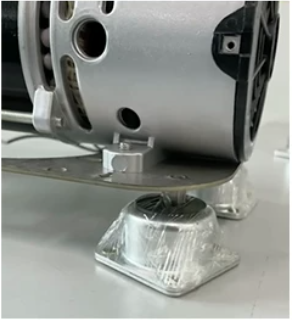
Electronic and precision equipment installed on vehicles is continuously exposed to vibration, road shock, engine excitation, and sudden mechanical impacts. These dynamic forces can affect sensitive components, loosen electrical connections, reduce measurement accuracy, and shorten equipment service life.
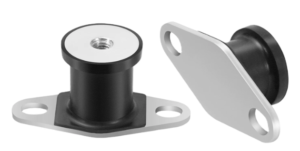
An Air Damping Vibration Isolator provides an effective solution for protecting sensitive equipment in mobile environments. By combining a high-quality rubber elastic element, internal air damping structure, and durable metal housing, the isolator helps reduce vibration transmission while absorbing mechanical shock.
How Does Air Damping Vibration Isolation Work?
Unlike a simple rigid rubber mount, an air damping vibration isolator uses controlled airflow inside its internal structure to generate damping.
When the supported equipment moves vertically due to vibration or shock, the elastic element compresses and rebounds. During this movement, air passes through internal air passages or damping orifices. The resulting airflow resistance dissipates part of the vibration energy and controls excessive oscillation.
This combination of elastic support and air damping provides both vibration isolation and shock cushioning.
The natural frequency of an isolation system is an important factor in determining its performance. In general, larger static deflection allows a lower natural frequency, helping the isolator reduce the transmission of low-frequency vibration. Damping is particularly important around the resonance region because it helps control excessive movement.
Why Is Low Natural Frequency Important?
Vibration isolators do not simply “remove” vibration. Their performance depends on the relationship between the excitation frequency of the equipment or vehicle and the natural frequency of the isolation system.
A properly selected low-frequency vibration isolator can significantly reduce vibration transmitted from the mounting base to sensitive equipment once the operating frequency is sufficiently above the isolator’s natural frequency.
This characteristic is particularly useful for vehicle-mounted systems, where vibration can originate from:
- Diesel and gasoline engines
- Vehicle suspension systems
- Rough road surfaces
- Off-road driving
- Transmission and drivetrain vibration
- Cooling fans and auxiliary motors
- Sudden braking or acceleration
- Transportation shock
- Loading and unloading impact
Applications in Vehicle-Mounted Electronic Equipment
Air damping vibration isolators are particularly suitable for protecting vehicle-mounted electrical and electronic equipment.
Typical applications include mobile communication cabinets, radio transceiver racks, RF communication modules, microwave communication equipment, vehicle-mounted control cabinets, navigation computers, GPS/INS navigation units, data acquisition systems, electronic control units, power distribution modules, mobile monitoring equipment, signal processing units, and onboard diagnostic equipment.
They can also be used underneath sensitive electronic chassis installed in communication trucks, mobile command vehicles, engineering vehicles, emergency response vehicles, mobile laboratories, radar vehicles, inspection vehicles, and specialized transportation platforms.
Vehicle-mounted electronic and precision equipment commonly requires protection against repeated vibration and shock generated during transportation and operation. Similar vibration isolation solutions are widely applied to communication, navigation, radar, instrumentation, and industrial control equipment.
Suitable for Radar and Communication Systems
Modern mobile radar and communication systems contain many vibration-sensitive components.
Examples include:
Radar equipment: radar signal processors, RF modules, antenna control units, radar power supplies, display consoles, electronic cabinets, and data processing units.
Communication equipment: microwave communication modules, radio transceivers, mobile base-station equipment, communication servers, network cabinets, satellite communication terminals, and telemetry systems.
Repeated mechanical vibration can influence connectors, PCB assemblies, sensors, optical components, and precision electronic modules. Installing suitable shock and vibration isolators between the equipment chassis and vehicle frame helps reduce these transmitted dynamic loads.
Applications in Avionics and Aerospace Support Equipment
Air damping vibration isolators can also be considered for selected avionics, aerospace support, and airborne electronic equipment where the isolator specifications match the required load and environmental conditions.
Potential applications include avionics racks, navigation electronics, communication modules, electronic instrument panels, flight test equipment, data recorders, airborne monitoring systems, and ground-support electronic instruments.
Vibration control is an important consideration for avionics equipment because electronic boards and components installed in aircraft are subjected to vibrational stress during operation.
Compact Design for Limited Installation Space
Mobile electronic systems often have restricted mounting space. Therefore, the vibration isolator must provide sufficient vertical load capacity without occupying excessive space.
A compact air damping isolator with an aluminum housing offers several practical advantages:
- Lightweight construction
- Compact mounting dimensions
- Good vibration attenuation
- Effective shock cushioning
- Stable vertical support
- Durable external protection
- Easy integration into equipment bases
- Long service life
These characteristics make this type of isolator suitable for both new equipment designs and vibration-control retrofit projects.
How to Select the Correct Air Damping Vibration Isolator
Correct load selection is essential.
The total equipment weight should first be divided according to the actual load carried by each mounting point. For example, a 40 kg electronic cabinet supported by four isolators does not necessarily mean exactly 10 kg per isolator. If the center of gravity is offset, individual mounting-point loads may be different.
For accurate selection, it is recommended to provide:
Equipment total weight, number of mounting points, load distribution, equipment dimensions, center of gravity, vibration frequency or RPM, expected shock conditions, installation orientation, and mounting-hole dimensions.
The selected isolator should operate within its recommended load range while maintaining sufficient static deflection and installation clearance.
FAQ
Can an Air Damping Vibration Isolator be used for vehicle-mounted electronics?
Yes. This is one of its important application areas. Vehicle electronics may experience continuous vibration from engines, road surfaces, suspension systems, and drivetrain components, together with occasional shock loads caused by potholes, braking, transportation, or off-road operation. A properly selected air damping isolator helps separate sensitive electronic equipment from these vibration sources while controlling movement through its damping mechanism.
What equipment can be installed on these isolators?
Typical equipment includes communication cabinets, radar electronics, navigation units, RF modules, electronic control cabinets, test instruments, data acquisition systems, monitoring equipment, mobile computers, signal processors, power electronic modules, and other precision electrical equipment. Selection should always be based on actual equipment weight, mounting arrangement, vibration conditions, and required shock protection.
Why is static deflection important?
Static deflection is closely related to the loaded natural frequency of an isolation system. Generally, greater deflection corresponds to a lower natural frequency, which can improve isolation against lower-frequency excitation. However, excessive deflection also requires sufficient installation clearance and must remain within the isolator’s allowable movement range. Therefore, simply selecting the softest isolator is not always the correct approach.
Can I select the isolator only according to total equipment weight?
No. Total weight is only the starting point. The actual load distribution at each mounting position is more important. Equipment with an offset motor, transformer, battery pack, power supply, or other heavy component may have significantly different loads at each mounting point. The vibration frequency, shock environment, number of isolators, center of gravity, and mounting orientation should also be considered.
What is the advantage of an aluminum housing?
An aluminum housing provides structural protection while keeping the overall isolator relatively lightweight. This is especially useful for vehicle-mounted and mobile equipment where both durability and weight control are important. The housing also helps protect the internal elastic and damping components from accidental contact and mechanical damage.
Contact Us
Our company’s new website is now live, featuring the latest product introductions. For more details, please visit https://shsjflex.com/ or contact [email protected].