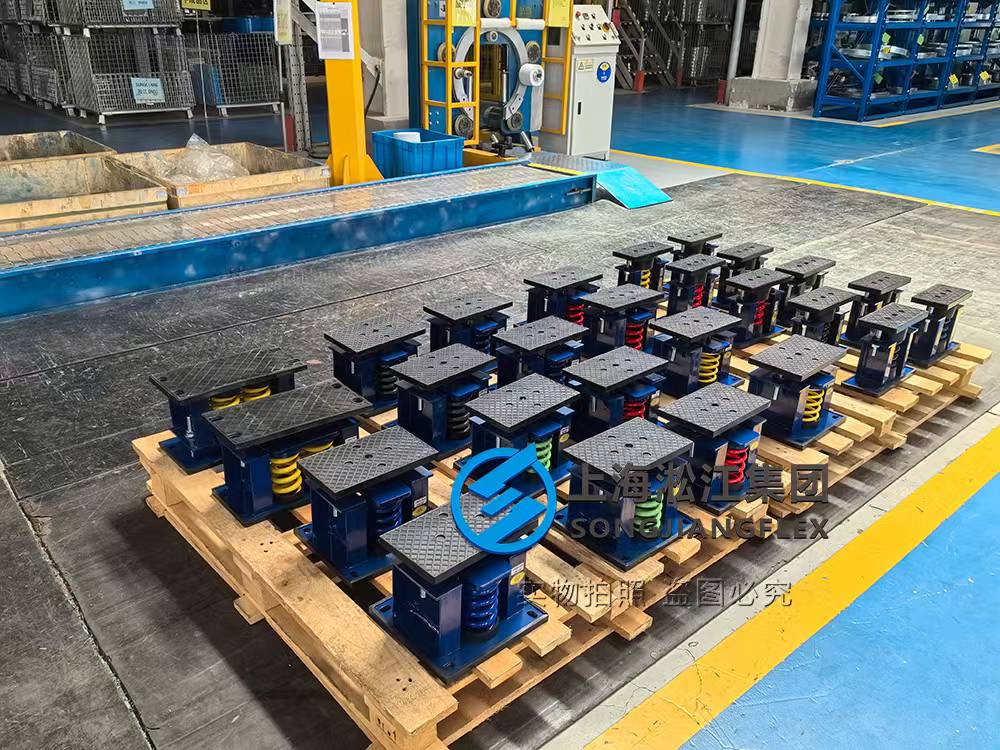
Mechanical equipment such as chillers, cooling towers, air handling units, pumps, fans, compressors, and generator sets can generate continuous vibration during operation. When these machines are installed directly on concrete floors, steel frames, rooftop platforms, or equipment foundations, vibration can easily be transmitted into the building structure.
An adjustable spring vibration isolator is designed to be installed between the equipment base and the supporting structure. By using a low-frequency steel spring together with a height-adjustment mechanism, the isolator helps reduce vibration transmission, structure-borne noise, and mechanical impact while also allowing accurate equipment leveling.
For large HVAC systems, industrial machinery, and building services equipment, adjustable spring mounts are widely used as part of the complete equipment base vibration isolation system.
What Is an Adjustable Spring Vibration Isolator?
An adjustable spring vibration isolator is a floor-mounted vibration control device consisting mainly of a steel coil spring, upper and lower support plates, adjustment bolt or nut, housing, and rubber acoustic pad.
The spring carries the static load of the equipment while providing flexible vertical movement. The adjustment mechanism allows installers to compensate for differences in equipment weight distribution or foundation height.
This is especially useful for large mechanical units because the load on every mounting point is not always identical.
Compared with ordinary rubber vibration mounts, spring isolators can provide greater static deflection and lower natural frequency, making them particularly suitable for controlling vibration from relatively low-speed rotating equipment.
Which Equipment Can Use Adjustable Spring Mounts?
Adjustable spring vibration isolators are suitable for many types of HVAC equipment, industrial machinery, and rotating mechanical equipment.
Typical applications include water-cooled chillers, air-cooled chillers, centrifugal chillers, screw chillers, cooling towers, packaged air handling units, rooftop air handling units, fresh air handling units, centrifugal fans, axial flow fans, exhaust fans, ventilation fans, induced draft fans, forced draft fans, and smoke exhaust fans.
They are also commonly installed beneath horizontal end-suction pumps, split-case centrifugal pumps, chilled-water circulation pumps, cooling-water pumps, condenser-water pumps, booster pumps, fire pumps, heat-pump units, refrigeration compressors, air compressors, vacuum pumps, and mechanical equipment skids.
For power and industrial applications, adjustable spring mounts may also be used beneath diesel generator sets, emergency generators, transformers, boiler auxiliary equipment, engine-driven equipment, and other rotating machinery.
Spring isolation is also frequently combined with a steel equipment base or concrete inertia base, especially for pumps, fans, compressors, and equipment with a relatively high center of gravity. Industry vibration-control guidance specifically identifies chillers, pumps, cooling towers, AHUs, fans, compressors, rooftop HVAC systems, and mechanical skids as common spring-isolator applications.
Why Is Height Adjustment Important for Equipment Bases?
One major advantage of an adjustable spring mount is its ability to level the machine after installation.
Large chillers, pumps, compressors, and packaged HVAC units may have uneven weight distribution. For example, the compressor side of a chiller may carry more load than another section of the equipment base.
If identical isolators are installed without considering the individual support-point loads, spring compression may vary significantly.
With an adjustable design, technicians can adjust the mounting height so that the equipment base remains level while maintaining the correct working condition of each spring.
This is particularly important when installing machinery on steel equipment bases, inertia bases, concrete foundations, rooftop platforms, or mechanical-room floors.
Equipment manufacturers also commonly require spring-isolator adjustment to be completed after the unit reaches its normal operating weight.
Adjustable Spring Isolators for Chillers
Chillers are one of the most common applications for spring vibration isolation systems.
A chiller contains compressors, motors, pumps, and other rotating components capable of generating continuous dynamic forces. These vibrations may travel through the equipment frame and into the concrete slab.
For centrifugal chillers, screw chillers, modular chillers, air-cooled chillers, and water-cooled chiller units, adjustable spring isolators can be positioned underneath the chiller base according to the load at each mounting point.
When selecting the isolator, engineers should evaluate the operating weight rather than simply the empty shipping weight.
For water-cooled equipment, this may include the equipment itself plus refrigerant, oil, and water contained within the heat exchanger, depending on the actual operating condition.
Chiller manufacturers also provide spring-isolator selection according to individual isolator loads where vibration transmission is a concern.
Spring Vibration Isolation for Pumps and Inertia Bases
Pumps often require more than just a spring placed directly below the pump feet.
For base-mounted centrifugal pumps, end-suction pumps, split-case pumps, chilled-water pumps, condenser-water pumps, and fire pumps, the motor and pump assembly may be installed on a common steel base or concrete inertia base.
The inertia base increases the stability of the assembly and helps control movement caused by motor torque, pipe forces, and starting or stopping conditions.
Spring isolators are then installed under the inertia base to reduce vibration transmission to the building structure.
Flexible rubber expansion joints or flexible pipe connectors can also be installed near the pump suction and discharge connections to reduce vibration bypass through rigid piping.
This creates a more complete pump vibration isolation system, rather than relying on the equipment mounts alone.
How Do You Select the Correct Spring Isolator?
Selecting an adjustable spring isolator should not be based only on the total machine weight.
Several parameters should be considered:
Equipment operating weight: Use the actual operating weight whenever possible.
Number of mounting points: Determine how many isolators will support the equipment.
Load at each support point: Do not automatically divide the total weight equally if the equipment has an uneven center of gravity.
Equipment operating speed: Motor RPM and dominant excitation frequency influence vibration-isolation requirements.
Required spring deflection: Different applications may require different static deflections.
Installation location: Ground-floor installations, suspended floors, rooftops, steel platforms, and vibration-sensitive buildings may require different solutions.
Equipment stability: Tall equipment, outdoor installations, or equipment exposed to wind or seismic forces may require restrained or seismic spring isolators instead of standard open spring mounts.
Proper isolator selection is therefore based on the complete combination of load, vibration frequency, spring deflection, equipment configuration, installation environment, and required isolation performance.
Frequently Asked Questions
Are adjustable spring vibration isolators suitable for heavy chillers?
Yes. Adjustable spring isolators can be designed for both relatively light HVAC equipment and very heavy chillers, provided the isolator load capacity is correctly selected.
For a heavy chiller, it is important to obtain the load at each support point instead of simply dividing the total equipment weight by four, six, or eight. Compressors, heat exchangers, motors, and piping connections can create uneven loading.
The spring selected for each position should operate within its recommended load range so that the required deflection and vibration isolation performance can be achieved.
For very heavy equipment, customized spring combinations or higher-capacity spring mounts can also be manufactured.
Can the same spring isolator be used for every mounting point?
Not always.
If the equipment has a symmetrical structure and uniform weight distribution, the same isolator model may be suitable for all mounting positions.
However, large chillers, compressors, generator sets, fans, and pump skids often have an uneven center of gravity.
For example, one support position may carry 600 kg while another carries 900 kg. Using exactly the same spring at both locations could result in different compression and working heights.
The better approach is to obtain the point load or support reaction at each equipment foot and select the spring accordingly.
What is the difference between a spring isolator and a rubber vibration mount?
Rubber vibration mounts are compact, simple, and well suited to many higher-frequency or relatively lightweight applications.
Spring isolators generally provide larger deflection and lower natural frequency, making them better suited to many large HVAC and mechanical equipment applications where low-frequency vibration needs to be controlled.
A spring isolator may also include a rubber acoustic pad underneath the steel structure. The spring primarily controls lower-frequency vibration, while the elastomeric element helps reduce high-frequency vibration and metal-to-metal sound transmission.
Therefore, the two technologies are often complementary rather than completely interchangeable.
Can adjustable spring mounts be installed outdoors?
Yes, but corrosion protection must be considered.
Cooling towers, rooftop chillers, rooftop AHUs, exhaust fans, and outdoor mechanical equipment may be continuously exposed to rain, humidity, condensation, and polluted air.
For these installations, spring surfaces and housings should have appropriate anti-corrosion treatment. Depending on project requirements, options may include powder coating, galvanized housings, hot-dip galvanizing, or corrosion-resistant metal components.
For coastal projects, chemical plants, or other aggressive environments, the environmental conditions should be provided during product selection.
What information is required when ordering spring vibration isolators?
To select a suitable adjustable spring vibration isolator for an equipment base, it is recommended to provide the equipment name, total operating weight, number of mounting points, individual point loads if available, equipment dimensions, motor speed or operating RPM, installation position, required spring deflection, and any height restrictions.
If the equipment is installed outdoors, on a rooftop, in a seismic zone, or on an inertia base, this information should also be provided.
Providing an equipment drawing or base layout is especially helpful because the spring isolators can then be selected according to the actual mounting positions and weight distribution.
Adjustable Spring Vibration Isolation for Modern Mechanical Equipment
From central HVAC plants and data centers to hospitals, commercial buildings, industrial factories, power plants, refrigeration stations, and mechanical equipment rooms, vibration control is becoming an increasingly important part of equipment installation.
A properly selected adjustable spring vibration isolator helps separate vibration-producing machinery from the supporting structure while providing stable equipment support and convenient leveling.
Whether the application involves a chiller, cooling tower, AHU, centrifugal pump, compressor, generator, industrial fan, heat pump, or complete equipment skid, selecting the correct spring load and deflection is essential for achieving reliable long-term vibration isolation.
Our company’s new website is now live, featuring the latest product introductions. For more details, please visit https://shsjflex.com/
[email protected]