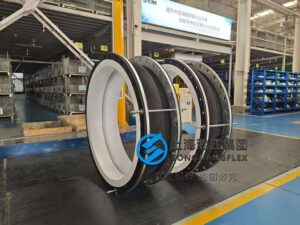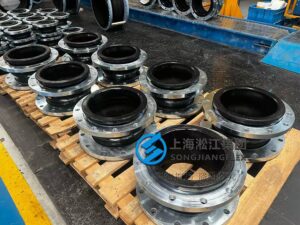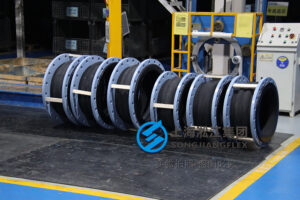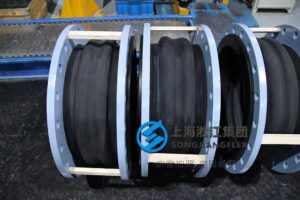
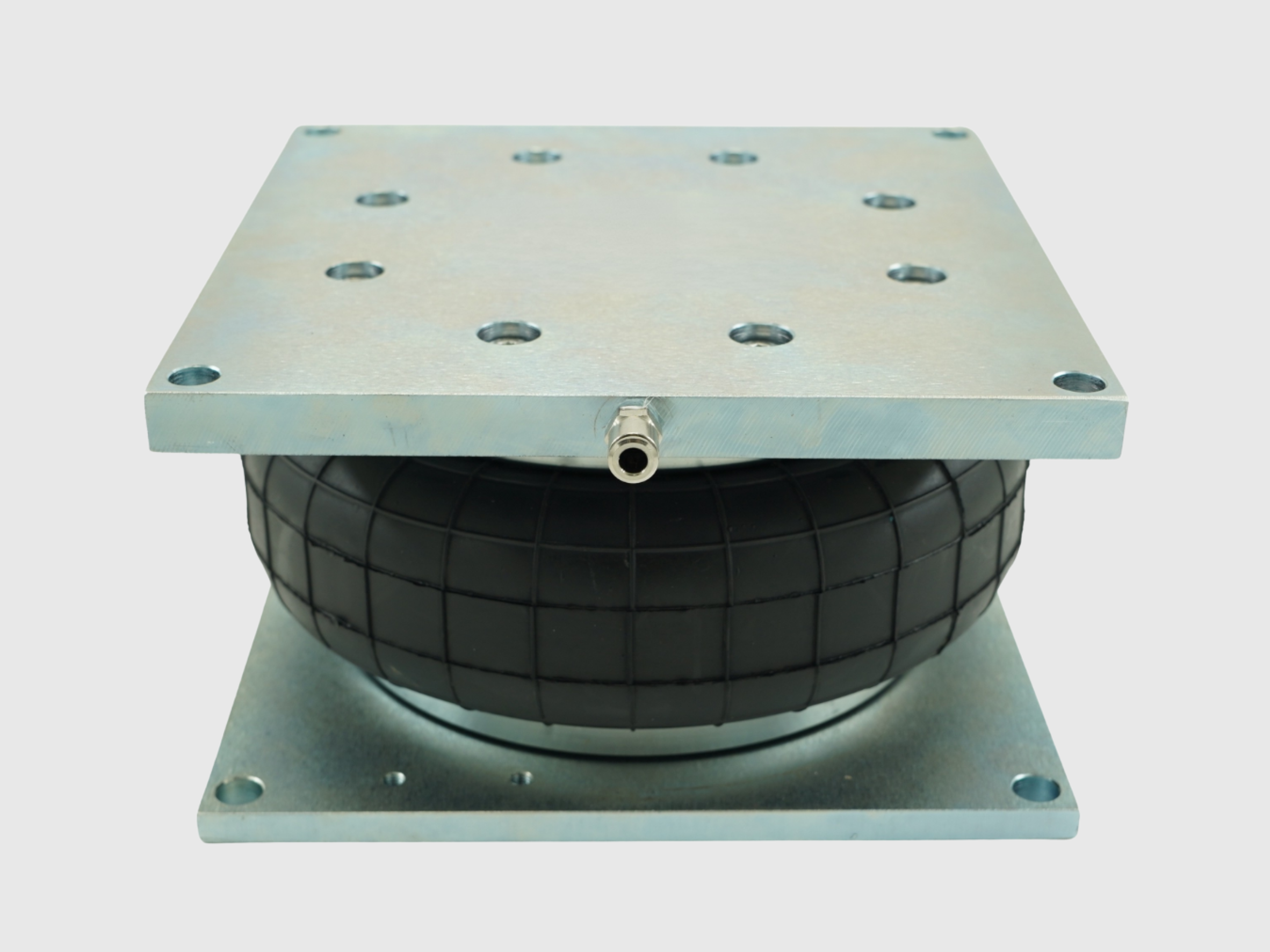
Industrial equipment increasingly requires vibration isolation systems that provide not only low-frequency vibration control but also greater operational safety. The PSB-1-Y Air Spring with optional stopper (With Stopper) is designed for applications where equipment movement must be controlled within a specified height range while maintaining the vibration isolation advantages of a pneumatic spring.
Compared with conventional coil springs or solid rubber vibration mounts, an industrial air spring vibration isolator uses compressed air and a flexible rubber body to support the equipment. This pneumatic structure can provide low natural frequency and flexible load adjustment, making air springs suitable for precision machinery and equipment where vibration transmission needs to be minimized.
Industry data also shows why air springs are widely used for vibration isolation. Depending on the air spring design and operating conditions, industrial air springs can achieve natural frequencies around 1.6–3 Hz, although actual values vary according to load, pressure, effective area and installation height.
What Is a PSB-1-Y Air Spring With Stopper?
The PSB-1-Y is an industrial pneumatic air spring that can be supplied with a stopper configuration. The stopper is intended to restrict excessive vertical travel and help prevent the air spring from operating outside its specified height range.
This is particularly important because the working height of an air spring directly affects its operating characteristics. Major industrial air-spring manufacturers specify recommended design heights and, for some products, minimum operating heights or restricted extended-height ranges.
For the PSB-1-Y series, the stopper option provides an additional mechanical safeguard. Depending on the selected configuration, a stopper can be designed to control excessive compression, extension, or both.
This makes the air spring with mechanical stopper particularly useful for machinery where unexpected air-pressure loss, excessive displacement, startup/shutdown movement, or abnormal operating conditions could otherwise allow excessive travel.
Why Is a Stopper Important for Air Spring Vibration Isolation?
An air spring should not be considered simply as a rubber cushion. Its vibration isolation performance depends on the relationship between equipment load, operating pressure, installation height, excitation frequency, natural frequency and dynamic displacement.
If an air spring is excessively compressed, stretched beyond its recommended height, or subjected to uncontrolled movement, the rubber body and mounting components may experience abnormal stress.
A properly designed stopper helps establish a physical movement limit.
For example, a lower stopper can prevent the supported equipment from dropping beyond the allowable minimum height if air pressure is suddenly lost. An upper stopper can restrict excessive extension and help keep the air spring within its allowable maximum height.
For safety-critical installations, the stopper should therefore be considered together with the equipment structure rather than as an independent accessory.
Where Can PSB-1-Y Air Springs Be Used?
The PSB-1-Y with stopper can be considered for many industrial machines requiring low-frequency vibration isolation and controlled vertical displacement.
Typical equipment may include:
- CNC machining centers, CNC milling machines and precision grinding machines
- Coordinate measuring machines (CMM) and optical measuring equipment
- Semiconductor inspection equipment and precision positioning systems
- Laser cutting, laser measurement and optical testing equipment
- Electronic component testing machines and laboratory instruments
- Industrial compressors and air compressor skids
- Centrifugal fans, blower units and ventilation equipment
- Water pumps, circulating pumps and pump skid systems
- Motor-driven equipment and motor-generator assemblies
- HVAC air-handling units and mechanical equipment
- Centrifuges and rotating process equipment
- Industrial test benches and dynamic testing machines
- Printing machinery and precision production equipment
- Packaging machinery and automated production lines
- Inspection platforms and precision weighing systems
Air-spring-type solutions are broadly associated with machinery vibration control because low natural frequency can reduce the transmission of machine-generated vibration into floors and surrounding structures. Industrial vibration-isolation applications commonly include HVAC equipment, pumps, motors and centrifuges.
However, model selection must always be based on actual operating conditions. The presence of a stopper does not mean that every PSB-1-Y model is automatically suitable for all equipment listed above.
Low Natural Frequency and Better Vibration Isolation
One of the main reasons engineers select a pneumatic vibration isolator is its ability to achieve a relatively low natural frequency.
In a vibration isolation system, the relationship between the machine excitation frequency and isolator natural frequency is critical. Once the operating frequency is sufficiently above the system’s resonance region, vibration transmission can be significantly reduced.
Commercial industrial air-spring data illustrates natural frequencies of approximately 1.6–3.2 Hz for different designs and loads.
This makes properly selected air springs particularly attractive for equipment where conventional elastomer mounts are too stiff or where greater isolation efficiency is required.
However, operation close to resonance must be evaluated carefully. Equipment with slow operating speeds, large excitation forces, long startup/shutdown cycles or large transient movements requires a complete dynamic analysis before an air spring is selected.
Why Working Height Matters
Air spring operating height is one of the most important selection parameters.
The air spring should normally operate around its specified design or standard working height. Different heights change the internal volume, effective area, load characteristics and dynamic behavior of the spring.
For example, published industrial air-spring specifications commonly identify a specific recommended vibration-isolation height and may also define a minimum height.
Therefore, simply selecting an air spring according to equipment weight is not sufficient.
For PSB-1-Y selection, engineers should consider:
Load per mounting point + required operating height + air pressure + machine operating frequency + allowable displacement + center-of-gravity position + number of air springs + startup/shutdown behavior.
The stopper configuration should then be determined according to the permissible vertical movement of the complete machine.
PSB-1-Y With Stopper for Unexpected Air Loss
A particularly useful feature of a lower-stop configuration is protection during unexpected pressure loss.
If an air hose, fitting, valve or pneumatic control circuit loses pressure, an ordinary air spring may collapse toward its minimum height. Where adequate mechanical clearance has not been designed into the machine, this movement could allow equipment components to contact surrounding structures.
A built-in or externally designed stopper provides a mechanical travel limit and can help reduce this risk.
This feature can be valuable for precision inspection platforms, optical equipment, CNC equipment, laboratory machinery and automated production equipment, where an uncontrolled change in machine height may affect alignment or nearby components.
The stopper, however, should not be treated as the normal load-supporting element during standard operation. Under normal conditions, the air spring should operate at the specified working height.
Installation Considerations for Air Springs With Stoppers
Correct installation is just as important as correct selection.
The upper and lower mounting surfaces should be appropriately aligned, and the air spring should not be installed with unintended twisting or excessive lateral offset. Mounting bolts should be properly tightened according to the design requirements.
Do not weld directly to the metal components of an installed air spring. Welding heat and sparks may damage the rubber body.
The system should also provide enough clearance for the rubber bellows to expand during compression and normal operation. Pipes, brackets, guards and other machine components should not rub against the air spring.
Most importantly, do not operate the air spring outside the height and pressure range specified for the selected model.
FAQ
1. What is the main advantage of a PSB-1-Y air spring with stopper?
The main advantage is the combination of pneumatic vibration isolation and mechanical travel limitation. During normal operation, compressed air supports the equipment and provides the required spring characteristics. If excessive vertical movement occurs, the stopper limits travel according to the designed clearance. This is particularly useful where machine components could otherwise collide or where sudden pressure loss could cause excessive downward movement.
2. Can the PSB-1-Y replace a conventional steel spring isolator?
In some applications, yes, but the two technologies should not be considered direct replacements without engineering evaluation. Steel spring isolators have fixed mechanical spring characteristics, while an air spring’s performance depends on pressure, load, volume and operating height. Air springs can offer lower natural frequencies and adjustable leveling characteristics, but they require an air supply and appropriate pneumatic controls. Selection should therefore be based on the equipment’s operating frequency, total weight, load distribution and required isolation efficiency.
3. How many PSB-1-Y air springs does one machine require?
There is no universal quantity. Four mounting points are common, but large machine bases may require six, eight or more air springs. Engineers should first determine the machine’s total operating weight and, more importantly, the actual load at each support point. Uneven center-of-gravity positions can create substantially different loads at individual mounts. Each air spring should therefore be selected according to its actual support load rather than simply dividing total machine weight equally.
4. Does adding a stopper improve vibration isolation performance?
Not directly. The stopper is primarily a movement-control and protective feature. During normal operation, adequate clearance should remain between the moving structure and stopper so that the air spring can isolate vibration freely. If the stopper remains in continuous contact during operation, it may create an additional vibration transmission path and reduce the intended isolation effect. Correct stopper clearance is therefore an important part of system design.
5. What information is required to select the correct PSB-1-Y model?
For accurate selection, please provide the equipment name, total operating weight, number of mounting points, load at each support point if available, machine operating speed or excitation frequency, required installation height, available mounting space, center-of-gravity information, desired vibration isolation efficiency, maximum expected vertical movement and environmental conditions. For equipment with variable operating speeds, startup and shutdown speed ranges should also be provided because the machine may pass through the resonance region during acceleration or deceleration.
Selecting the Right PSB-1-Y Air Spring
The PSB-1-Y Air Spring With Stopper is not simply an air cushion. It is part of an engineered vibration isolation system in which load capacity, pneumatic pressure, natural frequency, operating height, machine frequency and mechanical travel limits must work together.
For precision industrial machinery, rotating equipment, test systems and automated production equipment, the optional stopper provides an additional level of mechanical movement control while retaining the low-frequency isolation characteristics of the air spring.
Send us your equipment drawing, machine weight, mounting-point loads, operating frequency and required installation height, and our technical team can assist with PSB-1-Y model selection and stopper configuration.
Contact Us
Our company’s new website is now live, featuring the latest product introductions. For more details, please visit https://shsjflex.com/
Email: [email protected]