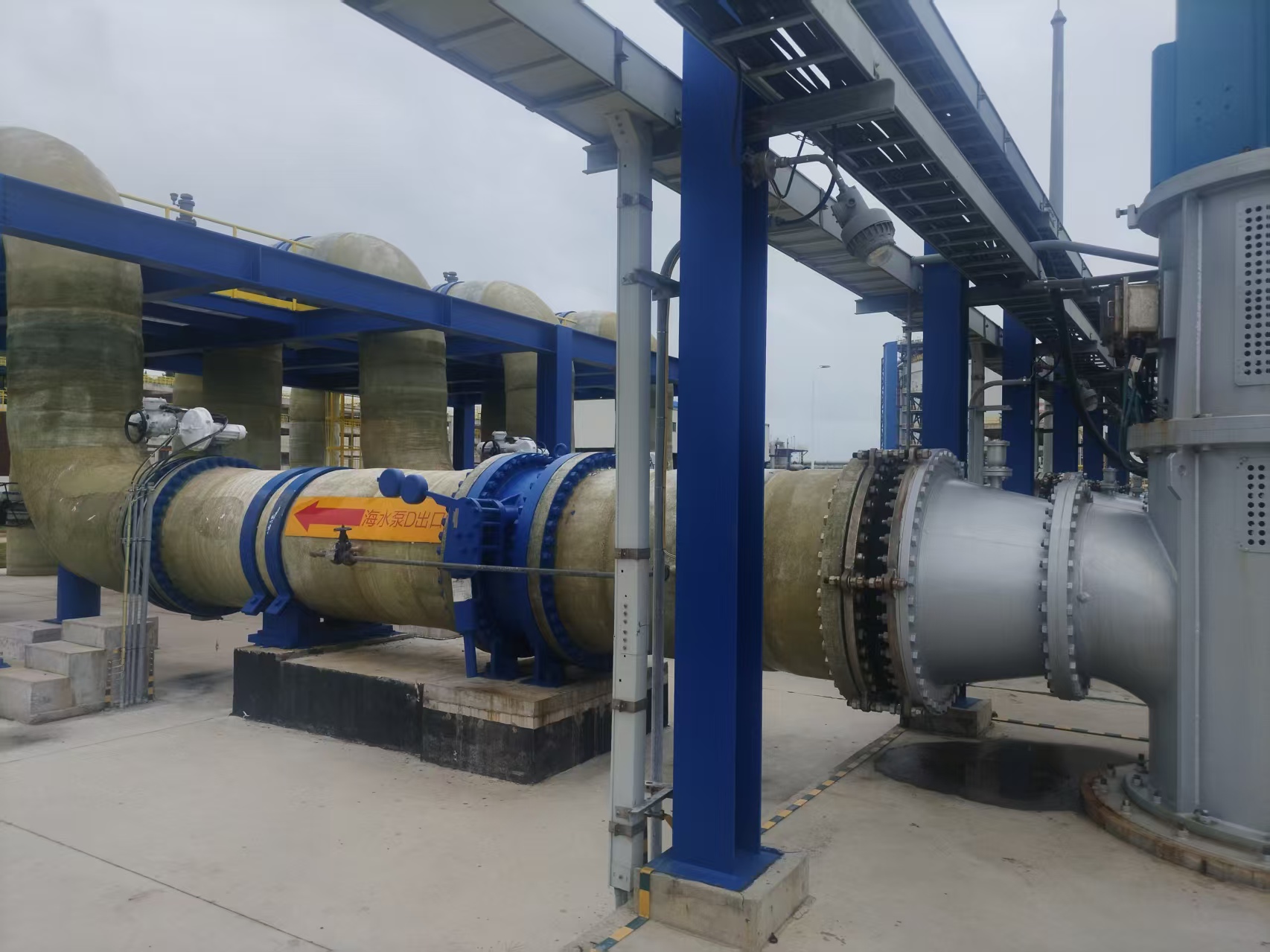
Seawater piping systems in power plants operate in one of the most challenging environments for industrial piping. Although the actual operating pressure may not be particularly high, continuous exposure to seawater, pump vibration, thermal movement, equipment loads and pipe alignment can create significant mechanical stress on the pipeline system.
This case study shares a DN900 seawater rubber expansion joint installation for a seawater cooling water system in Malaysia. The application is located at the outlet of a seawater pump and uses FRP/GRP piping rather than stainless steel piping.
For this case presentation, the project is referred to as the Jimah East Power Plant Seawater Cooling System, Negeri Sembilan, Malaysia. Jimah East Power is a real Malaysian power generation project with seawater intake facilities and Main Cooling Water (MCW) pumps. Public project information also confirms the use of GRP piping in the associated cooling-water infrastructure.
The specific DN900 expansion-joint operating parameters discussed below are presented as the technical conditions of this case study.
Project Background: Seawater Cooling Water Pipeline
The application is part of a seawater cooling-water pipeline system associated with a power plant.
The basic operating conditions are:
- Medium: Natural seawater
- Pipe size: DN900
- Pipeline material: FRP/GRP
- Expansion joint location: Seawater pump discharge
- Operating pressure: Approximately 3–4 kg/cm²
- Operating temperature: Approximately 10–35°C
- Pipe material selection: Fiberglass reinforced plastic
- Service: Seawater cooling water
- Main equipment: Seawater circulating pump / main cooling water pump
- Installation location: Pump outlet piping
- Primary concerns: Seawater corrosion, pump vibration, pipe movement and mechanical stress
The selection of GRP/FRP piping is particularly suitable for seawater applications because non-metallic piping can provide excellent corrosion resistance without the high material cost associated with large-diameter stainless steel piping.
GRP pipes are widely used in power plant cooling water, seawater intake and outfall systems, desalination plants, industrial cooling systems and other corrosive water applications.
In Malaysia, seawater is used as a cooling-water source in several thermal power plants. Tenaga Nasional Berhad, for example, identifies seawater as a cooling-water source for facilities including Janamanjung, Manjung, Jimah East Power, Prai Power Station and other plants.
Why Was the Rubber Expansion Joint Installed at the Seawater Pump Outlet?
The seawater pump is one of the most important pieces of equipment in the cooling-water system.
A typical seawater circulation system can include:
- Seawater intake structure
- Intake channel
- Trash rack
- Traveling water screen
- Seawater strainer
- Seawater pump
- Main cooling water pump
- Pump discharge header
- GRP/FRP cooling-water pipeline
- Condenser cooling-water system
- Heat exchanger
- Cooling-water return pipeline
- Seawater outfall system
At the pump discharge, the pipeline is directly connected to rotating equipment. Therefore, the expansion joint is not simply being used to compensate for thermal expansion.
It also helps isolate the connected piping from mechanical vibration and reduces the transmission of vibration and mechanical forces between the pump and the FRP pipeline.
This is especially important when the downstream pipe is made from FRP/GRP.
FRP is corrosion-resistant, lightweight and suitable for large-diameter seawater piping, but its mechanical behavior is different from that of steel piping. Rubber expansion joints installed in non-metallic piping systems therefore require careful consideration of pipe support, movement, flange loading and pressure thrust. The Fluid Sealing Association also highlights the need for special consideration when rubber expansion joints are used with non-metallic systems such as FRP.
Why Use FRP/GRP Pipe Instead of Stainless Steel?
One of the main reasons for selecting FRP/GRP piping in seawater systems is corrosion resistance.
Seawater contains dissolved salts and chloride ions that can create severe corrosion problems for many metallic materials.
For a large-diameter pipeline, replacing FRP with stainless steel can significantly increase material cost, fabrication cost, transportation weight and installation requirements.
GRP piping provides an alternative solution for applications such as:
- Seawater intake
- Seawater discharge
- Cooling water
- Power plant cooling systems
- Desalination plants
- Industrial seawater circulation
- Fire water systems
- Brackish water systems
- Wastewater systems
- Chemical process water
GRP pipe manufacturers commonly identify seawater intake and outfall, power plant cooling water, desalination and industrial water systems among the major applications for GRP piping.
Large-diameter GRP pipes have also been used in Malaysian power plant cooling-water projects. For example, public project information for the Prai CCGT Power Plant in Penang describes the installation of 3.2 m diameter GRP underwater pipes as part of the cooling-water intake and outfall system.
What Are the Actual Operating Conditions?
For this DN900 seawater pipeline case, the working conditions are relatively moderate compared with high-pressure industrial pipelines.
The design conditions considered for the rubber expansion joint are:
Nominal diameter: DN900
Medium: Seawater
Operating pressure: 3–4 kg/cm²
Operating temperature: 10–35°C
Pipe material: FRP/GRP
Installation position: Seawater pump discharge
Application: Cooling-water circulation
Although 3–4 kg/cm² is not considered extremely high pressure for an industrial pipeline, the pressure should not be the only factor considered when selecting a rubber expansion joint.
For a DN900 joint, the pressure thrust generated by internal pressure can be substantial because the effective cross-sectional area is large.
For example, at approximately 4 kg/cm², the theoretical pressure thrust based on the nominal pipe diameter can reach several tonnes of force depending on the effective diameter and actual joint geometry.
Therefore, control rods, anchors, guides and pipe supports must be evaluated together with the expansion joint.
The expansion joint should never be considered as an independent component.
Why Is Pressure Thrust Important for DN900?
This is one of the most frequently overlooked issues in large-diameter rubber expansion joint applications.
When internal pressure acts on the rubber bellows, it creates an axial pressure thrust.
For a simplified calculation:
Pressure thrust ≈ Pressure × Effective Area
As the diameter increases, the effective area increases rapidly.
This means that even when the operating pressure is relatively low, a DN900 rubber expansion joint can generate considerable axial force.
For this reason, the piping system normally needs properly designed:
- Main anchors
- Directional guides
- Pipe supports
- Sliding supports
- Pump foundation
- Flange connections
- Control rods where required
The purpose of these components is to ensure that the rubber expansion joint performs its intended function without transferring excessive loads to the FRP pipe or pump nozzle.
Why Is a Rubber Expansion Joint Suitable for Seawater?
For seawater service, the rubber compound must be selected according to the actual medium, temperature, pressure and environmental conditions.
For moderate-temperature seawater applications, EPDM rubber is commonly considered because of its good resistance to water, hot water, weathering, ozone and many aqueous environments.
The reinforcement system is also important.
A large-diameter rubber expansion joint is not simply a piece of rubber. The rubber body normally consists of multiple layers including:
- Inner rubber tube
- Reinforcing fabric
- Rubber reinforcement layers
- Outer rubber cover
- Flange reinforcement
- Molded or hand-built bellows structure
For large-diameter applications, the reinforcement design determines the pressure resistance, movement capability, fatigue performance and overall stability of the expansion joint.
The exact rubber compound should nevertheless be confirmed against the actual seawater composition, temperature, chlorine concentration and other chemicals in the system.
Why Is Vibration Isolation Important at the Pump Outlet?
The seawater pump is a rotating machine.
Depending on pump type, operating speed, impeller condition, alignment and foundation design, the pump can generate mechanical vibration.
The vibration can then travel into the connected piping.
A rubber expansion joint provides a flexible connection between the pump and the rigid piping system.
Its functions may include:
- Reducing vibration transmission
- Absorbing small axial movements
- Accommodating lateral movement
- Compensating for installation misalignment
- Reducing mechanical stress at the pump nozzle
- Helping isolate the pump from the downstream pipeline
This makes rubber expansion joints particularly useful at:
- Seawater pumps
- Cooling-water pumps
- Circulating-water pumps
- Fire pumps
- Booster pumps
- Chilled-water pumps
- Condenser cooling-water pumps
- Heat exchanger connections
A rubber expansion joint used at a pump connection should therefore be viewed as both a flexible connector and vibration-isolation component, rather than simply a thermal expansion component.
What Makes FRP Pipe Expansion Joints Different?
Installing a rubber expansion joint on an FRP pipeline requires more attention than installing one on a conventional carbon-steel pipeline.
FRP has different mechanical characteristics from steel, including differences in:
- Elastic modulus
- Thermal expansion
- Flexibility
- Flange stiffness
- Allowable external loads
- Support requirements
- Long-term creep behavior
The expansion joint therefore needs to be selected together with the FRP pipe system.
For example, excessive flange loading can potentially damage an FRP flange or create leakage at the connection.
This is why the following information should be checked before manufacturing:
- FRP pipe outside diameter
- FRP flange standard
- Flange thickness
- Bolt-hole pattern
- Flange material
- Pipe support arrangement
- Fixed-point locations
- Guide spacing
- Pump nozzle dimensions
- Available installation length
- Required axial movement
- Required lateral movement
- Required angular movement
Installation Scene: DN900 Seawater Pump Discharge
At the installation site, the DN900 seawater pump is connected to the large-diameter FRP cooling-water pipeline.
The rubber expansion joint is installed between the pump discharge connection and the downstream pipeline.
The typical installation sequence includes:
1. Check the Pump Nozzle
Before installation, technicians inspect the pump discharge flange and verify:
- Flange diameter
- Bolt-hole position
- Bolt size
- Flange face condition
- Nozzle alignment
- Installation gap
2. Check the FRP Pipeline
The FRP pipe is inspected for:
- Flange alignment
- Pipe support
- Pipe elevation
- Pipe centerline
- Flange flatness
- Mechanical damage
- Installation stress
3. Position the Rubber Expansion Joint
The rubber expansion joint is positioned between the two flanges.
The joint should not be forced into position by excessive pulling or pushing.
If the installation gap is incorrect, the piping system should be adjusted rather than using the rubber joint as a tool to force the pipe into alignment.
4. Tighten the Bolts Evenly
Large-diameter rubber expansion joints require uniform bolt tightening.
Uneven tightening can cause:
- Flange leakage
- Uneven compression
- Rubber deformation
- Local stress concentration
A cross-pattern tightening sequence is normally recommended.
5. Inspect Pipe Supports and Guides
After installation, the support system should be checked.
The rubber joint should not be expected to carry the weight of the adjacent DN900 pipeline.
The pipe should have an independent support structure.
This is particularly important for FRP piping because excessive mechanical loads can damage the pipe or flange.
What About Seawater Corrosion?
Corrosion resistance is one of the biggest advantages of this system design.
The main pipeline is manufactured from FRP/GRP rather than conventional steel.
The rubber expansion joint also avoids relying on a large metallic bellows as the flexible element.
This creates a practical combination:
FRP/GRP Pipe + Seawater-Compatible Rubber Expansion Joint + Proper Flange + Proper Pipe Support
The result is a flexible seawater pipeline system designed to minimize corrosion-related maintenance while maintaining the required flexibility.
Similar non-metallic piping concepts are widely used in power generation, desalination and seawater treatment applications.
Where Else Can This Type of Expansion Joint Be Used?
The same engineering concept can be applied to many large-diameter water and seawater systems.
Typical applications include:
Power Plants
- Main Cooling Water Systems
- Circulating Water Systems
- Seawater Intake Systems
- Seawater Outfall Systems
- Condenser Cooling Water
- Auxiliary Cooling Water
- Cooling Water Pump Discharge
- Cooling Water Pump Suction
- Heat Exchanger Connections
- Desulfurization Water Systems
Desalination Plants
- Seawater Intake
- Pretreatment Systems
- Reverse Osmosis Feed Water
- Brine Discharge
- Seawater Pump Connections
- Energy Recovery Systems
Marine and Offshore Facilities
- Seawater Cooling
- Ballast Water Systems
- Fire Water Systems
- Engine Cooling Water
- HVAC Seawater Cooling
- Offshore Platform Utility Water
Industrial Facilities
- Chemical Plants
- Petrochemical Plants
- Pulp and Paper Mills
- Steel Plants
- Mining Facilities
- Water Treatment Plants
- Wastewater Treatment Plants
- Industrial Cooling Systems
FRP piping is already widely associated with corrosive industrial applications, including chemical processing, power plant cooling water, seawater intake and desalination.
How Do You Select a DN900 Seawater Rubber Expansion Joint?
The nominal diameter alone is not sufficient.
For a DN900 expansion joint, the manufacturer should normally receive the following information:
1. Nominal diameter: DN900
2. Medium: Seawater
3. Operating pressure: 3–4 kg/cm²
4. Operating temperature: 10–35°C
5. Pipe material: FRP/GRP
6. Connection: Flanged
7. Face-to-face length: To be confirmed according to site installation dimensions
8. Axial movement: To be confirmed
9. Lateral movement: To be confirmed
10. Angular movement: To be confirmed
11. Flange standard: To be confirmed
12. Bolt-hole arrangement: To be confirmed
13. Pump type: Seawater circulating pump / cooling-water pump
14. Installation position: Pump discharge
15. Anchor and guide arrangement: To be reviewed
These parameters allow the expansion-joint manufacturer to select the rubber compound, reinforcement construction, flange configuration and movement capability.
FAQ: Can Rubber Expansion Joints Be Used With FRP/GRP Pipes?
Yes. Rubber expansion joints can be used with FRP/GRP piping, and this is a practical solution for many seawater, cooling-water and industrial piping systems.
However, the expansion joint should not simply be selected according to the pipe diameter. FRP piping has different mechanical properties from carbon steel, and the flange, pipe support, guide and anchor arrangement must be considered.
The expansion joint should be installed in a location where it can accommodate the required movement while the adjacent FRP pipe remains properly supported.
For pump connections, the rubber expansion joint can also help reduce vibration transmission between the rotating equipment and the FRP pipeline.
Industry guidance specifically recognizes that rubber expansion joints used with non-metallic piping such as FRP require special consideration because non-metallic piping systems respond differently to movement and external loads.
FAQ: Is EPDM Suitable for Seawater?
EPDM is often a suitable elastomer for seawater and water-service applications, particularly at moderate temperatures.
It offers good resistance to water, weathering, ozone and many aqueous environments. This makes it a commonly considered rubber material for cooling-water and seawater flexible connectors.
However, material selection should always be based on the actual operating environment.
For example, if the seawater contains elevated chlorine, oxidizing chemicals, hydrocarbons or other aggressive substances, the rubber compound should be reviewed against the complete chemical composition.
For the case described here, with seawater at approximately 10–35°C and relatively low operating pressure, EPDM is a logical material candidate, subject to confirmation of the actual seawater chemistry and project specification.
FAQ: Is 3–4 kg/cm² Pressure Too Low for a DN900 Rubber Expansion Joint?
No.
A low operating pressure does not mean that the expansion joint can be selected without considering mechanical forces.
The most important issue for a large-diameter joint is that pressure thrust is related to the effective area of the joint.
As diameter increases, the effective area becomes very large.
Therefore, even a relatively low pressure can generate significant axial thrust.
For DN900 applications, the design engineer should review the pressure thrust together with the anchor system, pipe guides and supports.
The actual pressure rating of the expansion joint should also include appropriate design and safety margins rather than simply matching the normal operating pressure.
FAQ: Can a Rubber Expansion Joint Be Installed Directly on the Seawater Pump?
Yes, pump connection is one of the common applications for rubber expansion joints.
However, the exact installation arrangement depends on the pump nozzle, piping configuration and support system.
The joint should normally be installed close to the pump connection so that it can reduce the transmission of vibration and accommodate small movements.
The downstream pipe must be independently supported.
The rubber expansion joint should not be used to support the weight of the pipeline.
For large-diameter DN900 applications, it is particularly important to check the pump nozzle allowable loads and the pressure thrust of the expansion joint.
FAQ: Does a Rubber Expansion Joint Solve FRP Pipe Alignment Problems?
Only to a limited extent.
A rubber expansion joint can accommodate a certain amount of movement and installation tolerance, but it should never be used to compensate for major pipe misalignment.
If the FRP pipe and pump nozzle are seriously misaligned, the pipeline should be corrected before installing the expansion joint.
Using excessive force to pull a rubber expansion joint into position can create permanent stress in the joint and additional loads on the FRP flange.
Correct installation should therefore include checking the centerline, flange alignment, installation length and pipe support arrangement before final bolt tightening.
FAQ: Why Is FRP Often Used for Seawater Cooling Pipelines?
FRP/GRP is attractive for seawater piping because of its corrosion resistance, relatively low weight and suitability for large-diameter piping.
In power plant and industrial cooling-water systems, the pipe may be continuously exposed to seawater. Using corrosion-resistant non-metallic piping can reduce the long-term corrosion concerns associated with conventional metallic piping.
This is one reason GRP pipes are used in seawater intake and outfall systems, desalination plants and power plant cooling-water systems.
Public project references in Malaysia demonstrate the use of large GRP piping in power plant cooling-water infrastructure.
FAQ: What Information Should We Provide When Requesting a DN900 Rubber Expansion Joint Quote?
For an accurate quotation and technical selection, it is recommended to provide:
- Pipe diameter
- Pipe material
- Medium
- Operating pressure
- Design pressure
- Operating temperature
- Design temperature
- Required face-to-face length
- Axial movement
- Lateral movement
- Angular movement
- Flange standard
- Flange drilling
- Flange material
- Pump nozzle information
- Pipe support drawing
- Anchor location
- Guide arrangement
- Installation drawing
- Project standard
- Required certificates
For a DN900 seawater application, a general description such as “DN900, seawater, 3–4 kg/cm², 10–35°C, FRP pipe, pump discharge” provides a useful starting point, but the final design should be confirmed from the complete piping arrangement.
Conclusion
This Malaysia seawater cooling-water project demonstrates why a rubber expansion joint can be an important component in large-diameter FRP/GRP seawater piping.
The pipeline itself is designed around corrosion resistance, while the rubber expansion joint provides flexibility and vibration isolation at the connection between the seawater pump and the FRP pipeline.
For this case, the main operating conditions are:
DN900 | Seawater | 3–4 kg/cm² | 10–35°C | FRP/GRP Pipe | Seawater Pump Discharge
Although the operating pressure is relatively low, the large DN900 diameter means that pressure thrust, pipe supports, anchors and guides still require careful engineering consideration.
The correct combination of FRP/GRP piping, seawater-resistant rubber expansion joints, proper pipe supports and correctly designed anchors and guides can provide a reliable solution for power plant seawater cooling systems.
For engineers, EPC contractors, mechanical contractors and power plant maintenance teams, the most important lesson is simple: select the rubber expansion joint as part of the complete piping system—not as an isolated component.
About Our Rubber Expansion Joints
Shanghai Songjiang Vibration Absorber Group specializes in rubber expansion joints, flexible connectors and vibration isolation products for industrial piping systems.
Our products can be customized according to:
- Large pipe diameter
- Seawater service
- FRP/GRP piping
- Pump connections
- Cooling-water systems
- Desalination systems
- Power plant applications
- Industrial water systems
- Chemical process piping
- High-vibration equipment connections
Our company’s new website is now live, featuring the latest product introductions. For more details, please visit https://shsjflex.com/
Email: [email protected]