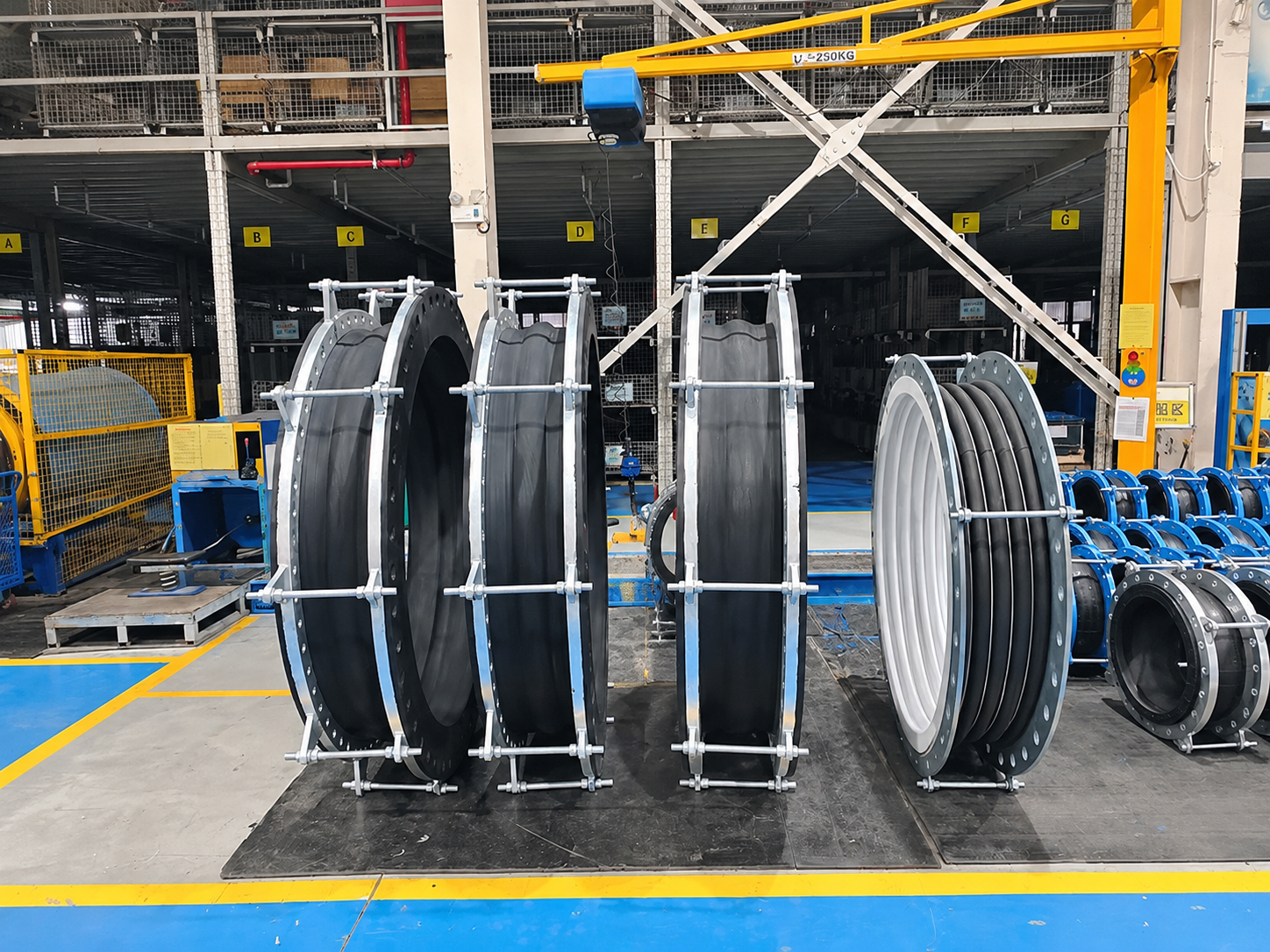
DN1400 Hand-Wrapped Rubber Expansion Joint: Structure and Custom Manufacturing
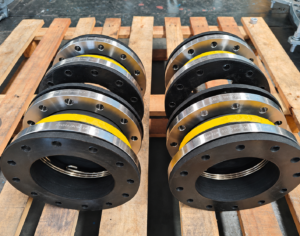
The DN1400 hand-wrapped rubber expansion joint is a large-diameter flexible pipe connector manufactured for demanding marine and industrial piping systems. This particular design was customized for a South Korean shipbuilding customer for use in a seawater desalination project.
With a nominal diameter of DN1400, the product is intended for large-bore pipeline connections where flexibility, vibration absorption, and movement compensation are important. Unlike conventional molded rubber expansion joints, hand-wrapped manufacturing provides greater flexibility when producing oversized products with non-standard dimensions and project-specific structural configurations.
1. Why Use Hand-Wrapped Manufacturing for DN1400 Expansion Joints?
Manufacturing a rubber expansion joint with a diameter of DN1400 requires specialized production processes and careful control of its overall construction.
The hand-wrapped manufacturing process involves building the rubber body layer by layer around a dedicated forming structure. Reinforcement materials are incorporated into the construction to provide the required mechanical strength and structural stability.
This manufacturing approach offers several advantages:
- Large-diameter customization: Suitable for oversized rubber expansion joints that may be difficult to manufacture using conventional molding equipment.
- Flexible structural design: Allows reinforcement arrangements to be developed according to project-specific pressure and movement requirements.
- Non-standard dimensions: Supports customized diameters, face-to-face lengths, and connection configurations.
- Special material construction: Allows different rubber compounds and lining solutions to be evaluated according to the conveyed medium.
- Project-specific manufacturing: Provides flexibility for marine engineering, desalination facilities, and large industrial pipeline projects.
For large-diameter rubber expansion joints, the reinforcement structure plays an important role in maintaining the balance between flexibility and mechanical strength. The design must consider internal pressure, pipeline movement, external operating conditions, and the forces transmitted through connected piping.
2. Seawater Resistance and Customized Internal Lining Options
Seawater desalination projects require careful consideration of material compatibility because rubber components may be exposed to seawater, varying salinity levels, treatment chemicals, and different operating temperatures.
The selection of rubber compounds should be based on the actual chemical composition and operating conditions.
Potential material options include:
- EPDM rubber: Commonly considered for water-related applications because of its resistance to water, ozone, and weathering.
- Chloroprene rubber (CR): May be considered for certain marine environments where weathering resistance is important.
- Fluoropolymer lining: An optional customized internal lining solution may be evaluated when additional chemical resistance is required. PTFE is one possible material, subject to compatibility and structural design verification.
A fluoropolymer-lined rubber expansion joint requires additional engineering consideration. The lining material, bonding structure, deformation requirements, and operating pressure must be evaluated together to ensure that the flexible construction remains suitable for its intended service.
For seawater applications, engineers should also distinguish between ordinary seawater exposure, chlorinated seawater, concentrated brine, and chemical cleaning conditions. These media can have different compatibility requirements.
3. Vibration Absorption and Pipeline Movement Compensation
Large seawater pipelines are frequently connected to pumps and other rotating equipment. Mechanical vibration and pipeline movement can create additional stress on connected piping components.
A properly designed DN1400 rubber expansion joint can help accommodate:
- Axial compression and extension.
- Lateral pipeline displacement.
- Angular movement within specified design limits.
- Equipment vibration transmission.
- Installation misalignment within permitted tolerances.
- Movement caused by changes in operating temperature.
However, rubber expansion joints should not be used as substitutes for proper pipeline supports, anchors, or guides. Pressure thrust and movement forces must be considered during system engineering. For large-diameter installations, control rods and other restraint arrangements may also be required depending on the design conditions.
Where Are DN1400 Seawater-Resistant Rubber Expansion Joints Used?
Large-diameter hand-wrapped rubber expansion joints are suitable for piping systems that require customized flexible connections, particularly in marine engineering, seawater desalination, and industrial water treatment.
1. Seawater Desalination Plants
Desalination facilities use extensive pipeline networks to transport raw seawater, treated water, and concentrated brine.
Potential installation locations include:
- Seawater intake pipelines.
- Raw seawater transfer systems.
- Seawater circulation pipelines.
- Reverse osmosis (RO) pretreatment systems.
- High-capacity seawater booster pump connections.
- Brine discharge pipelines.
- Desalinated water transfer systems.
In these applications, rubber expansion joints provide flexible connections between pipeline sections and connected equipment.
For seawater intake and transfer pipelines, resistance to the actual seawater environment is an important material selection factor. For reverse osmosis systems, operating pressure and chemical exposure should be evaluated according to the specific installation position.
2. Marine and Shipbuilding Piping Systems
Marine vessels and offshore facilities often contain large seawater piping networks used for cooling, circulation, water treatment, and other auxiliary systems.
Typical connected equipment includes:
- Marine seawater circulation pumps.
- Main engine cooling water pumps.
- Central cooling system heat exchangers.
- Ballast water transfer pumps.
- Marine firefighting water pumps.
- Shipboard desalination equipment.
- Seawater filtration systems.
In shipbuilding applications, customized rubber expansion joints help accommodate relative movement and vibration between equipment and connected pipelines.
The design may require special flange dimensions, face-to-face lengths, rubber compounds, and internal lining configurations to match the vessel’s piping layout.
3. Large Industrial Water Pumping Stations
Beyond marine applications, DN1400 rubber expansion joints can also be considered for large industrial water transfer and treatment systems.
Typical applications include:
- Horizontal split-case centrifugal pump discharge connections.
- Vertical turbine pump discharge pipelines.
- Industrial cooling water circulation systems.
- Municipal water supply pumping stations.
- Large-capacity water treatment facilities.
- Industrial wastewater transfer pipelines.
For these installations, engineers should evaluate operating pressure, possible vacuum conditions, pipeline movement, and pump vibration before selecting the appropriate expansion joint configuration.
4. Engineering Considerations for Large-Diameter Custom Expansion Joints
Selecting a DN1400 rubber expansion joint requires more than confirming the nominal pipeline diameter.
The following information should be considered during technical evaluation:
- Nominal diameter and actual pipe dimensions.
- Face-to-face installation length.
- Operating pressure and design pressure.
- Operating temperature and design temperature.
- Conveyed medium and chemical composition.
- Required axial, lateral, and angular movements.
- Flange material, drilling pattern, and connection standards.
- Vacuum requirements, if applicable.
- Pipeline support, anchoring, and restraint arrangements.
For seawater desalination projects, providing the actual medium composition and chemical treatment conditions is particularly important when selecting the rubber compound or optional internal lining.
Frequently Asked Questions
1. What Is the Difference Between Hand-Wrapped and Molded Rubber Expansion Joints?
Hand-wrapped rubber expansion joints are manufactured by building rubber and reinforcement layers around a forming structure, while molded products are produced using dedicated molds. Hand-wrapped manufacturing is particularly useful for oversized and non-standard configurations where conventional molding equipment may be limited. The manufacturing method does not automatically determine product quality or pressure capacity; these depend on the material formulation, reinforcement design, production control, and final engineering requirements.
2. Which Rubber Material Is Suitable for Seawater Expansion Joints?
EPDM is commonly considered for seawater-related applications because of its resistance to water, ozone, and weathering. However, the appropriate material depends on seawater composition, operating temperature, salinity, chlorine concentration, and chemical cleaning agents. Chloroprene rubber and specialized fluoropolymer lining solutions may also be evaluated for particular conditions. Material selection should be based on chemical compatibility data and the actual operating environment rather than the general description of seawater resistance.
3. Can a DN1400 Rubber Expansion Joint Withstand High Pressure?
The pressure capacity of a DN1400 rubber expansion joint depends on its rubber construction, reinforcement materials, flange configuration, and overall structural design. Large-diameter joints require particular attention to pressure thrust because the forces acting on the pipeline can become significant. Engineers should provide both operating and design pressure, together with any surge conditions. Proper anchoring, pipeline supports, and restraint arrangements must also be evaluated before confirming the final configuration.
4. Is an Internal PTFE Lining Necessary for Seawater Applications?
Not every seawater application requires PTFE lining. EPDM or another compatible rubber compound may be sufficient depending on the medium and operating conditions. An internal PTFE lining may be considered when additional chemical resistance is required, particularly where treatment chemicals or aggressive process fluids are involved. However, the lining must be compatible with the required movement, pressure, temperature, and bonding structure. The final selection should follow a complete application-specific engineering review.
5. How Should a Large-Diameter Rubber Expansion Joint Be Installed?
A large-diameter rubber expansion joint should be installed according to its approved dimensional drawing and movement requirements. The mating flanges must be properly aligned, and the joint should not be twisted or forced into position. Excessive axial compression or extension during installation should be avoided. Engineers must also verify bolt arrangements, pipe supports, fixed points, and any required control rods. Incorrect installation can introduce additional stress and reduce the service life of the flexible connector.
6. Can Rubber Expansion Joints Be Installed at Seawater Pump Outlets?
Yes. Rubber expansion joints can be installed at suitable seawater pump inlet or outlet connections when their pressure, vacuum, movement, and material requirements are properly evaluated. Their flexibility helps accommodate certain pipeline movements and reduces the transmission of equipment vibration. However, pump nozzle loads, pressure thrust, cavitation-related operating conditions, and pipeline support arrangements must be considered. The expansion joint should be selected as part of the complete pump piping system.
7. Can DN1400 Rubber Expansion Joints Be Customized for Korean Shipbuilding Projects?
Yes. DN1400 hand-wrapped rubber expansion joints can be manufactured according to project-specific drawings and technical requirements. Customization may include overall dimensions, face-to-face length, rubber compound, reinforcement structure, internal lining, and flange drilling. For Korean shipbuilding and seawater desalination projects, customers should provide piping drawings, operating conditions, seawater specifications, and applicable technical standards. These details allow the manufacturer to evaluate the appropriate construction and connection arrangement.
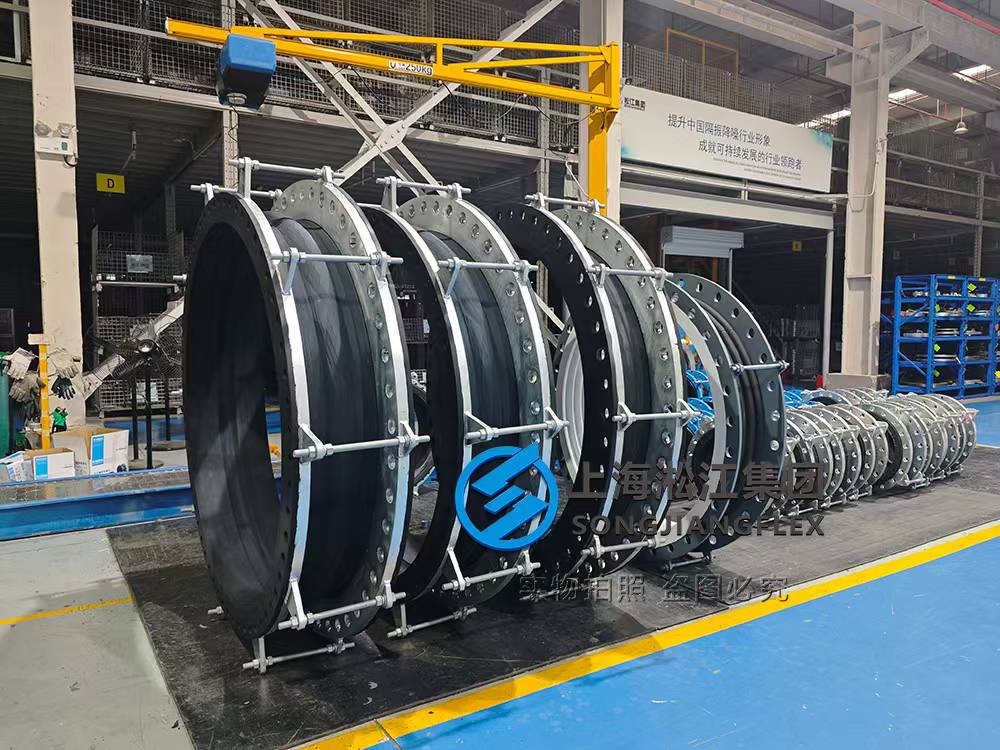
Conclusion and Contact Information
The DN1400 hand-wrapped rubber expansion joint provides a customized flexible connection solution for large-diameter seawater pipelines, marine cooling systems, and desalination facilities. Its hand-wrapped construction offers flexibility for oversized dimensions, while optional internal lining solutions can be evaluated for specific chemical service requirements.
For customized rubber expansion joint solutions, please provide your equipment weight, pipeline dimensions, technical drawings, operating pressure, temperature, medium composition, and applicable project standards. These details will help determine a suitable product configuration.
Email: [email protected]
Our company’s new website is now live, featuring the latest product introductions. For more details, please visit https://shsjflex.com/