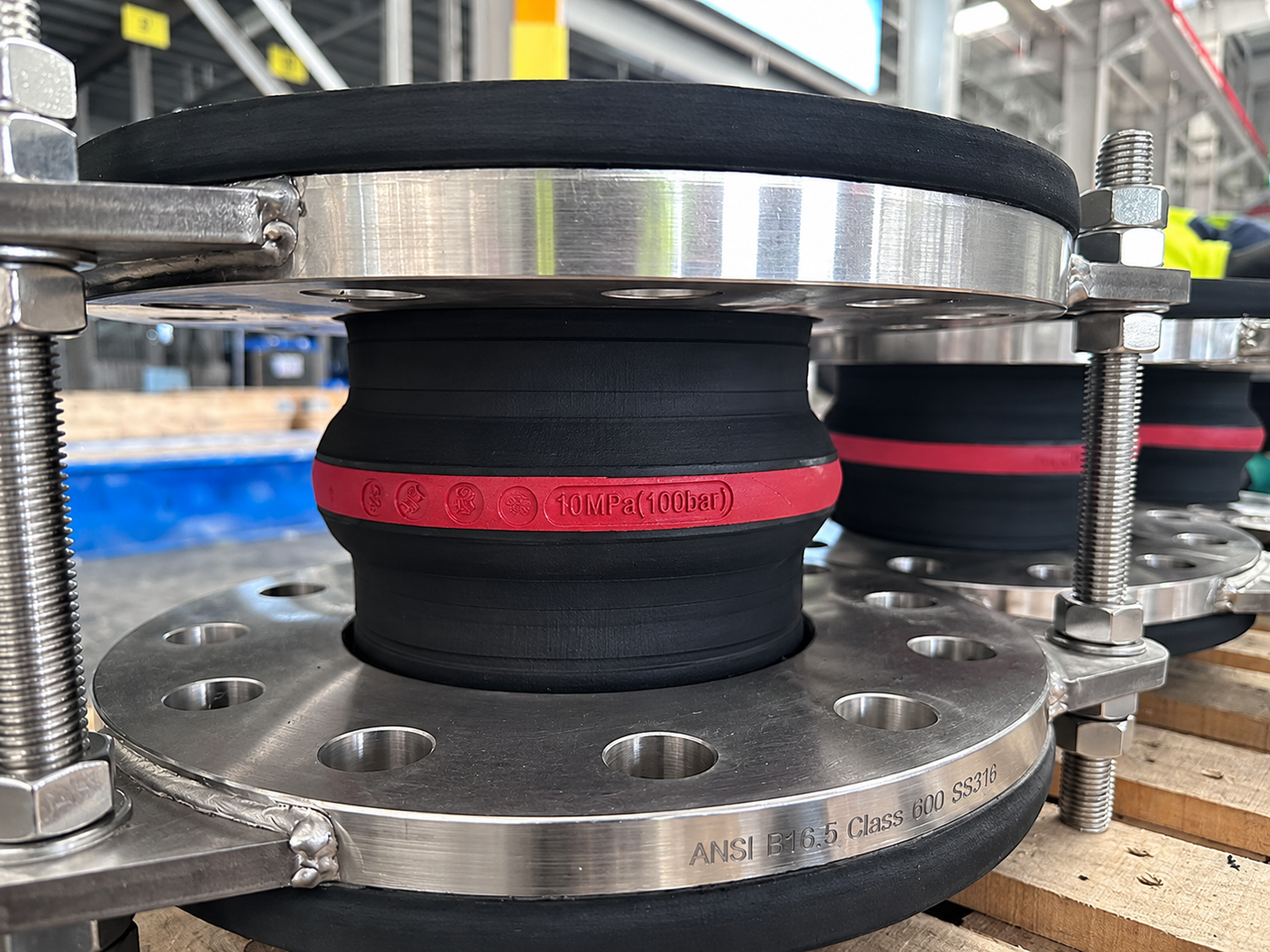
A high-pressure rubber expansion joint is a flexible piping component engineered to accommodate pipeline movement, reduce vibration transmission, and protect connected equipment under demanding pressure conditions. Unlike conventional molded rubber expansion joints, hand-wrapped expansion joints offer greater flexibility in structural design, reinforcement arrangements, and dimensional customization.
The product combines an elastomer body, engineered reinforcement layers, and metal flange connections through an integrally vulcanized construction. Rubber compounds and reinforcement configurations are selected according to operating pressure, temperature, fluid compatibility, and required movement.
High-pressure rubber expansion joints can be engineered for industrial pumping stations, petrochemical pipelines, power generation facilities, and high-pressure water transmission systems. Their application requires careful evaluation of pressure thrust, pipeline anchoring, operating conditions, and the interaction between internal pressure and mechanical displacement.
Custom 10 MPa Rubber Expansion Joint with Class 600 Flanges
A custom ultra-high-pressure rubber expansion joint has been manufactured for an overseas customer with a specified pressure of 10 MPa (100 bar). The product features a hand-wrapped, integrally vulcanized rubber structure and flange connection dimensions based on ANSI Class 600 requirements.
The hand-wrapped manufacturing process allows the reinforcement structure and rubber body geometry to be customized for demanding pressure conditions.
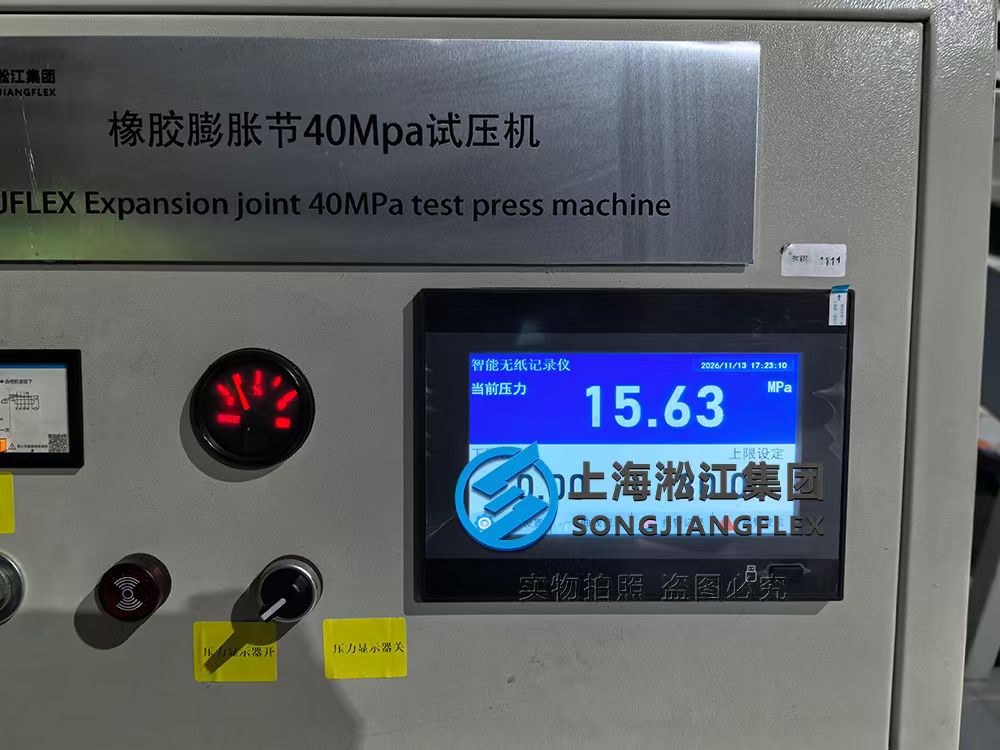
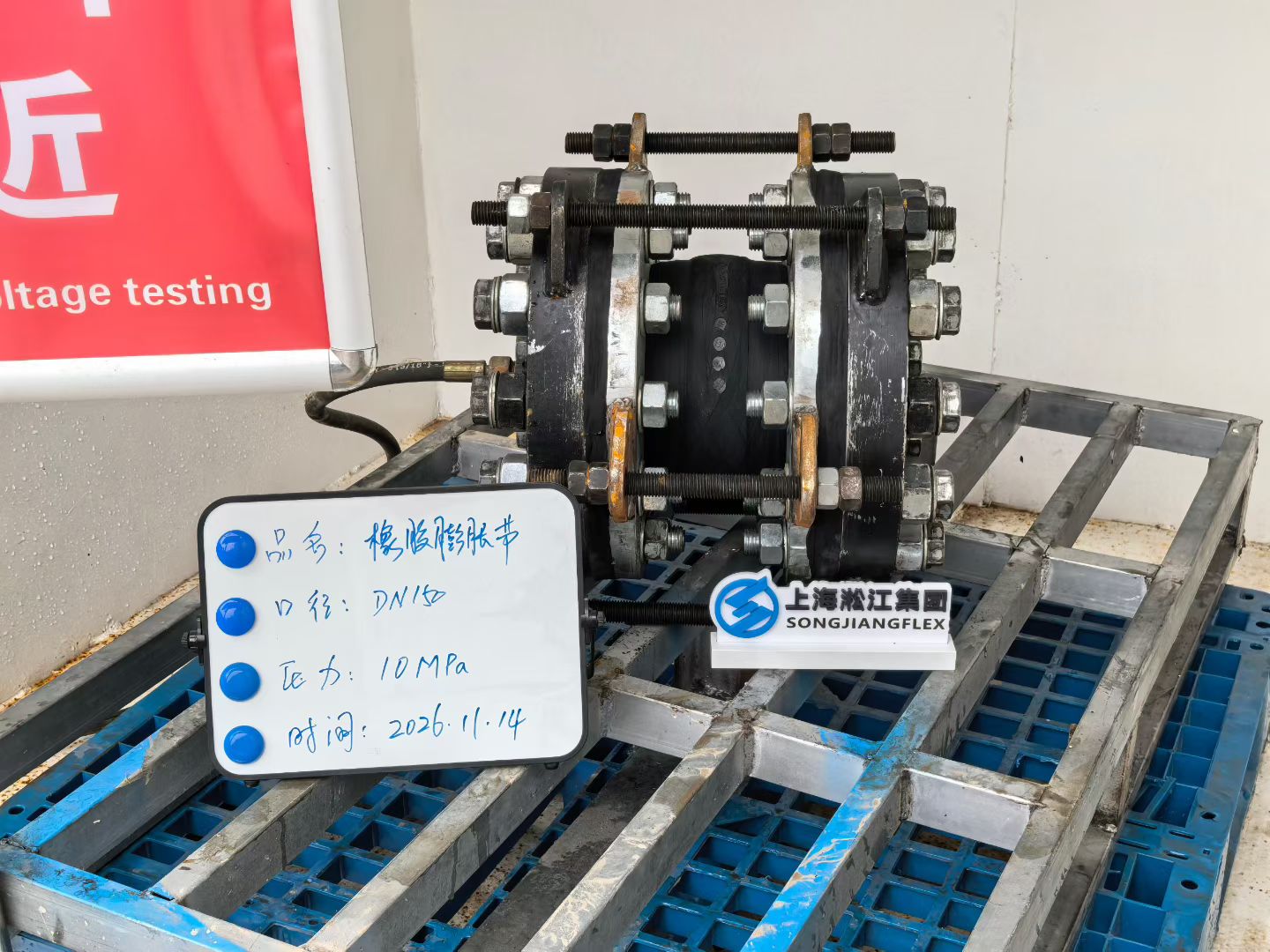
Figures 1 and 2 show the on-site hydrostatic pressure testing of the expansion joint at 1.5 times its specified pressure, equivalent to 15 MPa (150 bar).
Hydrostatic testing is an important quality control procedure for evaluating pressure integrity, structural deformation, and potential leakage. Final operating limits must be established according to the approved design specifications and documented test results.
Frequently Asked Questions
1. How is a 10 MPa rubber expansion joint designed?
A 10 MPa rubber expansion joint requires a specially engineered reinforcement structure rather than simply increasing the rubber wall thickness. The design must consider internal pressure, effective pressure area, reinforcement strength, rubber compound properties, flange construction, and required movement. Hand-wrapped manufacturing allows these elements to be adjusted according to specific engineering requirements. The relationship between pressure resistance, structural flexibility, and fatigue performance must also be evaluated before the final design is approved.
2. Does ANSI Class 600 mean a rubber expansion joint can withstand 10 MPa?
Not necessarily. ANSI Class 600 identifies a flange pressure-temperature classification and does not automatically establish the pressure rating of the complete rubber expansion joint. Under ASME B16.5, allowable flange pressure depends on material grade and operating temperature. Class 600 connection dimensions alone do not demonstrate suitability for 10 MPa service. The rubber body, reinforcement structure, flange material, bolting, and sealing arrangement must all be independently evaluated for the specified operating and testing conditions.
ALEKVS+1
3. Why is hydrostatic testing performed at 1.5 times the specified pressure?
Hydrostatic testing provides a controlled method for evaluating the pressure integrity of a rubber expansion joint. For a product with a specified pressure of 10 MPa, a test factor of 1.5 corresponds to 15 MPa, or 150 bar. During testing, leakage, abnormal deformation, and structural integrity can be assessed against agreed acceptance criteria. However, a hydrostatic test does not establish fatigue life, burst pressure, or continuous operating capability at the test pressure.
4. Which rubber materials are suitable for high-pressure expansion joints?
Rubber material selection depends primarily on fluid compatibility, operating temperature, environmental exposure, and mechanical performance. EPDM is commonly considered for water-based systems, while NBR is frequently selected for compatible oil-containing media. Other elastomers may be required for aggressive chemicals or specialized operating environments. Pressure resistance depends on the complete reinforced composite structure rather than the rubber compound alone. Material compatibility should therefore be confirmed before manufacturing an ultra-high-pressure rubber expansion joint.
5. How does integral vulcanization benefit high-pressure rubber expansion joints?
Integral vulcanization consolidates the rubber body and reinforcement layers into a bonded composite structure. Properly controlled vulcanization helps achieve bonding consistency between layers and enables internal pressure loads to be distributed through the reinforced structure. For custom high-pressure applications, manufacturing quality also depends on reinforcement positioning, rubber thickness control, curing conditions, and flange-end construction. Integral vulcanization is an important manufacturing feature, but pressure capability must still be supported by engineering evaluation and appropriate testing.
6. Are control rods and pipeline anchors necessary for 100 bar rubber expansion joints?
Pressure thrust management is essential in high-pressure piping systems. Internal pressure acting on the effective area of a rubber expansion joint generates substantial axial force, which increases significantly with pressure and effective diameter. Depending on the piping configuration, engineered anchors, guides, and suitably rated restraint assemblies may be required. Conventional movement-limiting control rods should not automatically be assumed capable of resisting full pressure thrust. The restraint system must be designed for the actual operating and test loads.
7. What information is required to order a custom ultra-high-pressure rubber expansion joint?
Customers should provide the nominal pipe diameter, face-to-face length, design pressure, operating pressure, maximum temperature, fluid composition, flange standard, flange material, and required axial, lateral, or angular movement. Information about pressure surges, vacuum conditions, operating cycles, and pipeline anchoring is also important. For overseas industrial projects, hydrostatic test requirements, inspection procedures, technical drawings, and material documentation should be agreed upon before production to ensure compatibility with the intended piping system.
Conclusion and Contact Information
Custom hand-wrapped rubber expansion joints provide an engineered solution for demanding industrial piping applications where conventional expansion joint designs may be unsuitable. The combination of integral vulcanization, customized reinforcement structures, Class 600 connection dimensions, and hydrostatic pressure testing supports project-specific engineering requirements.
We offer customized design and manufacturing support for high-pressure rubber expansion joints. Please provide your technical drawings, pipe dimensions, operating pressure, temperature, fluid medium, and movement requirements for engineering evaluation and quotation.
Email: [email protected]
Our company’s new website is now live, featuring the latest product introductions. For more details, please visit https://shsjflex.com/