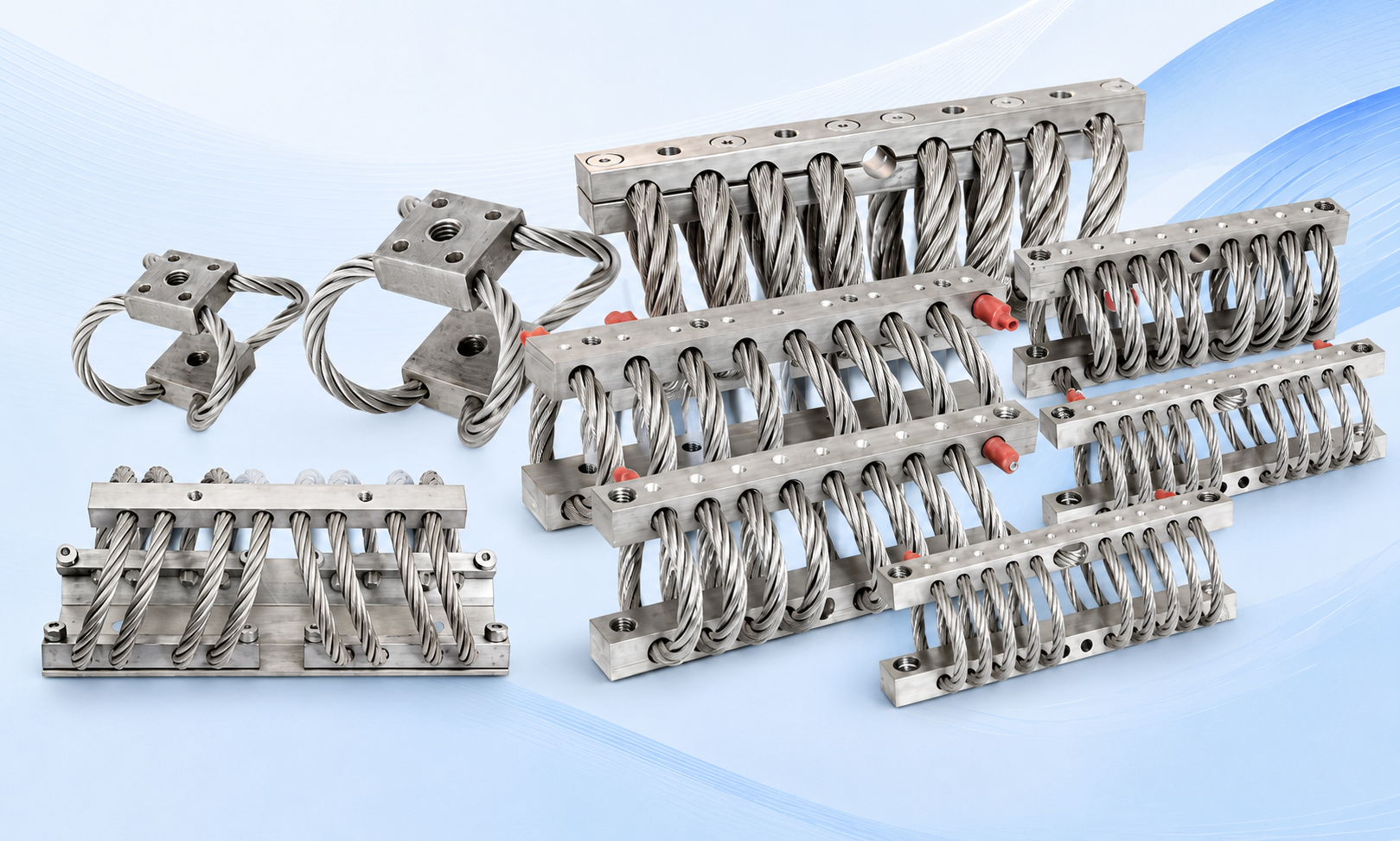
Modern industrial equipment, military systems, aerospace platforms, and marine electronics are constantly exposed to severe vibration, shock loads, and dynamic operating environments. Traditional rubber mounts and spring isolators often struggle to maintain stable performance under extreme temperatures, corrosive atmospheres, heavy impacts, or long-term cyclic loading.
Wire Rope Vibration Isolators, also known as wire rope shock mounts or cable vibration isolators, are specifically engineered to provide superior vibration isolation and shock protection while requiring virtually no maintenance. Their all-metal construction allows them to operate reliably in environments where conventional vibration isolators fail.
Whether protecting delicate electronic equipment or heavy industrial machinery, wire rope isolators offer an unmatched combination of durability, flexibility, and reliability.
What Is a Wire Rope Vibration Isolator?
A wire rope vibration isolator is a mechanical isolation device constructed from high-strength stainless steel wire ropes clamped between corrosion-resistant aluminum alloy or stainless steel retaining bars.
Instead of relying on rubber or springs, the intertwined wire rope provides excellent elasticity and internal friction, allowing the isolator to absorb:
- Continuous machine vibration
- High-impact shock loads
- Multi-directional dynamic forces
- Structural resonance
- Transportation vibration
Since there are no bonded rubber elements, the isolator maintains consistent performance across an extremely wide temperature range and is unaffected by UV radiation, ozone, oil, salt spray, or most chemicals.
Where Are Wire Rope Vibration Isolators Used?
Because of their exceptional environmental resistance, wire rope isolators are widely installed across numerous industries and mission-critical equipment.
Typical applications include:
Aerospace Equipment
- Aircraft avionics cabinets
- Flight data recorders
- UAV payload stabilization systems
- Helicopter electronic modules
- Radar systems
- Navigation equipment
- Airborne communication systems
Defense & Military Systems
- Missile launch electronics
- Armored vehicle communication equipment
- Military generators
- Mobile command centers
- Tactical surveillance systems
- Battlefield communication shelters
- Weapon control systems
Marine & Offshore Equipment
- Shipboard radar cabinets
- Marine navigation consoles
- Sonar systems
- Engine monitoring units
- Offshore drilling instrumentation
- Marine control panels
- Ship communication equipment
Industrial Machinery
- Industrial compressors
- Hydraulic power units
- CNC machine tools
- Laser cutting machines
- Precision inspection systems
- Semiconductor manufacturing equipment
- Industrial robots
- Vacuum pumps
- Industrial cooling systems
Energy Industry
- Wind turbine electrical cabinets
- Solar inverter cabinets
- Generator control systems
- Transformer monitoring equipment
- Nuclear auxiliary equipment
- Gas turbine monitoring systems
- Power distribution cabinets
Transportation Equipment
- Railway electronic cabinets
- Metro signaling systems
- Electric locomotive controllers
- Autonomous vehicle sensors
- Heavy mining vehicles
- Construction machinery electronics
Why Choose Wire Rope Isolators Instead of Rubber Mounts?
Although rubber vibration mounts perform well under normal industrial conditions, wire rope vibration isolators provide several advantages when operating in demanding environments.
Excellent Shock Absorption
The intertwined stainless steel cable dissipates impact energy gradually, making the isolator ideal for applications involving repeated shock loads, drops, transportation impacts, or explosive environments.
Wide Temperature Range
Unlike rubber materials that harden or soften with temperature changes, stainless steel wire rope isolators maintain stable performance in environments ranging from approximately -70°C to +260°C, depending on the model and materials.
Corrosion Resistance
Manufactured from stainless steel wire ropes and corrosion-resistant mounting bars, these isolators perform exceptionally well in:
- Offshore platforms
- Marine vessels
- Chemical processing plants
- Coastal environments
- Desert applications
- High-humidity conditions
Maintenance-Free Design
Wire rope isolators contain no rubber, hydraulic oil, or moving mechanical parts requiring lubrication. Their simple construction minimizes maintenance while delivering a long service life.
Multi-Axis Vibration Isolation
Unlike many traditional isolators designed for only one direction, wire rope isolators effectively isolate vibration in:
- Vertical direction
- Horizontal direction
- Axial direction
- Combined multi-axis excitation
This makes them especially suitable for equipment experiencing complex vibration profiles.
How Do Wire Rope Vibration Isolators Improve Equipment Reliability?
Uncontrolled vibration affects equipment in many ways:
- Loosened fasteners
- PCB solder joint fatigue
- Connector failures
- Sensor calibration drift
- Bearing wear
- Structural cracking
- Noise generation
- Reduced equipment lifespan
Properly selected wire rope isolators significantly reduce transmitted vibration energy, helping maintain stable equipment performance while extending maintenance intervals and reducing unexpected downtime.
Key Features of Wire Rope Vibration Isolators
- Stainless steel wire rope construction
- Excellent vibration isolation efficiency
- High shock absorption capability
- Long fatigue life
- Corrosion resistant
- No aging or cracking like rubber
- Suitable for outdoor applications
- Maintenance-free operation
- Multiple mounting orientations available
- Reliable performance under harsh environments
How to Select the Right Wire Rope Vibration Isolator?
Selecting the correct model involves evaluating multiple operating conditions rather than simply matching equipment weight.
Important design considerations include:
- Equipment weight
- Center of gravity
- Mounting orientation
- Static load per isolator
- Operating vibration frequency
- Shock acceleration
- Installation space
- Environmental temperature
- Corrosion exposure
- Transportation requirements
Professional vibration analysis ensures the selected isolator delivers the desired natural frequency and isolation performance without compromising equipment stability.
Frequently Asked Questions
What makes wire rope vibration isolators different from rubber vibration mounts?
Wire rope vibration isolators use stainless steel cables instead of elastomer materials to absorb vibration and shock. This allows them to maintain stable performance under extreme temperatures, UV exposure, salt spray, oil contamination, and chemical environments where rubber components may deteriorate over time. They also provide superior resistance to repeated shock loading and generally require less maintenance, making them ideal for demanding industrial, aerospace, marine, and defense applications.
Can wire rope vibration isolators withstand heavy shock loads?
Yes. One of the primary advantages of wire rope isolators is their outstanding shock absorption capability. The flexible stainless steel cable structure dissipates impact energy through controlled deformation and internal friction, helping protect sensitive equipment from transportation impacts, mechanical shocks, accidental drops, explosions, or severe operational vibrations. They are widely used to safeguard mission-critical electronics and precision instruments in harsh environments.
Are wire rope vibration isolators suitable for outdoor installations?
Absolutely. Their all-metal construction provides excellent resistance to rain, snow, ultraviolet radiation, ozone, salt spray, humidity, and many industrial chemicals. Because they contain no rubber elements that can crack or age, wire rope isolators are frequently installed on offshore platforms, marine vessels, mining equipment, wind turbines, railway systems, and outdoor communication infrastructure, where long-term reliability is essential.
How many wire rope isolators should be installed on one piece of equipment?
The required quantity depends on several factors, including equipment weight, center of gravity, dimensions, mounting orientation, expected shock loads, and overall stability requirements. While many systems use four isolators, larger or taller equipment may require six, eight, or more units to achieve balanced load distribution and adequate resistance to overturning moments. Engineering calculations are recommended to determine the optimal configuration.
Do wire rope vibration isolators require regular maintenance?
One of the biggest advantages of wire rope isolators is their maintenance-free operation. Since there are no bonded rubber parts, hydraulic fluids, or mechanical springs that require adjustment or lubrication, routine maintenance is minimal. Periodic visual inspections to check mounting hardware and confirm that the wire rope has not been subjected to abnormal mechanical damage are generally sufficient for long-term service.
Contact Us
Our company’s new website is now live, featuring the latest product introductions.
🌐 Website: https://shsjflex.com/
📧 Email: [email protected]
If you need assistance selecting the appropriate wire rope vibration isolator for your application, our engineering team is ready to provide customized recommendations based on your equipment weight, operating environment, vibration characteristics, and installation requirements.