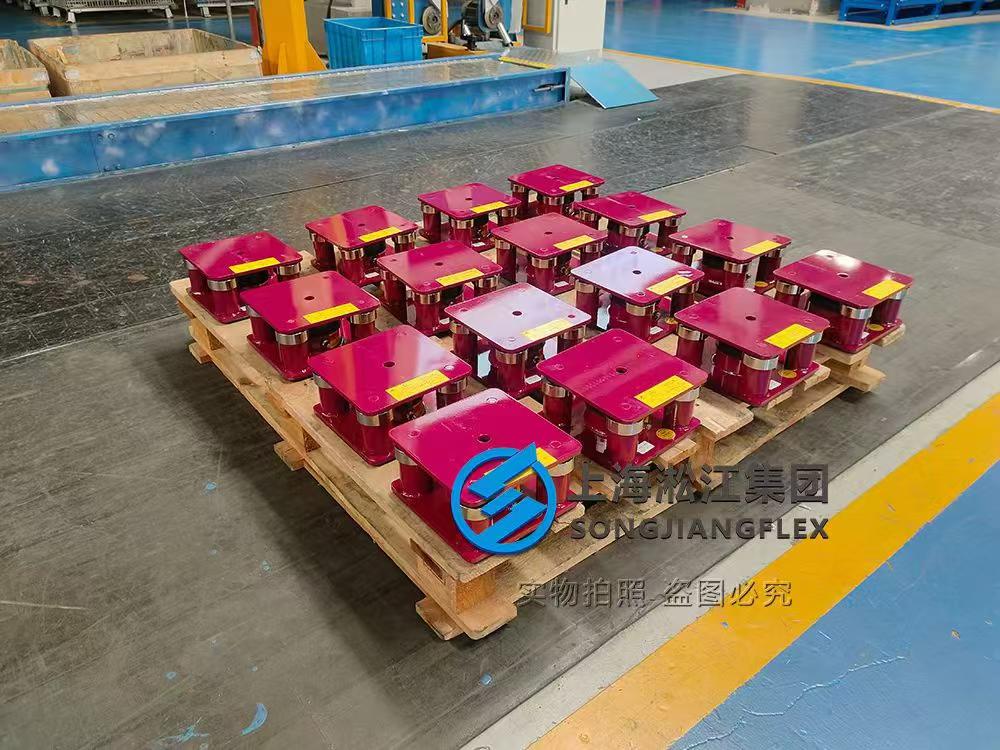
Modern precision equipment is becoming increasingly sensitive to vibration. Even small vibrations transmitted through factory floors, concrete foundations, nearby production machines, HVAC systems, pumps, compressors, or moving vehicles can affect machining accuracy, measurement repeatability, optical alignment, and equipment stability.
The KQJZ-B Damped Air Vibration Isolator is specially designed for applications requiring excellent low-frequency vibration isolation and fast vibration attenuation. It combines an air cushion (air spring) with an integrated hydraulic damping system, providing both soft pneumatic support and effective vibration damping in one compact isolation unit.
Unlike conventional rubber vibration mounts or mechanical spring isolators, the KQJZ-B uses compressed air to create a low-stiffness support system, while the hydraulic damping mechanism helps control excessive oscillation during equipment startup, shutdown, load changes, impact, and external disturbances.
This combination makes the KQJZ-B particularly suitable for precision machinery, semiconductor equipment, optical instruments, measuring machines, laboratory equipment, inspection systems, and other vibration-sensitive industrial applications.
How Does the KQJZ-B Air and Hydraulic Damping System Work?
The operating principle of the KQJZ-B can be summarized as:
Air Cushion + Hydraulic Damping + Equipment Support + Vibration Isolation
The air cushion supports the equipment through compressed air. Compared with a rigid support structure, pneumatic support can provide relatively low system stiffness, which is particularly useful for isolating low-frequency vibration.
However, a very soft isolation system may experience noticeable movement when the equipment is suddenly disturbed.
This is where the integrated hydraulic damping mechanism becomes important.
When vertical movement occurs, the hydraulic damping system dissipates part of the vibration energy and helps suppress excessive oscillation. This allows the supported machine to return to a stable operating condition more quickly.
In practical applications, the air cushion primarily provides vibration isolation, while the hydraulic damping mechanism provides motion control and vibration attenuation.
The combination helps achieve a balance between isolation efficiency and equipment stability.
What Are the Main Advantages of the KQJZ-B Damped Air Isolator?
Excellent Low-Frequency Vibration Isolation
The pneumatic air cushion provides a soft elastic support system that helps reduce the transmission of low-frequency floor vibration to sensitive machinery.
This is especially important in factories where vibration may originate from nearby CNC machines, stamping presses, forklifts, compressors, pumps, elevators, HVAC equipment, or other production machinery.
Integrated Hydraulic Damping
The built-in hydraulic damping mechanism helps control excessive movement around the resonance region.
Instead of allowing the equipment to oscillate for an extended period after being disturbed, hydraulic damping helps dissipate vibration energy and shorten stabilization time.
Improved Equipment Stability
For measuring, inspection, optical, and precision machining equipment, vibration can directly influence accuracy.
By reducing vibration transmission between the machine and its foundation, the KQJZ-B can help create a more stable working environment.
Suitable for Heavy Precision Equipment
Different load capacities can be designed according to equipment weight, center of gravity, mounting arrangement, and the number of vibration isolators installed.
This allows KQJZ-B damped air isolators to be used for both individual precision machines and larger integrated equipment platforms.
Air Pressure Can Be Adjusted
The pneumatic support characteristics can be matched to the actual machine load by adjusting the operating air pressure within the permitted range.
For machines with uneven weight distribution, each mounting position can be selected according to the actual load rather than simply dividing the total machine weight equally.
Which Equipment Can Use KQJZ-B Damped Air Vibration Isolators?
KQJZ-B pneumatic vibration isolators can be considered for a wide range of vibration-sensitive equipment, including:
Precision Machining Equipment
- CNC precision machining centers
- High-speed CNC milling machines
- Ultra-precision lathes
- Precision grinding machines
- Surface grinding machines
- Cylindrical grinding machines
- Jig grinding machines
- Gear grinding machines
- Precision boring machines
- Diamond turning machines
- Ultra-precision polishing machines
- Wafer grinding and polishing equipment
Coordinate Measuring and Inspection Equipment
- Coordinate Measuring Machines (CMM)
- Optical measuring machines
- Vision measuring systems
- Roundness measuring machines
- Surface roughness testers
- Contour measuring machines
- Laser interferometers
- Precision dimensional inspection systems
- Automated optical inspection equipment
- 3D scanning and metrology systems
Semiconductor and Electronics Equipment
- Semiconductor inspection equipment
- Wafer inspection systems
- Wafer probing stations
- Wafer measurement equipment
- Lithography-related auxiliary equipment
- Semiconductor packaging inspection machines
- IC testing equipment
- PCB inspection equipment
- Microelectronic assembly equipment
- Precision dispensing equipment
- Laser processing equipment
Optical and Photonics Equipment
- Optical tables
- Laser experiment platforms
- Optical benches
- Microscope platforms
- Electron microscope auxiliary platforms
- Interferometer systems
- Spectrometer platforms
- Photonics research equipment
- Precision lens inspection systems
- Laser alignment systems
Laboratory and Scientific Instruments
- Precision balances
- Analytical balances
- Laboratory testing platforms
- Material testing instruments
- Surface analysis equipment
- Precision sensors
- Calibration systems
- Research laboratory instruments
- Vibration-sensitive experimental platforms
Why Is Floor Vibration a Problem for Precision Equipment?
Industrial vibration does not always come from the machine itself.
A precision measuring machine installed inside a factory may receive vibration through the building structure from equipment located tens of meters away.
Common vibration sources include:
- CNC machining centers
- Punching and stamping presses
- Air compressors
- Cooling towers
- Chillers
- Water pumps
- Industrial fans
- Elevators
- Forklifts
- Overhead cranes
- Heavy trucks
- Railway traffic
- Nearby construction activities
These vibrations can propagate through concrete floors and structural foundations.
For ordinary industrial machines, the vibration level may be acceptable. For a high-resolution measuring machine, optical instrument, semiconductor inspection system, or ultra-precision machining center, however, even relatively small vibration can become an important source of measurement error.
This is why low-frequency vibration isolation is increasingly important in precision manufacturing facilities.
Air Spring Isolator vs. Rubber Vibration Mount
Rubber vibration mounts are simple, economical, compact, and suitable for many conventional industrial machines.
However, their stiffness is determined largely by rubber geometry and hardness. For extremely vibration-sensitive equipment, especially where lower natural frequency is required, conventional rubber mounts may not provide sufficient isolation.
A pneumatic air isolation system can provide a softer support characteristic.
For this reason, KQJZ-B damped air isolators are generally more suitable for applications where precision, low-frequency isolation, and fast stabilization are important.
Air Isolator vs. Steel Spring Isolator
Steel spring isolators are widely used for HVAC equipment, pumps, fans, chillers, generators, compressors, and industrial machinery.
They offer excellent load-bearing capability and are effective in many vibration-control applications.
However, precision measuring and optical equipment often requires a different isolation approach.
The KQJZ-B combines a pneumatic spring effect with hydraulic damping, making it particularly useful when the objective is not simply to support heavy equipment but also to reduce low-frequency environmental vibration and control equipment movement.
How to Select the Correct KQJZ-B Air Vibration Isolator
Correct selection should be based on actual operating conditions rather than machine weight alone.
For accurate model selection, the following information is recommended:
- Equipment name and application
- Total equipment weight
- Number of isolators required
- Load distribution at each mounting point
- Equipment dimensions
- Center-of-gravity position
- Operating vibration frequency
- External floor vibration conditions
- Required vibration isolation performance
- Available installation space
- Required installation height
- Air supply conditions
- Operating environment
- Expected horizontal and vertical movement
For example, a 4,000 kg machine using four isolators does not necessarily mean each isolator carries exactly 1,000 kg.
If the center of gravity is offset, one side of the machine may carry significantly more load.
Therefore, selecting each air isolator according to the actual load at each support point is strongly recommended.
Can KQJZ-B Isolators Improve Measurement Accuracy?
A vibration isolator does not directly increase the intrinsic accuracy of a measuring instrument.
However, it can reduce environmental vibration transmitted to the machine.
For equipment such as CMMs, laser measuring systems, optical instruments, microscopes, surface measuring machines, and semiconductor inspection equipment, reducing external vibration can help the machine operate under more stable conditions.
This can be especially valuable in factories where precision inspection equipment is installed close to heavy production machinery.
Frequently Asked Questions
1. What is the difference between KQJZ-B and a conventional air spring?
A conventional air spring mainly provides pneumatic support and vibration isolation. The KQJZ-B combines the pneumatic support function with an integrated hydraulic damping mechanism.
The air cushion helps achieve soft support and low-frequency vibration isolation, while hydraulic damping helps reduce excessive oscillation and shorten the time required for the equipment to become stable after disturbance.
This makes the KQJZ-B particularly suitable for precision machinery that requires both vibration isolation and controlled dynamic movement.
2. Can KQJZ-B be used under a Coordinate Measuring Machine?
Yes. Coordinate Measuring Machines are typical vibration-sensitive machines and can benefit from pneumatic vibration isolation, particularly when installed in production workshops with nearby machining equipment.
However, selection should consider the CMM weight, dimensions, support positions, center of gravity, environmental vibration spectrum, and accuracy requirements.
For high-precision CMM applications, actual site vibration measurement is recommended before finalizing the isolation solution.
3. Can the isolator be customized for different equipment weights?
Yes. The load capacity and configuration can be selected or customized according to equipment requirements.
For proper selection, customers should provide total machine weight, number of mounting points, dimensions, center-of-gravity information, and preferably the actual load at each support position.
Uneven load distribution is common in industrial equipment, so the same isolator model does not always need to be installed at every mounting point.
4. Does the KQJZ-B require compressed air?
Yes. Because the KQJZ-B uses pneumatic support, an appropriate compressed-air source is required.
The actual operating pressure depends on the selected model and supported load. Air pressure should always remain within the specified operating range.
For precision installations, stable and clean compressed air is recommended.
5. Can KQJZ-B isolate horizontal vibration?
The air isolation system can provide vibration isolation in multiple directions, but vertical and horizontal characteristics are not necessarily identical.
The actual performance depends on the isolator structure, installation arrangement, supported machine, center of gravity, and operating conditions.
If horizontal vibration is a major concern, customers should provide vibration direction, frequency, amplitude, and equipment dimensions so that the application can be evaluated properly.
6. Is KQJZ-B suitable for CNC machine tools?
It can be suitable for precision CNC machines, grinding machines, machining centers, and other machine tools where environmental vibration isolation is required.
However, dynamic cutting forces must also be considered. A machine producing strong reciprocating or impact forces may require a different isolation strategy from a CMM or optical instrument.
Therefore, the machine operating principle, spindle speed, moving mass, cutting process, weight, and vibration characteristics should be evaluated before selection.
7. How many air vibration isolators are required?
Four support points are common, but the correct quantity depends on equipment dimensions, weight distribution, frame rigidity, center of gravity, and structural design.
Large machines may require six, eight, or more support points.
The objective is not simply to use more isolators, but to ensure that each isolator operates within an appropriate load range while maintaining stable equipment support.
8. Can KQJZ-B replace a concrete machine foundation?
Not automatically.
A vibration isolator and a machine foundation perform different functions. The isolator reduces vibration transmission, while the foundation provides structural support, mass, rigidity, and load distribution.
For some precision machines, an air isolation system can simplify foundation requirements. For very heavy or highly dynamic machinery, however, foundation design may still be essential.
The complete machine-foundation-isolator system should be evaluated as a whole.
KQJZ-B for Modern Precision Manufacturing
As manufacturing accuracy continues to improve, vibration control is becoming increasingly important.
The KQJZ-B Damped Air Vibration Isolator provides a practical solution by integrating an air cushion and hydraulic damping system into a single vibration isolation unit.
It is particularly suitable for applications requiring:
low-frequency vibration isolation, pneumatic machine support, hydraulic damping, precision equipment stabilization, micro-vibration control, floor vibration isolation, and high-accuracy machinery protection.
For customized model selection, please provide your equipment weight, dimensions, number of mounting points, operating frequency, and vibration conditions.
Contact Us
Our company’s new website is now live, featuring the latest product introductions.
For more details, please visit:
Email: [email protected]