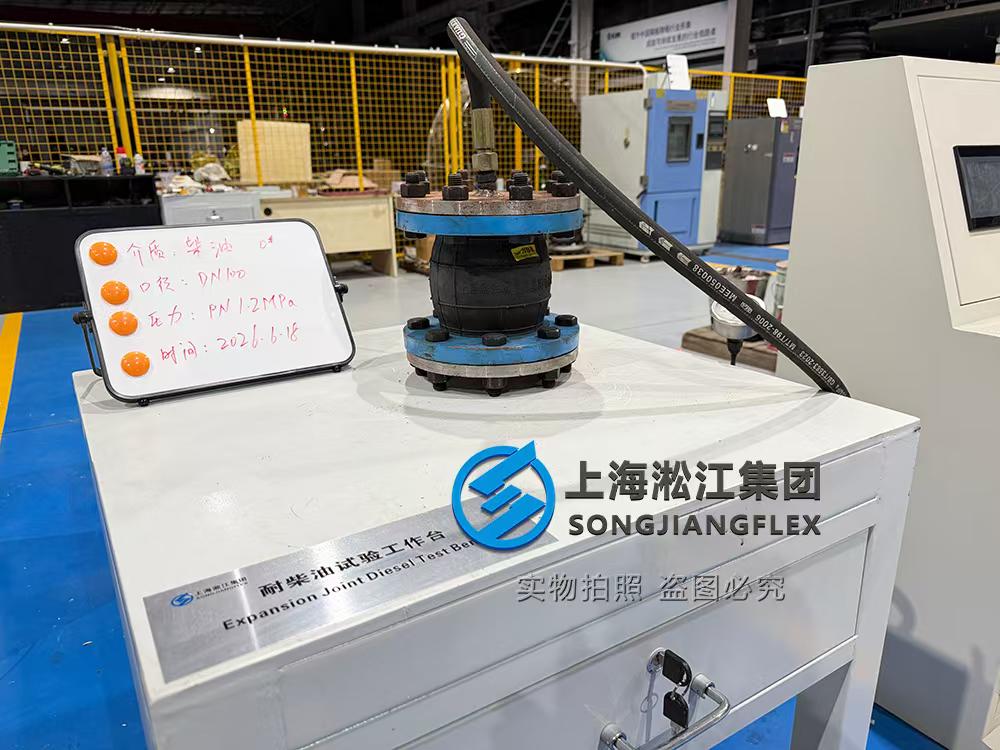
Diesel fuel piping systems are widely used in diesel generator installations, emergency power plants, fuel transfer stations, marine engine rooms, data centers, industrial boiler systems, and heavy machinery. Although the piping itself may appear relatively simple, vibration generated by pumps and engines can continuously transfer into connected pipelines.
A diesel-resistant rubber expansion joint provides a flexible connection between equipment and rigid piping. It helps absorb vibration, compensate for minor movement and installation deviation, and reduce structure-borne noise while maintaining compatibility with diesel and fuel oil.
For applications where diesel is the actual operating medium, material selection is especially important. Standard water-service rubber expansion joints should not automatically be used in fuel systems. NBR, or nitrile rubber, is commonly selected because of its resistance to petroleum oils, diesel fuel, and fuel oils. Parker’s material guidance specifically identifies NBR as suitable for diesel fuel and fuel oils, while Trelleborg also uses an NBR inner layer in rubber expansion joints designed for fuel and petrochemical applications.
Why Is NBR Suitable for Diesel Fuel?
The inner rubber layer is continuously exposed to the pipeline medium, so its chemical compatibility directly affects service reliability.
NBR is an acrylonitrile-butadiene elastomer known for its balance of mechanical strength, wear resistance, and resistance to petroleum-based fluids. Increasing acrylonitrile content can improve resistance to oils and fuels, although compound formulation must also consider elasticity and compression characteristics.
This makes properly formulated NBR rubber expansion joints suitable for many diesel-related applications, including diesel fuel, fuel oil, lubricating oil, and petroleum-based fluids.
EPDM, by comparison, is excellent for many water, hot-water, ozone, and weathering applications, but is generally not recommended for petroleum oils and hydrocarbon fluids.
Therefore, rubber material should always be selected according to the actual medium, not simply according to pipe diameter or pressure rating.
Diesel Medium Pressure Testing
For fuel-service expansion joints, checking dimensions alone is not enough. Pressure integrity is one of the most important considerations.
A diesel medium pressure test can be used when required by the agreed inspection procedure to evaluate the completed rubber expansion joint under conditions more representative of its intended service.
During testing, attention should be paid to several areas:
- Leakage around the rubber body and flange connection
- Abnormal swelling or deformation of the rubber
- Stability of the reinforced rubber body under pressure
- Flange sealing performance
- Bonding condition between rubber and reinforcing structure
- Dimensional behavior of the expansion joint during pressurization
- Condition of the joint after pressure release
The specific test pressure, holding time, test temperature, and acceptance criteria should always be defined according to the product design, rated working pressure, applicable standard, and project specification. A pressure test should never be performed at an arbitrary pressure simply because another rubber joint of the same nominal diameter has a higher pressure rating.
Where Are Diesel-Resistant Rubber Expansion Joints Used?
One of the most common applications is the diesel generator fuel system.
Large standby generators used in data centers, hospitals, airports, telecom facilities, financial centers, semiconductor factories, and emergency power stations usually have dedicated diesel storage and transfer systems. These systems can include bulk storage tanks, day tanks, transfer pumps, fuel polishing equipment, duplex filters, booster pumps, and supply/return pipelines.
Rubber flexible joints may be installed near the diesel transfer pump suction and discharge connections to reduce pump vibration transmitted into the rigid piping.
Another important application is the diesel generator engine fuel supply system. Generator sets from manufacturers such as Caterpillar, Cummins, MTU, Perkins, MAN, and Mitsubishi can generate mechanical vibration during operation. Properly selected flexible connections help isolate the associated piping from equipment vibration.
Other typical applications include:
Fuel Transfer Pump Skids: Flexible joints can be installed around centrifugal pumps, gear pumps, screw pumps, and diesel transfer pump assemblies.
Emergency Generator Rooms: Hospitals, commercial complexes, airports, and data centers often use multiple generator sets connected to centralized diesel storage systems.
Industrial Boiler Fuel Systems: Diesel or light fuel oil may be supplied to burners through pump and filtration skids.
Marine Auxiliary Diesel Systems: Fuel oil and lubricating oil piping in marine machinery spaces can require specialized flexible connections. Marine applications require particular attention to classification, fire protection, installation position, and isolation arrangements. DNV documentation for approved rubber expansion joints, for example, specifies particular limitations and safety provisions for fuel-oil and lubricating-oil piping.
Tank and Fuel Loading Systems: Flexible pipeline components can also be found in fuel transfer and loading/unloading systems; specialized fuel-handling products are widely used for road tanker and similar transfer applications.
How Does a Rubber Expansion Joint Reduce Pump Vibration?
A rigid steel pipeline provides an efficient path for transmitting mechanical vibration.
When a diesel transfer pump, fuel circulation pump, or engine vibrates, these dynamic forces can travel through the connected pipe and pipe supports. The result may be increased noise, flange stress, support vibration, and undesirable loads on nearby equipment.
A rubber expansion joint introduces a flexible section between the vibration source and the rigid pipeline.
Its elastomeric body can help attenuate high-frequency vibration while also accommodating specified axial, lateral, and angular movement. This is particularly useful around rotating equipment such as centrifugal pumps, screw pumps, gear pumps, diesel engines, and generator auxiliary systems.
However, an expansion joint should not be treated as a solution for uncontrolled pipeline movement. Correct pipe anchoring, guides, supports, and—where required—control rods remain essential parts of the piping design.
Important Information Before Selecting a Diesel Expansion Joint
A reliable selection should be based on more than DN and flange standard.
Before manufacturing, engineers should confirm the nominal diameter, face-to-face length, flange standard, working pressure, test pressure, operating temperature, actual fuel composition, required movement, vacuum condition if applicable, and installation environment.
The exact diesel specification is particularly important. Different fuel formulations can contain different levels of aromatic hydrocarbons or additives. Standard NBR has broad diesel and fuel-oil compatibility, but material compatibility should still be checked for the actual fuel composition. Parker, for example, notes limitations for standard NBR with high-aromatic-content fuels and certain aromatic hydrocarbons.
For more demanding temperature or fuel conditions, specially formulated NBR, HNBR, or FKM may be evaluated depending on the application.
FAQ
1. Can an ordinary EPDM rubber expansion joint be used for diesel fuel?
It is generally not recommended. EPDM performs very well with water, hot water, weathering, and ozone, but petroleum oils and hydrocarbon fluids are a major compatibility limitation. Parker specifically lists EPDM as not recommended for petroleum oils and hydrocarbon fluids.
For diesel service, an appropriately formulated NBR fuel-resistant rubber is usually a more suitable starting point. The final selection should still consider temperature, fuel formulation, pressure, and required service life.
2. Why conduct a pressure test using diesel medium?
When specified by the customer or inspection procedure, testing with the actual or representative service medium can provide additional verification of the completed product’s behavior under fuel-service conditions.
The purpose is not simply to see whether the joint “holds pressure.” Inspection should consider leakage, abnormal deformation, rubber condition, sealing areas, flange connections, and the overall structural response of the expansion joint.
Testing requirements should be established before production because test pressure, holding time, medium, safety measures, and acceptance criteria may differ between projects.
3. Can diesel-resistant rubber expansion joints be installed on generator fuel pipes?
Yes, provided the expansion joint is correctly selected for the particular fuel system.
Typical locations can include diesel transfer pump connections, day-tank circulation lines, fuel filtration skids, generator auxiliary fuel piping, and other vibration-sensitive connections.
However, the working pressure, fuel temperature, pipe diameter, flange specification, required movement, installation arrangement, and applicable fire or classification requirements must be confirmed before selection.
4. Is NBR always the best rubber for every diesel application?
No. NBR is widely used for diesel and petroleum oils, but the correct elastomer depends on the complete operating environment.
Higher temperatures, unusual fuel additives, high aromatic content, outdoor exposure, marine conditions, or other aggressive service conditions may justify evaluating HNBR, FKM, or a specially formulated NBR compound. FKM generally provides stronger high-temperature and oil/fuel resistance, while HNBR can offer improved temperature and ozone performance compared with conventional NBR.
5. What information should be provided when requesting a quotation?
For an accurate quotation and technical selection, provide at least the pipe size, working pressure, operating temperature, exact medium, flange standard, face-to-face length, required axial/lateral movement, quantity, and application equipment.
For generator projects, also indicate whether the joint is installed on the supply line, return line, transfer-pump suction, transfer-pump discharge, or another specific position.
Contact Us
Our company’s new website is now live, featuring the latest product introductions. For more details, please visit https://shsjflex.com/ [email protected]