Industrial piping systems are constantly exposed to vibration, pressure fluctuations, thermal expansion, equipment movement, and installation stress. Pumps, chillers, cooling towers, compressors, heat exchangers, and other rotating equipment can transfer vibration directly into connected pipelines, increasing noise and mechanical stress.
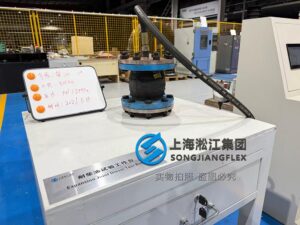
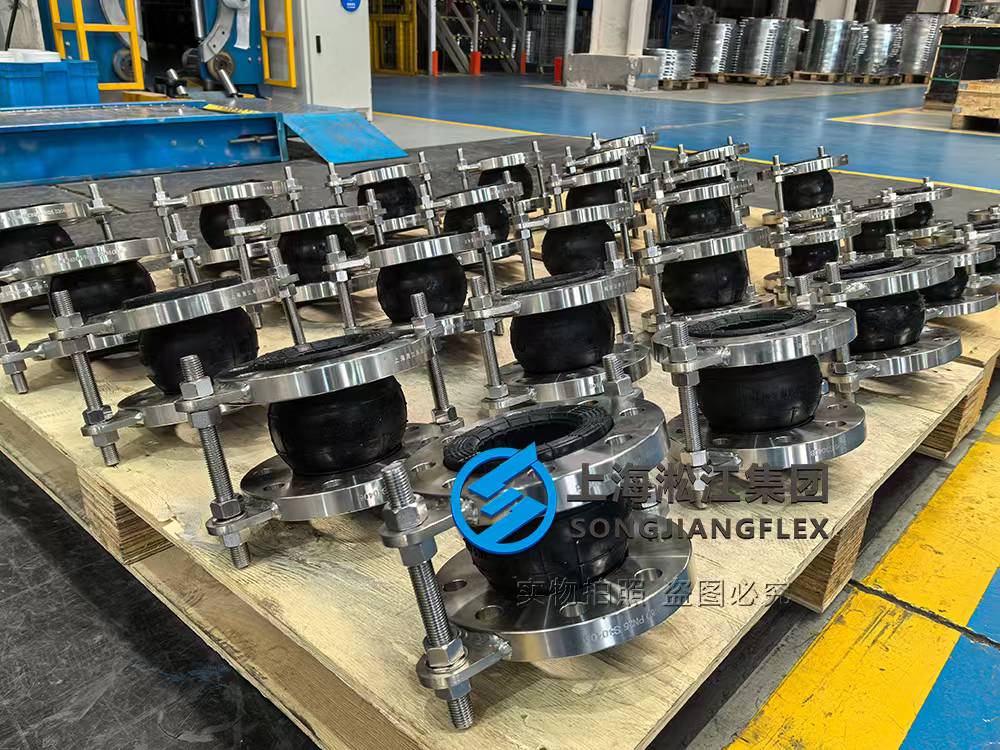
A rubber expansion joint with 304 stainless steel flanges and control rods provides a practical flexible connection for these applications. It combines an elastomeric flexible body with corrosion-resistant SUS304 stainless steel flanges and an external restraint system designed to control excessive movement.
This configuration is widely considered for HVAC systems, pump rooms, industrial cooling-water pipelines, water-treatment equipment, circulation systems, and other applications where vibration isolation and controlled pipeline movement are required.
What Is a Restrained Rubber Expansion Joint?
A restrained rubber expansion joint consists of several main components:
- Flexible rubber bellows
- Reinforcing cord fabric
- Internal reinforcement structure
- SUS304 stainless steel flanges
- Stainless steel control rods or tie rods
- Limit plates or control rod plates
- Nuts and washers
- Optional spherical and conical washers
- Optional vacuum reinforcement rings
The rubber body provides flexibility, while the external control rods restrict excessive axial extension.
Unlike a rigid pipe spool, the flexible rubber connector can accommodate a designed amount of axial movement, lateral movement, angular deflection, vibration, and installation deviation.
The control rod assembly adds another level of protection by helping prevent the rubber joint from being excessively stretched due to pressure thrust or unexpected pipeline movement.
Why Choose 304 Stainless Steel Flanges?
Carbon-steel flanges are suitable for many standard industrial applications, but stainless steel flanges can offer advantages where corrosion resistance, cleanliness, or long-term appearance is important.
SUS304 stainless steel flanges are commonly considered for:
- Chilled-water pump rooms
- Cooling-water circulation systems
- Commercial HVAC installations
- Water-treatment equipment
- Clean-water pipelines
- Food-processing utility systems
- Pharmaceutical utility piping
- Humid mechanical rooms
- Outdoor equipment installations
- General industrial process-water systems
Compared with ordinary painted carbon steel, stainless steel does not depend solely on an external coating for corrosion protection.
For more aggressive chloride, seawater, chemical, or highly corrosive environments, however, 304 stainless steel should not automatically be selected. Depending on the actual medium and environmental conditions, SS316L or another corrosion-resistant material may be more appropriate.
What Is the Function of the Control Rods?
One of the most important features of this design is the external control rod system, also called tie rods, limit rods, or restraint rods.
When pressure develops inside a piping system, the flexible joint can be subjected to pressure thrust. Without appropriate anchors, guides, or restraints, excessive axial extension may damage the rubber bellows or connected equipment.
The control rod assembly is designed to restrict this excessive extension while allowing the joint to operate within its specified movement range.
Typical benefits include:
- Limiting excessive axial extension
- Reducing the risk of overextension
- Helping control pressure-thrust effects
- Protecting the flexible rubber body
- Improving reliability during pressure fluctuations
- Providing additional protection during abnormal system movement
It is important to understand that control rods do not replace proper pipe supports, anchors, and guides. The complete piping system still needs to be engineered correctly.
Where Is This Rubber Flexible Connector Used?
1. Centrifugal Pump Suction and Discharge Lines
This is one of the most common applications.
Typical equipment includes:
- End-suction centrifugal pumps
- Horizontal split-case pumps
- Vertical inline pumps
- Vertical turbine pumps
- Multistage centrifugal pumps
- Booster pumps
- Condensate pumps
- Cooling-water pumps
- Chilled-water pumps
- Hot-water circulation pumps
- Fire-water pumps
- Process-water pumps
Installing a rubber expansion joint near the pump can help isolate mechanical vibration and reduce vibration transmission into rigid piping.
2. Chiller and HVAC Systems
Large HVAC systems contain rotating machinery and pipelines operating at different temperatures.
Typical equipment includes:
- Water-cooled centrifugal chillers
- Screw chillers
- Magnetic-bearing chillers
- Chilled-water pumps
- Condenser-water pumps
- Cooling towers
- Plate heat exchangers
- Shell-and-tube heat exchangers
- Air handling units
- Heat-pump systems
- District cooling stations
A SUS304 flanged rubber expansion joint can provide a flexible connection between equipment and chilled-water or condenser-water piping.
3. Cooling Tower Circulation Systems
Cooling-tower installations frequently include large pumps, valves, strainers, heat exchangers, and long pipelines.
Rubber flexible joints may be installed around:
- Cooling tower inlet piping
- Cooling tower outlet piping
- Condenser-water pumps
- Cooling-water circulation pumps
- Heat exchanger connections
- Butterfly valves
- Check valves
- Pump manifolds
The flexible rubber body helps absorb vibration and limited movement generated by equipment operation and temperature variation.
4. Water Treatment Equipment
Restrained rubber expansion joints are also useful in:
- Reverse osmosis pretreatment systems
- Ultrafiltration systems
- Sand filter systems
- Activated-carbon filtration systems
- Backwash pump lines
- Raw-water pump stations
- Treated-water booster stations
- Wastewater lift stations
- Sewage treatment plants
- Sludge circulation systems
- Membrane filtration skids
- Industrial water recycling systems
Rubber material must always be selected according to the actual fluid composition.
EPDM, NBR, NR or Other Rubber?
The correct elastomer depends on the operating medium.
EPDM is commonly considered for water, chilled water, cooling water, and many HVAC applications.
NBR is frequently selected for certain oil-containing media because of its oil-resistance characteristics.
Natural Rubber (NR) provides good elasticity and vibration-damping characteristics in suitable applications.
Other materials such as CR, FKM, Hypalon/CSM, or PTFE-lined structures may be considered when the fluid or operating environment requires additional chemical, weather, temperature, or corrosion resistance.
Material selection should not be based only on the name of the fluid. Engineers should also confirm:
- Fluid concentration
- Operating temperature
- Working pressure
- Maximum surge pressure
- Vacuum conditions
- Chemical additives
- Cleaning chemicals
- Required service life
Why Install Rubber Expansion Joints Near Pumps?
A rotating pump can generate vibration through rotor imbalance, hydraulic pulsation, cavitation, bearing conditions, and motor operation.
With a completely rigid piping connection, some of this dynamic energy can be transmitted through pump nozzles, flanges, pipe supports, walls, floors, and adjacent equipment.
A properly selected anti-vibration rubber connector introduces a flexible section between the vibration source and rigid piping.
This can help reduce:
- Pipeline vibration transmission
- Structure-borne noise
- Stress around pump connections
- Minor movement-related loads
- Vibration transferred to valves and instruments
The rubber joint should not, however, be used to compensate for severe pipe misalignment or unsupported pipe weight.
Typical Customization Options
Industrial projects often require non-standard configurations. Rubber expansion joints can therefore be customized according to project drawings and operating requirements.
Common options include:
- DN25 to large-diameter customized sizes
- Single-sphere construction
- Double-sphere construction
- Hand-built large-diameter construction
- SUS304 flanges
- SUS316L flanges
- EN 1092-1 flange drilling
- ASME/ANSI flange drilling
- JIS flange drilling
- GB flange drilling
- Customized flange dimensions
- Stainless steel control rods
- Spherical washers
- Conical washers
- Vacuum reinforcement rings
- EPDM, NBR, NR, CR, FKM or CSM rubber
- PTFE lining
- Special face-to-face lengths
Installation Recommendations
Correct installation is essential for long service life.
The connected piping should be properly aligned before the joint is installed. Do not pull severely misaligned pipes together by tightening flange bolts.
Pipe weight should be supported independently. A rubber expansion joint is a flexible connector, not a structural pipe support.
Flange bolts should be tightened gradually and evenly. Control rods should also be adjusted according to the required movement range rather than randomly tightened against the joint.
Before installation, confirm the DN size, flange standard, face-to-face length, pressure, temperature, medium, movement requirements, and restraint arrangement.
Frequently Asked Questions
Can 304 stainless steel flanges be used outdoors?
Yes, SUS304 provides good corrosion resistance for many general outdoor and industrial environments. It is particularly useful where painted carbon-steel flanges may require frequent coating maintenance. However, coastal environments, seawater systems, high-chloride conditions, and aggressive chemical atmospheres require additional material evaluation. SS316L may be more appropriate in some of these applications.
Are control rods necessary on every rubber expansion joint?
Not necessarily. The requirement depends on the piping layout, anchors, operating pressure, pressure thrust, equipment mounting arrangement, and allowable movement. Control rods are particularly valuable where excessive extension must be prevented or where the system cannot rely entirely on conventional anchoring. They should be treated as part of the piping restraint design rather than simply as an optional decorative accessory.
Can the control rods completely stop the rubber joint from moving?
That is generally not their purpose. The rubber body needs a specified movement range to perform its vibration-isolation and movement-compensation functions. The rods are normally adjusted so that the joint can operate within its designed range while preventing excessive extension or displacement.
Can this joint be installed directly at a pump outlet?
Yes. Pump suction and discharge piping is one of the most common locations for rubber flexible connectors. However, the pipe should have suitable supports, guides, and anchors, and the joint must be selected for the actual operating pressure, temperature, fluid, vacuum condition, and pump characteristics. For suction service, vacuum resistance should also be evaluated.
Is EPDM always the best rubber material for water?
EPDM is widely used for many water, chilled-water, cooling-water, and HVAC services, but the word “water” alone is not enough to finalize material selection. Temperature, chemical additives, water-treatment chemicals, glycol concentration, pressure, and other process conditions should be reviewed.
Can 304 stainless steel flanges be replaced with 316L?
Yes. SS316L flanges and restraint hardware can be supplied when the application requires improved corrosion resistance. This is commonly considered for more aggressive industrial environments, coastal projects, and selected chemical applications. The actual choice should be based on corrosion conditions rather than assuming that the higher stainless-steel grade is necessary for every project.
Can the face-to-face length be customized?
Yes. Customized installation lengths can be manufactured for replacement projects and special piping layouts. When replacing an existing joint, provide the existing face-to-face length, flange OD, flange ID, PCD, bolt-hole quantity, bolt-hole diameter, operating conditions, and installation photographs or drawings whenever possible.
Conclusion
A rubber expansion joint with 304 stainless steel flanges and control rods combines vibration isolation, flexible movement compensation, corrosion-resistant metal components, and controlled axial restraint in one compact pipeline component.
For pump rooms, HVAC systems, cooling-water circulation, water treatment, industrial process utilities, and equipment connections, the design can provide a practical solution when correctly selected according to pressure, temperature, medium, movement, flange standard, and piping support conditions.
Our company’s new website is now live, featuring the latest product introductions. For more details, please visit https://shsjflex.com/
[email protected]