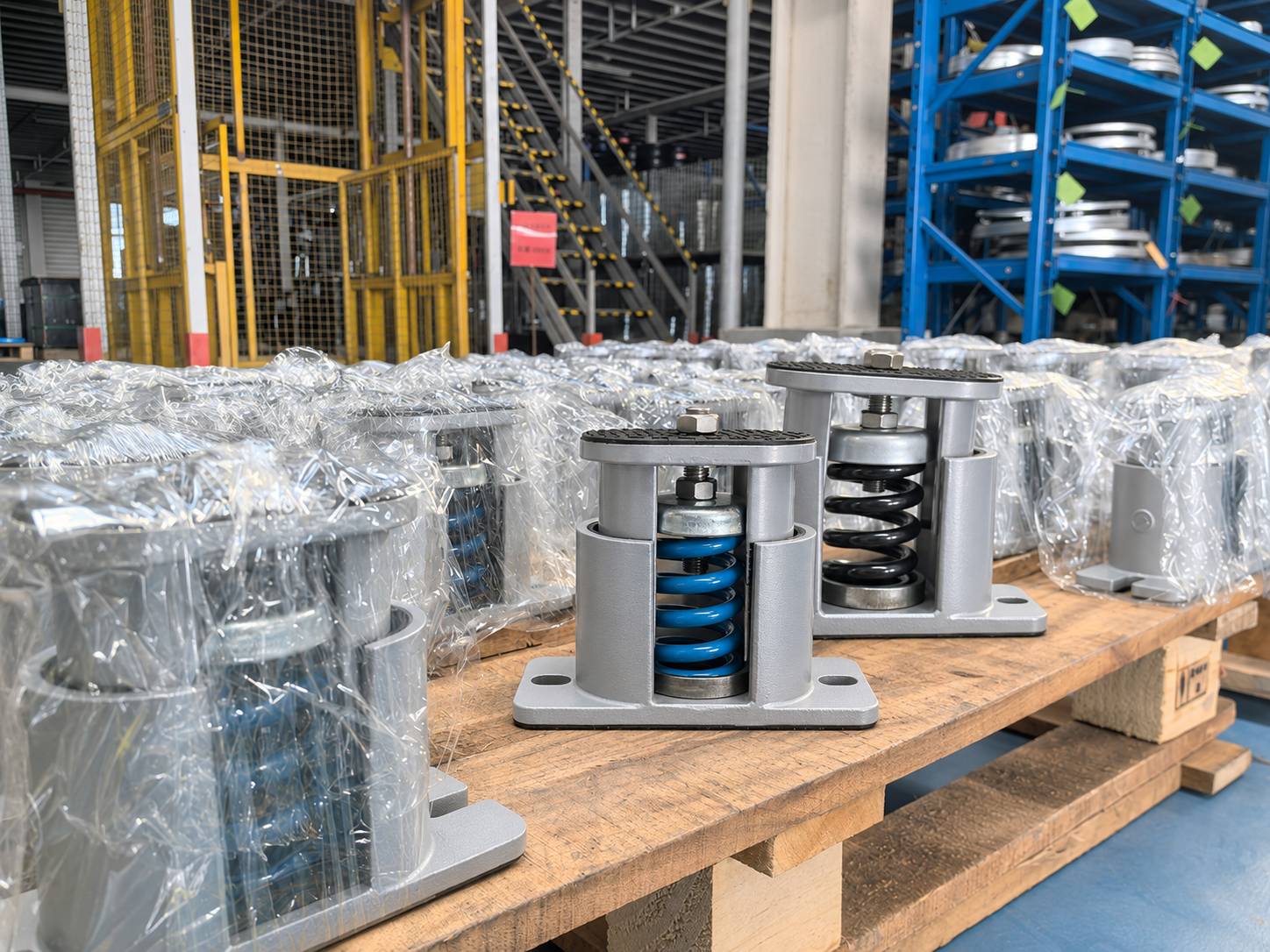
Adjustable spring isolators support industrial fans and reduce the vibration transmitted through their mounting points. A typical mount uses a steel coil spring to carry the equipment load, upper and lower mounting components to transfer that load, and a threaded adjustment mechanism to set the installed height. Under operating load, the spring deflects to provide an elastic connection between the fan assembly and its supporting structure.
These mounts are used beneath base-mounted centrifugal fans, industrial blowers, and ventilation fan assemblies. They are particularly useful where vibration can travel through a steel platform or building floor into adjacent spaces. For a fan and motor on a common frame, the mounts support the complete assembly and allow installers to level the frame at its support points.
How Height Adjustment Helps Level an Industrial Fan
A centrifugal fan with a motor mounted to one side can place more weight on the drive-side mounts. Dividing the total assembly weight by the number of mounts can therefore lead to the wrong spring selection. When the expected load at each position is known, spring rates can be chosen so the mounts reach comparable working deflections under different loads.
The height adjuster then lets the installer level the common base within the mount’s adjustment range. A level base can still sit on springs that are too stiff for their actual loads, so commissioning should include checking both the base level and the working deflection at each mount.
Frequently Asked Questions
1. How do I size adjustable spring isolators for a centrifugal fan?
Size each isolator using the operating load at its mounting point and the static deflection required for the application. Include the fan, motor, drive components, and common base when calculating support loads. If the center of gravity is offset, use the equipment drawing or measured support reactions to establish the load distribution. Then check the selected spring rate, loaded height, and available travel against the installation drawing and clearance requirements.
2. What static deflection does a variable-speed fan need?
Select static deflection using the lowest sustained operating speed and check for resonance across the fan’s speed range. Static deflection is the amount the spring compresses under the supported weight. For a simple vertical spring system, greater loaded deflection corresponds to a lower natural frequency. If a variable-frequency drive allows the fan to run near a natural frequency of the isolated assembly or support structure, vibration can increase at that speed. Review startup and shutdown behavior as well.
3. What materials should I specify for outdoor fan spring mounts?
Specify corrosion protection for the entire mount based on its exposure, including the steel spring, mounting plates, and adjustment hardware. For a rooftop exhaust fan, confirm whether the mounts will see direct rain, standing water, salt spray, or chemical washdown. Check that any optional elastomer pads are suitable for the service temperature and exposure. If wind uplift or lateral movement is a design concern, have the project engineer confirm the required restraint and anchorage arrangement.
4. How should I install and level adjustable fan spring mounts?
Install the mounts on a rigid support and level the fan assembly using the common base as your reference. Once the operating weight is on the springs, follow the mount manufacturer’s sequence for adjusting height and verifying working deflection. Check the fan and motor alignment separately on belt-driven or coupled assemblies. Independently supported ductwork, correctly fitted flexible duct connectors, and flexible electrical connections help prevent attached services from providing a rigid path for vibration.
5. Can the same spring mounts support centrifugal fans and axial fans?
Use the same type of base-mounted spring isolator only when both fan assemblies have compatible support arrangements and the selected mounts suit their respective loads. A base-mounted centrifugal fan or axial fan can use spring mounts at its designated support points. An inline axial fan suspended from overhead steel generally needs spring hangers designed for suspended service. For fans with significant airflow thrust, check whether separate thrust restraints are required to control movement at the duct connections.
6. Will spring isolators solve fan vibration caused by an imbalanced impeller?
Spring isolators can reduce the vibration transmitted from an imbalanced impeller into the support structure. Correct the imbalance at the fan, since the impeller, shaft, and bearings remain subject to the forces it generates. If the fan still vibrates after mount installation, inspect the impeller for buildup or damage, check alignment and fasteners, and verify that the springs are working at their intended deflection. On variable-speed fans, record the speeds at which vibration increases to help identify resonance.
7. What information is needed to quote custom adjustable fan isolators?
Send the fan assembly drawing, operating weight, speed range, quantity, and mounting-point layout. Include individual support loads if available. Otherwise, provide component weights and center-of-gravity information so the load distribution can be estimated. For replacement mounts, include the existing model, bolt-hole dimensions, installed height, and available clearance. Identify outdoor exposure and any thrust or seismic restraint requirements so the spring selection and proposed mounting arrangement can be reviewed together.
Conclusion and Contact Information
Adjustable spring isolators help limit vibration transmission from industrial fans and let installers level the base under operating load. For a new centrifugal fan, blower, or replacement installation, we can review the load at each support and discuss spring selection, installed height, and custom mounting dimensions. Send your fan drawing, operating weight, minimum and maximum speeds, required quantity, and site conditions so we can review the application and prepare a quotation.
Email: [email protected]
Our company’s new website is now live, featuring the latest product introductions. For more details, please visit https://shsjflex.com/