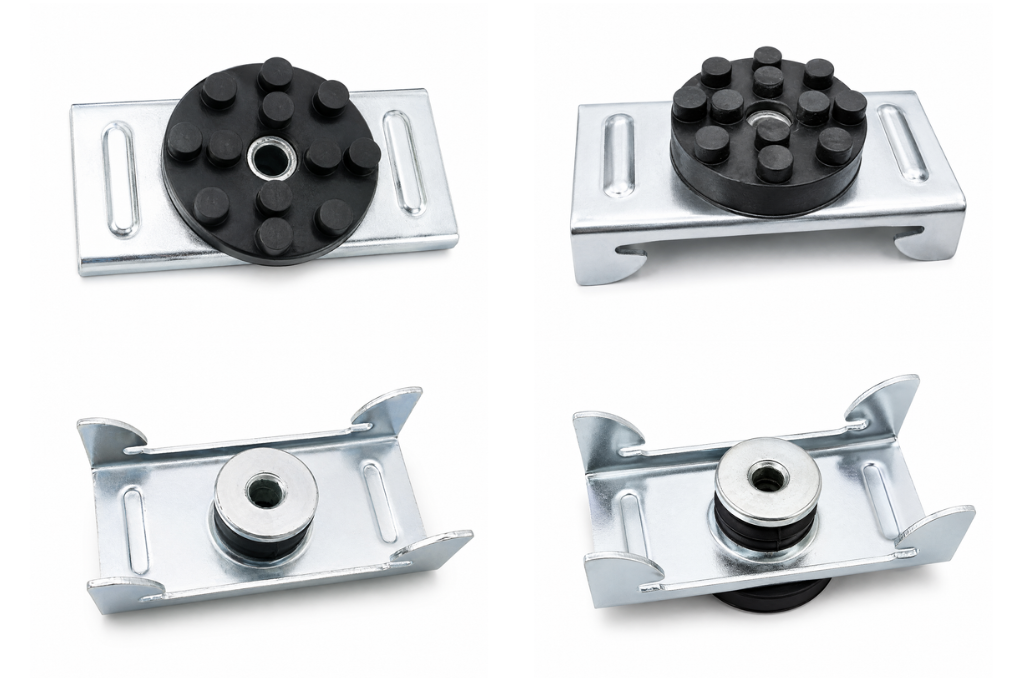
Modern buildings often require more than traditional insulation materials to achieve effective noise control. Airborne sound, impact noise, mechanical vibration, and structure-borne noise can travel through walls, ceilings, studs, joists, and other rigid building components.
RAIC Type Sound Isolation Clips are designed to create a resilient connection between the building structure and the finished wall or ceiling system. By reducing direct rigid contact, these acoustic isolation clips help limit vibration transfer and improve the overall sound isolation performance of architectural assemblies.
RAIC Type Sound Isolation Clips are suitable for residential, commercial, entertainment, hospitality, mechanical equipment rooms, and industrial noise-control projects.
What Is an RAIC Type Sound Isolation Clip?
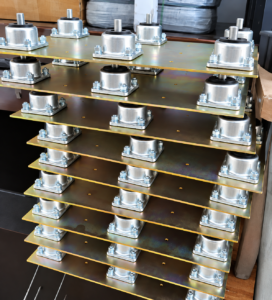
The RAIC Type Sound Isolation Clip is a compact acoustic vibration isolation component consisting of a strong metal bracket combined with an elastic rubber isolator.
The standard product size is approximately 76 × 38 × 30 mm, with green, red, and black color options available. The maximum acoustic design load is approximately 36 lbs (16.3 kg) per clip, subject to the actual installation arrangement and acoustic system design.
Instead of connecting gypsum board or other finishing materials directly to the structural framing, the RAIC clip provides an elastic interface between the supporting structure and the secondary framing system.
This helps reduce the transmission path of vibration and structure-borne sound.
Main Product Features
- Product Type: RAIC Type Sound Isolation Clip
- Size: 76 × 38 × 30 mm
- Structure: Metal bracket + elastic rubber isolator
- Available Colors: Green, red, black
- Maximum Acoustic Design Load: 36 lbs / approximately 16.3 kg
- Suitable Structures: Wood studs, metal studs, concrete walls and ceilings
- Application: Wall and ceiling acoustic isolation systems
- Main Function: Sound isolation, vibration decoupling, impact-noise reduction and structure-borne noise control
Why Are Resilient Sound Isolation Clips Important?
A common problem in architectural acoustics is structural coupling.
When drywall, gypsum board, metal channels, studs, ceiling frames, or other components are rigidly connected to the main building structure, vibration can pass directly through these connections.
For example, footsteps from an upper floor may generate vibration in the floor slab. Loudspeakers and subwoofers in a cinema can excite walls and ceilings. HVAC equipment can transmit low-frequency mechanical vibration into nearby rooms.
RAIC Type Sound Isolation Clips introduce an elastic vibration-isolation layer into these rigid transmission paths.
This mechanical decoupling can help reduce vibration transfer through the structure and support better acoustic performance when combined with appropriate wall or ceiling materials.
Where Can RAIC Type Sound Isolation Clips Be Used?
RAIC acoustic clips can be incorporated into many architectural soundproofing and vibration-control systems.
Typical applications include:
Recording and Broadcasting Facilities
- Professional recording studios
- Vocal recording booths
- Podcast studios
- Radio broadcasting rooms
- Television production studios
- Music rehearsal rooms
- Voice-over booths
- Audio editing rooms
- Mixing rooms
- Mastering studios
Cinema and Entertainment Facilities
- Commercial cinemas
- Private home theaters
- Screening rooms
- Multipurpose theaters
- Live music venues
- Karaoke rooms
- Nightclubs
- Entertainment centers
- Gaming rooms
- E-sports rooms
Residential Buildings
- Apartments
- Condominiums
- Bedrooms
- Home offices
- Home theaters
- Music practice rooms
- Apartment partition walls
- Suspended ceilings
- Multi-family residential buildings
Hotels and Commercial Buildings
- Hotel guest rooms
- Hotel corridors
- Conference rooms
- Meeting rooms
- Executive offices
- Call centers
- Training rooms
- Shopping centers
- Restaurants
- Office partition walls
Mechanical and Industrial Areas
- HVAC equipment rooms
- AHU rooms
- Fan rooms
- Pump rooms
- Compressor rooms
- Generator rooms
- Chiller equipment rooms
- Elevator machine rooms
- Transformer rooms
- Mechanical plant rooms
These applications may involve noise and vibration generated by air handling units, centrifugal fans, axial fans, ventilation fans, pumps, chillers, compressors, generators, motors, transformers, ductwork, piping systems and other rotating mechanical equipment.
How Do RAIC Clips Work with Hat Channels?
One common installation method combines sound isolation clips with metal furring channels or hat channels.
The clip is mounted to the structural wall, ceiling, stud, or joist. A compatible metal channel is then installed through the clip system, followed by gypsum board or another acoustic finishing layer.
The principle can be summarized as:
Building Structure → RAIC Isolation Clip → Furring/Hat Channel → Gypsum Board → Finished Acoustic Surface
The elastic rubber element reduces direct rigid contact between the secondary wall or ceiling and the main structure.
This creates a decoupled wall or ceiling assembly, helping limit structure-borne vibration transmission.
Depending on the project, the system may also incorporate acoustic insulation, mineral wool, fiberglass insulation, multiple layers of gypsum board, damping compounds, acoustic sealant, or other soundproofing materials.
RAIC Clips for Wall Soundproofing Systems
In wall applications, RAIC Type Sound Isolation Clips can be installed on wood studs, metal studs, masonry walls, or concrete walls.
They are especially useful where improved sound separation is required between adjacent spaces.
For example, a recording studio may need to prevent music and low-frequency sound from entering neighboring rooms. A hotel may require improved acoustic privacy between guest rooms. Apartment projects may require better separation between residential units.
By creating a resilient connection between the structural wall and the finished wall surface, acoustic clips can help reduce direct vibration transmission through the wall assembly.
RAIC Clips for Ceiling Sound Isolation
Ceilings are another important transmission path for impact and airborne noise.
Typical sources include:
- Footsteps from upper floors
- Furniture movement
- Dropped objects
- Exercise equipment
- Mechanical equipment
- Pumps and motors
- HVAC systems
- Loudspeakers and subwoofers
RAIC clips can be incorporated into a resilient suspended ceiling system to reduce direct mechanical coupling between the ceiling finish and the structural slab or joists.
For projects involving severe impact noise or low-frequency vibration, the complete acoustic system should be designed according to the required performance level, structural load, ceiling configuration, and available installation space.
What Types of Noise Can RAIC Clips Help Control?
RAIC Type Sound Isolation Clips are primarily designed to help control vibration transmitted through rigid building structures.
Airborne Noise
Examples include speech, television sound, music, loudspeakers, machinery noise, and traffic noise.
A properly designed decoupled wall or ceiling system can help reduce the amount of airborne sound passing into adjacent spaces.
Structure-Borne Noise
Structure-borne noise occurs when vibration travels through concrete slabs, steel framing, timber framing, walls, ceilings, or other structural elements.
Mechanical equipment such as pumps, fans, compressors, and HVAC units can generate this type of vibration.
Impact Noise
Footsteps, dropped objects, furniture movement, gym equipment, and other physical impacts can generate vibration that travels through floors and ceilings.
Resilient isolation systems help interrupt these rigid transmission paths.
Mechanical Equipment Vibration
Rotating machinery can generate continuous vibration at specific operating frequencies.
Examples include:
AHUs, FCUs, exhaust fans, ventilation fans, centrifugal fans, pumps, compressors, chillers, cooling towers, generators, electric motors and other building service equipment.
When vibration from this equipment enters the building structure, acoustic isolation components can form part of a broader vibration-control solution.
RAIC Clips vs. Direct Drywall Installation
Traditional drywall systems may be attached directly to studs or framing. While this construction method is simple, rigid mechanical connections can provide an efficient path for vibration transmission.
RAIC Type Sound Isolation Clips create a resilient separation between the structural framing and the finished acoustic surface.
This approach may provide several benefits:
- Reduced structural vibration transmission
- Improved wall and ceiling decoupling
- Better control of airborne noise
- Better control of structure-borne sound
- Reduced impact-noise transmission
- Improved acoustic privacy
- Suitable for high-performance soundproofing assemblies
Actual acoustic performance depends on the complete assembly rather than the isolation clip alone.
What Determines the Acoustic Performance of an Isolation Clip System?
Sound isolation performance cannot be determined solely by the clip.
Several factors influence the final performance, including:
Clip spacing and layout: The number and location of isolation clips affect load distribution and system performance.
Rubber properties: Rubber hardness, elasticity, damping characteristics, and deflection under load influence vibration isolation.
Wall or ceiling mass: Multiple layers of gypsum board generally provide greater mass than a single lightweight layer.
Cavity insulation: Mineral wool or fiberglass insulation may help absorb acoustic energy inside wall and ceiling cavities.
Mechanical decoupling: Avoiding unnecessary rigid connections and acoustic bridges is critical.
Perimeter sealing: Gaps around walls, doors, ceilings, electrical boxes, ducts, and penetrations can significantly reduce acoustic performance.
For this reason, RAIC clips should be considered as one component of an integrated architectural acoustic isolation system.
Installation Considerations for RAIC Type Sound Isolation Clips
Before installation, engineers and contractors should determine the total supported weight and the required number of clips.
The load calculation should include gypsum board, channels, acoustic panels, finishing materials, and any other supported components.
Clip spacing should be designed so that the allowable load of each clip is not exceeded.
During installation, contractors should also avoid creating acoustic short circuits. Screws or other fasteners should not unintentionally bypass the resilient isolation layer and create a rigid connection between the isolated surface and the main structure.
Perimeter gaps and penetrations should be treated according to the acoustic design requirements.
Frequently Asked Questions About RAIC Type Sound Isolation Clips
1. What is the main purpose of an RAIC Type Sound Isolation Clip?
The main purpose is to reduce vibration and structure-borne sound transmission between the building structure and the finished wall or ceiling assembly.
Instead of creating a completely rigid connection, the rubber element provides an elastic interface. This allows the secondary framing and finishing surface to be partially mechanically decoupled from the primary structure.
The clip can therefore be useful in applications where acoustic privacy, vibration reduction, impact-noise control, or improved wall and ceiling sound isolation is required.
2. Can RAIC clips be used for recording studios?
Yes. Recording studios are one of the typical applications for resilient acoustic isolation systems.
Professional studios may contain studio monitors, subwoofers, musical instruments, drums, amplifiers, and other sources capable of producing significant acoustic energy, particularly at low frequencies.
RAIC clips can be used as part of a decoupled wall or ceiling system. However, professional recording studio design normally requires consideration of wall mass, cavity depth, insulation materials, door and window isolation, ventilation noise, electrical penetrations, flanking transmission, and room-within-a-room construction.
The isolation clip is therefore an important component, but it should be integrated into the overall acoustic design.
3. Can these clips be installed on concrete ceilings?
Yes. RAIC Type Sound Isolation Clips can be incorporated into concrete ceiling sound-isolation systems when suitable anchors and installation methods are selected.
The clips can support a secondary metal channel framework below the concrete slab. Gypsum board or other ceiling materials are then attached to the isolated framing.
The anchor type, clip quantity, spacing, total ceiling weight, and safety factor should be determined according to the actual structural conditions.
4. Are RAIC clips suitable for hotel room soundproofing?
Yes. Hotels require acoustic privacy between guest rooms, corridors, mechanical rooms, elevators, entertainment spaces, and other areas.
RAIC clips can be incorporated into partition walls and suspended ceilings to reduce structural coupling. They can be particularly useful around rooms adjacent to elevators, HVAC equipment rooms, conference facilities, restaurants, bars, or entertainment areas.
For hotel applications, the complete wall and ceiling assembly should also address door seals, service penetrations, ductwork, piping penetrations, electrical outlets, and flanking transmission.
5. Can RAIC clips reduce HVAC noise?
They can help reduce the structure-borne component of HVAC noise when incorporated into an appropriately designed acoustic system.
HVAC noise can originate from air handling units, fan coil units, exhaust fans, ventilation fans, ductwork, compressors, chillers, pumps, and electric motors.
However, HVAC noise may include both airborne noise and mechanical vibration. Therefore, an effective solution may require multiple measures, including equipment vibration isolators, flexible duct connectors, flexible pipe connectors, acoustic duct lining, silencers, spring isolators, rubber mounts, and architectural isolation clips.
RAIC clips primarily address vibration transmission through the wall or ceiling structure rather than directly isolating heavy HVAC machinery.
6. How many RAIC sound isolation clips are required?
The required quantity depends on the total supported weight, clip load capacity, framing arrangement, channel spacing, ceiling or wall dimensions, and required safety factor.
For example, the weight calculation should consider the gypsum board, metal channels, acoustic panels, insulation where structurally relevant, and other supported finishing components.
Because each project has a different layout, determining clip quantity only according to room area is not recommended. Contractors should establish a load-distribution layout based on the complete wall or ceiling assembly.
7. Can RAIC clips completely eliminate noise?
No single acoustic component can completely eliminate noise.
Sound can travel through walls, ceilings, floors, doors, windows, ductwork, piping, structural columns, electrical penetrations, and many other paths.
RAIC clips are intended to reduce mechanical coupling and structure-borne vibration transmission. Better results are normally achieved when they are combined with appropriate acoustic insulation, gypsum board mass, cavity design, perimeter sealing, damping materials, and control of flanking transmission.
8. What information should be provided when selecting RAIC clips?
For a more accurate recommendation, it is helpful to provide the wall or ceiling dimensions, total supported weight, number and thickness of gypsum board layers, type and dimensions of metal channels, substrate type, installation spacing, required acoustic performance, and information about the main noise source.
For projects involving mechanical equipment, additional information such as equipment type, operating speed or frequency, equipment weight, vibration characteristics, and installation location can help determine whether additional vibration isolators are required.
RAIC Type Sound Isolation Clips for Modern Acoustic Engineering
As expectations for building acoustic comfort continue to increase, reducing rigid vibration transmission has become an important consideration in residential, commercial, hospitality, entertainment, and industrial construction.
RAIC Type Sound Isolation Clips provide a compact and practical method of introducing resilient decoupling into wall and ceiling systems.
When properly selected and installed as part of a complete acoustic assembly, they can help reduce structure-borne noise, impact sound, vibration transfer, and unwanted sound transmission while maintaining a practical installation structure.
For recording studios, cinemas, hotels, apartments, conference rooms, offices, home theaters, mechanical rooms, and other noise-sensitive environments, RAIC acoustic isolation clips can provide an effective component for modern architectural soundproofing and vibration-control systems.
Contact Us
Our company’s new website is now live, featuring the latest product introductions. For more details, please visit: