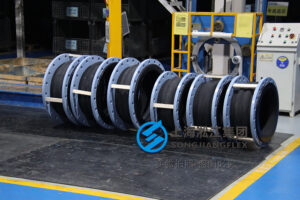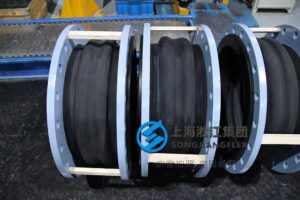
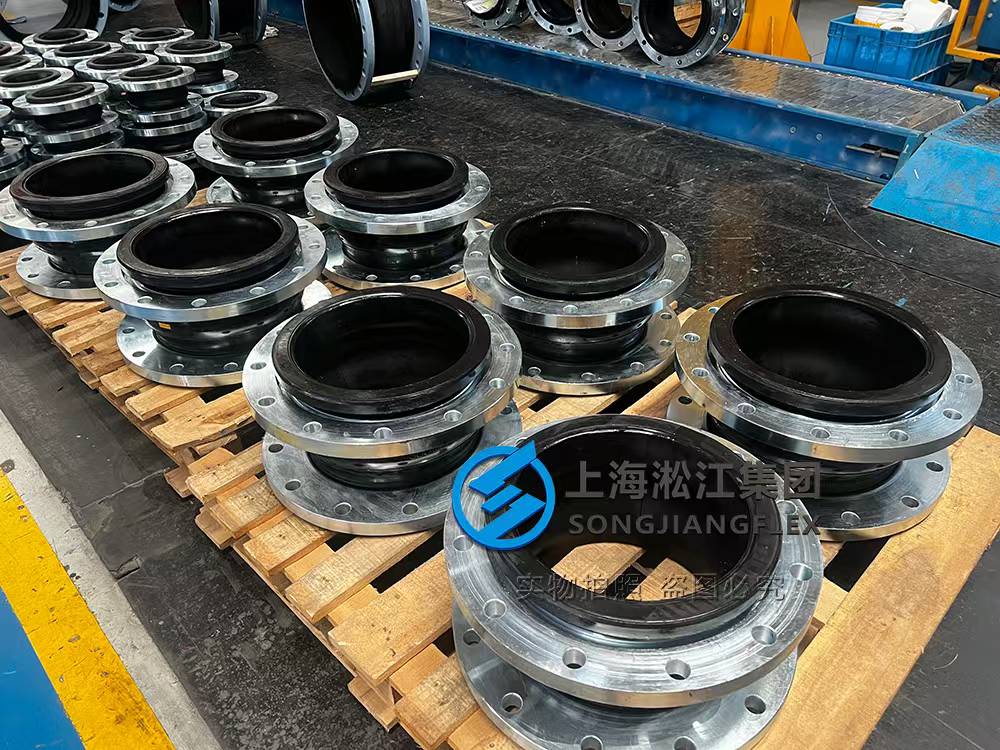
Another batch of custom-made rubber expansion joints for a chemical plant piping system has completed production and is ready for shipment to our customer in China.
Chemical plant piping is very different from ordinary water piping. The transported medium may include acids, alkalis, solvents, process water, wastewater, oils, or other chemical solutions. At the same time, the pipeline may be connected to pumps, reactors, storage tanks, scrubbers, filters, heat exchangers, and other process equipment.
For this reason, our first question is not simply:
“What DN size do you need?”
Instead, we need to understand the customer’s exact chemical medium, concentration, operating temperature, working pressure, pipeline movement, flange standard, installation length, equipment connection, and operating environment.
For this Chinese chemical plant order, the rubber flexible connectors were manufactured according to the customer’s specific piping requirements before being inspected, packed, and prepared for shipment.
Why Do Chemical Plants Need Customized Rubber Expansion Joints?
Chemical plant piping is constantly exposed to a combination of mechanical and chemical stresses.
A process pump generates vibration. A reactor heats and cools during production cycles. A storage tank changes slightly under filling and emptying conditions. Long pipelines expand and contract as temperatures change.
At the same time, the internal medium may continuously attack the wetted surfaces of the piping components.
A properly selected chemical-resistant rubber expansion joint can help accommodate:
- pump vibration;
- thermal expansion and contraction;
- axial compression and extension;
- lateral displacement;
- limited angular movement;
- minor installation deviation;
- pressure fluctuations;
- equipment start-stop vibration.
Chemical piping applications therefore require the flexible joint to be selected according to both mechanical movement and chemical compatibility.
Which Chemical Plant Equipment Uses Rubber Flexible Connections?
Rubber expansion joints can be found around many different types of chemical process equipment.
Chemical Transfer and Circulation Pumps
Typical equipment includes:
horizontal centrifugal chemical pumps, vertical chemical pumps, magnetic-drive pumps, fluoroplastic-lined centrifugal pumps, acid transfer pumps, caustic circulation pumps, process-water pumps, scrubber circulation pumps, chemical dosing pumps, wastewater pumps, and cooling-water circulation pumps.
Flexible joints may be installed on suitable pump suction or discharge piping to reduce vibration transmission and accommodate limited pipeline movement.
However, the rubber joint should not be expected to support the weight of the pump, valve, or unsupported pipeline. Proper anchors, guides, and pipe supports remain important parts of the system.
Reactors and Process Vessels
Chemical production lines may include:
stainless steel reactors, glass-lined reactors, polymerization reactors, mixing vessels, neutralization tanks, crystallizers, reaction kettles, agitated vessels, and batch-processing tanks.
When reactors operate through repeated heating and cooling cycles, connected piping can experience thermal movement.
A customized rubber expansion joint may provide flexibility between the process vessel and rigid piping where the medium, temperature, pressure, and movement conditions are suitable.
Scrubber and Exhaust-Gas Treatment Systems
Chemical plants often use:
packed-bed scrubbers, wet scrubbers, spray towers, absorption towers, neutralization towers, scrubber circulation pumps, mist eliminators, and chemical dosing systems.
The circulation piping may carry acidic or alkaline solutions while simultaneously experiencing pump vibration.
For aggressive chemical service, material selection becomes particularly important, and FKM or PTFE-lined rubber expansion joints may need to be evaluated instead of a standard general-purpose rubber joint.
Heat Exchangers and Cooling Systems
Chemical process plants also contain:
plate heat exchangers, shell-and-tube heat exchangers, cooling-water pumps, cooling towers, process coolers, condensers, circulation pumps, and utility-water systems.
These systems can experience both equipment vibration and temperature-related pipeline movement, making flexible piping connections useful at selected positions.
Customization Starts with the Chemical Medium
One of the most important decisions is the inner rubber material.
There is no single rubber compound suitable for every chemical.
EPDM is commonly considered for water and many polar chemical media.
NBR is more commonly associated with petroleum oils, fuels, and hydrocarbon-containing service.
FKM may be considered for higher-temperature and more chemically demanding applications.
PTFE-lined rubber expansion joints can provide another option for highly corrosive chemical service.
Chemical concentration and temperature must also be considered. A rubber compound that performs satisfactorily with a dilute chemical at ambient temperature may not provide the same performance at a higher concentration or temperature.
Therefore, for chemical plant orders, we prefer customers to provide the exact chemical name and concentration, rather than simply writing “chemical liquid.”
Flange Dimensions Must Match the Actual Pipeline
Customization is not limited to rubber material.
For a chemical plant project, we also confirm the connection dimensions carefully.
These can include:
DN/NPS size, flange outside diameter, flange inside diameter, PCD, number of bolt holes, bolt-hole diameter, flange thickness, sealing-face configuration, and flange material.
Depending on the project, the connection may follow standards such as EN 1092-1, ASME B16.5, JIS B2220, or project-specific flange dimensions.
Flange materials can also be selected according to the environment and medium, including carbon steel, galvanized carbon steel, SS304, or SS316L.
For chemical plants where the external atmosphere contains corrosive mist, the flange coating and material should also be considered.
Pressure, Vacuum and Movement Are Different Design Conditions
A common mistake is selecting a rubber expansion joint only according to nominal diameter and pressure class.
For customized chemical piping, we separately review:
normal working pressure, design pressure, test pressure, possible pressure surge, minimum pressure or vacuum, operating temperature, axial movement, lateral movement, and angular movement.
Pump suction piping deserves particular attention because vacuum can load the rubber body inward.
If negative pressure is possible, the product may require a structure specifically designed for vacuum service.
Likewise, maximum axial, lateral, and angular movement values should not automatically be assumed to occur simultaneously. Combined movements should be evaluated according to the actual piping condition.
Why Are Control Rods Sometimes Added?
Some chemical plant pipelines require rubber expansion joints with control rods or limit rods.
Internal pressure creates axial pressure thrust. This becomes increasingly important as pipe diameter and pressure increase.
Depending on the piping design, control rods can help limit excessive extension and protect the rubber body against abnormal movement.
However, control rods do not automatically replace correctly engineered pipe anchors.
The entire system—including anchors, guides, supports, valves, equipment nozzles, expansion joints, and control rods—should be considered together.
From Customer Requirements to Shipment
For this Chinese chemical plant order, customization follows a clear process:
Customer operating data → chemical compatibility review → rubber material selection → flange confirmation → structural design → drawing confirmation → production → dimensional inspection → pressure/quality inspection as required → packaging → shipment.
The purpose is simple: the finished flexible connector should correspond to the actual pipeline rather than merely match the nominal DN size.
FAQ
1. What information should a chemical plant provide before ordering rubber expansion joints?
Please provide as much application data as possible, especially the exact chemical medium, concentration, normal and maximum temperature, working pressure, design pressure, vacuum condition, DN/NPS size, face-to-face length, required movement, flange standard, and quantity.
We also recommend identifying the connected equipment—for example, whether the joint is installed on a chemical pump suction line, pump discharge line, reactor connection, scrubber circulation line, heat exchanger connection, storage tank outlet, or wastewater treatment pipeline.
A pipeline drawing is particularly helpful for non-standard applications.
2. Can EPDM be used for all chemical plant pipelines?
No.
EPDM has useful resistance to water, weathering, ozone, and many polar chemical environments, but that does not make it universally suitable for every chemical.
For example, oil and hydrocarbon-containing media may require NBR or another compatible elastomer. Aggressive chemicals, solvents, oxidizing media, or elevated temperatures may require FKM or a PTFE-lined structure.
The correct material should be selected according to the specific chemical + concentration + temperature + pressure, not according to industry name alone.
3. Can you manufacture according to an existing chemical plant drawing?
Yes. Customized manufacturing is especially useful for replacement and retrofit projects.
Customers can provide an existing drawing showing the DN, face-to-face length, flange dimensions, bolt-hole pattern, rubber material, pressure rating, movement, and accessories.
However, we still recommend confirming the current operating medium and conditions. An old joint may have been selected many years ago, while the process medium, temperature, or operating pressure may have changed.
Our objective is not simply to copy the appearance of the old product but to manufacture a joint suitable for the actual current application.
4. When should a PTFE-lined rubber expansion joint be considered?
A PTFE-lined structure can be considered when the transported chemical is too aggressive for conventional elastomers or when broader chemical resistance is required.
The PTFE layer acts as the primary wetted barrier, while the reinforced rubber body provides flexibility and vibration isolation.
Typical applications can include selected acid-transfer systems, alkali piping, chemical process lines, scrubber systems, pharmaceutical chemical lines, and pollution-control piping.
The exact chemical composition, concentration, temperature, pressure, vacuum condition, and required movement still need to be reviewed before final selection.
Customized for the Process, Not Just the Pipe Size
This batch of custom rubber expansion joints for our Chinese chemical plant customer is now ready for shipment.
For us, customization means more than producing a special size.
It means understanding what is flowing through the pipeline, which equipment the joint connects to, what temperature and pressure it experiences, how much movement is required, and exactly how the flange must connect to the customer’s piping.
Whether your project involves a chemical transfer pump, reactor, scrubber, absorption tower, heat exchanger, process tank, wastewater treatment unit, or chemical circulation system, send us the operating parameters and drawings for technical evaluation.
Our company’s new website is now live, featuring the latest product introductions. For more details, please visit https://shsjflex.com/
Email: [email protected]